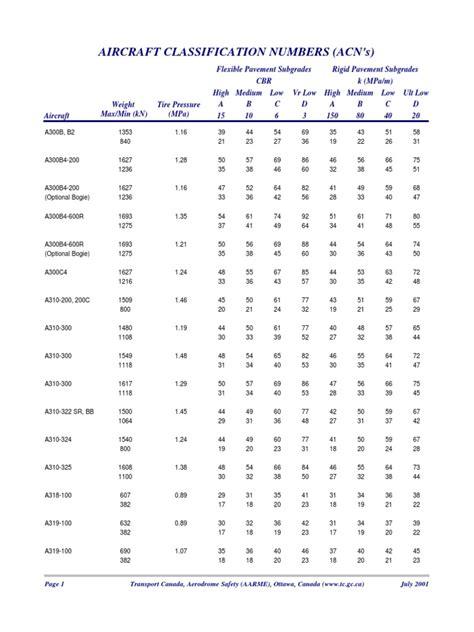
The Aircraft Classification Number (ACN) is an important metric that indicates how an aircraft affects pavement structures based on its configuration and the strength of the subgrade. This number helps in assessing the impact of various aircraft on different types of pavements without detailing specific pavement thicknesses. The ACN is calculated as twice the single-wheel load, expressed in thousands of kilograms, with the tire pressure set at 1.25 megapascals (or 181 psi). Additionally, this load depends on the subgrade strength, which is categorized into four groups: high, medium, low, and ultra-low, for both flexible and rigid pavements.
The ACN is influenced not just by the weight of the aircraft but also by the design of its landing gear, including the spacing between wheels. The International Civil Aviation Organization (ICAO) provides ACN values for various aircraft. Manufacturers must calculate and publish the ACN for new aircraft in their flight manuals. Typically, ACN values are listed for two weights: the maximum authorized total weight and the operating weight when the aircraft is empty. If an aircraft operates at a weight between these two, its ACN can be derived through linear interpolation, but extrapolation is not allowed.
For flexible pavements, the subgrade categories are defined as follows:
-
High Strength – CBR 15 (All CBR above 13%)
-
Medium Strength – CBR 10 (For CBR between 8% to 13%)
-
Low Strength – CBR 6 (For CBR between 4% to 8%)
-
Ultra Low Strength – CBR 3 (For CBR below 4%)
The California Bearing Ratio (CBR) is a test that evaluates the mechanical strength of subgrades and base courses by measuring the pressure needed to penetrate soil or aggregate with a standard plunger. The result is expressed as a percentage.
For rigid pavements, the subgrade categories are as follows:
-
High Strength – k = 150 MN/m³ (All k values above 120 MN/m³)
-
Medium Strength – k = 80 MN/m³ (For values between 60 and 120 MN/m³)
-
Low Strength – k = 40 MN/m³ (For values between 25 and 60 MN/m³)
-
Ultra Low Strength – k = 20 MN/m³ (All k values below 25 MN/m³)
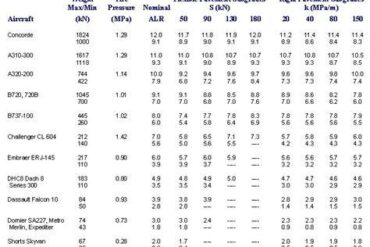
As an example, consider the A320-200 aircraft. Its ACN at maximum weight (725 kN) for flexible pavements is: A – 37; B – 39; C – 44; D – 50. For rigid pavements, the ACN values are: A – 40; B – 43; C – 45; D – 48. At minimum weight (402 kN), the ACN for flexible pavements is: A – 19; B – 19; C – 21; D – 25, while for rigid pavements it is: A – 20; B – 21; C – 23; D – 24.