Alaska Airlines is marking a major milestone at San Diego International Airport (SAN), where its network will reach 50 nonstop routes with the launch of seasonal service to Loreto, Mexico. The new route reflects the carrier’s aggressive expansion at San Diego and comes as Alaska continues adding capacity across a market where Southwest Airlines is also growing rapidly.
According to OAG data, Alaska Airlines has scheduled approximately 8.5 million round-trip seats for sale from San Diego in 2026, representing a remarkable 38% increase over its previous capacity record in 2025. That translates to roughly 2.3 million additional seats in only 12 months, an unusually large increase for a single airport operation.
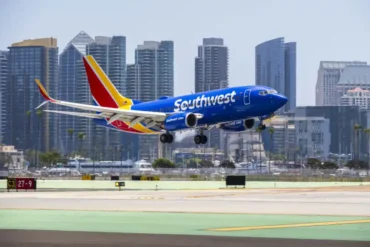
Southwest has been expanding at a similarly striking pace. The airline has added approximately 2.2 million seats compared with 2025, accompanied by several new routes from San Diego. The result is an increasingly competitive market in which the two carriers are expanding simultaneously, giving passengers more nonstop options while putting additional pressure on both airlines to fill their growing schedules.

Alaska Airlines Adds Loreto as Its 50th San Diego Route
Alaska Airlines’ 50th San Diego route will connect San Diego International Airport with Loreto International Airport (LTO) in Mexico. The new service is scheduled to begin on December 19, 2026, arriving just ahead of the Christmas travel period and Mexico’s busy winter tourism season.
The route covers approximately 507 nautical miles (939 kilometers) each way, making it a relatively short international flight. Rather than deploying a mainline aircraft, Alaska will use 76-seat Embraer E175 regional jets operated by SkyWest Airlines. Flights are scheduled on Wednesdays and Saturdays, with service currently planned through April 28, 2027.
The schedule gives travelers a convenient weekend-oriented option between Southern California and one of Mexico’s growing resort destinations. From San Diego, the flight will operate as AS3474 from 11:55 a.m. to 2:55 p.m., while the return journey is scheduled from Loreto between 3:45 p.m. and 5:00 p.m. local time.
The Loreto connection is not entirely new to the San Diego market. According to US Department of Transportation data, nonstop service between the two airports last operated when Aeromexico served the route between 2002 and 2006. During that period, the market carried 52,181 round-trip passengers, while the average load factor was only 61.1%.
For Alaska, however, the route offers more than local San Diego-Loreto traffic. SAN is an important part of the carrier’s broader network, allowing passengers from elsewhere on the West Coast to connect through San Diego. That network feed could help strengthen the route’s economics, particularly because Alaska’s own nonstop service between San Francisco and Loreto ended in April 2026.

Full List of Alaska Airlines Routes From San Diego
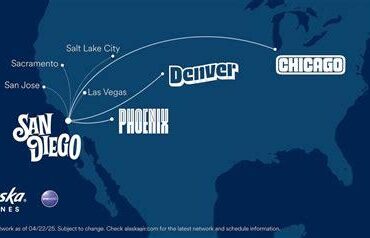
With the Loreto launch included, Alaska Airlines will operate 47 domestic routes and three international routes from San Diego at various points between September 2026 and July 2027. The schedule remains subject to change, meaning additional routes could still be announced while some existing services could eventually be adjusted.
The five domestic markets added during 2026 are Dallas/Fort Worth, Oakland, Reno, Santa Barbara, and Tulsa. These additions demonstrate how Alaska is expanding beyond its traditional western network while also entering markets where established competitors already have substantial positions.
Dallas/Fort Worth places Alaska directly against American Airlines and Frontier Airlines at one of the largest airports in the United States. Oakland, Reno, and Santa Barbara put the airline into direct competition with Southwest, while Tulsa stands out because it has not had nonstop Alaska service and was last served by Frontier in 2018.
The relatively small number of completely new domestic markets also reveals an important feature of Alaska’s San Diego strategy. Much of the airline’s enormous capacity growth has come not from opening new destinations, but from adding frequencies to existing routes. Domestic seats are up approximately 39% from 2025, while E175 flying has increased by roughly 48%, allowing Alaska to build network breadth without relying exclusively on larger aircraft.
The complete scheduled domestic network includes:
- Anchorage, Austin, Boise, Boston, Bozeman, Chicago O’Hare, Dallas/Fort Worth, Denver, Eugene, Everett, Fort Lauderdale, Fresno, Honolulu, Jackson Hole, Kahului, Kalispell, Kona, Las Vegas, Lihue, Medford, Missoula, Monterey, Newark, New York JFK, Oakland, Orlando, Phoenix, Raleigh/Durham, Redmond, Reno, Sacramento, Salt Lake City, San Francisco, San José, San Luis Obispo, Santa Barbara, Santa Rosa, Seattle, Spokane, Steamboat Springs, Sun Valley, Tampa, Tulsa, Vail, Washington Dulles, and Washington National.
The three international destinations are Loreto, Los Cabos, and Puerto Vallarta, all in Mexico.
Alaska Airlines Expands While Southwest Builds Its Own San Diego Network
The scale of Alaska’s expansion becomes clearer when placed beside Southwest’s strategy. Alaska now has 50 routes from San Diego, compared with 47 for Southwest, although the two airlines approach the market differently in several areas.
Southwest has added nine routes from SAN during 2026, including service to Boston, Bozeman, Fort Lauderdale, Kahului, Puerto Vallarta, Santa Barbara, Santa Rosa, Seattle, and Spokane. The overlap between the two networks has consequently become substantial, with the airlines now competing directly on 29 destinations.
Alaska holds the capacity advantage between the two carriers on several important markets, including Austin, Boston, Bozeman, Eugene, Fort Lauderdale, Fresno, Honolulu, Kahului, Kona, Lihue, Orlando, Portland, Puerto Vallarta, Santa Barbara, Santa Rosa, Seattle, Spokane, and Tampa.
Southwest, meanwhile, has more capacity on routes including Boise, Denver, Las Vegas, Oakland, Phoenix, Reno, Sacramento, Salt Lake City, San Francisco, and San José.
That split illustrates why San Diego has become such an important battleground. Neither carrier is simply adding a handful of isolated routes. Both are building deeper networks, increasing frequencies and targeting destinations where the other already has a customer base.
What the 50-Route Milestone Means for San Diego
Alaska Airlines reaching 50 nonstop routes from San Diego is significant not merely because of the headline number, but because of how quickly the network has expanded. The airline has moved from a comparatively strong Western US presence into a broader network spanning the mainland, Hawaii, Mexico and several major business markets.
The emphasis on E175 flying is particularly important. Smaller regional jets allow Alaska to serve thinner markets such as Tulsa, Loreto and other secondary destinations while maintaining connections to larger hubs. At the same time, higher frequencies on established routes give travelers more departure choices without requiring every market to support a larger aircraft.
Internationally, three destinations may not represent a record for Alaska from San Diego. The airline previously served Cancun, Mexico City, Vancouver and Zihuatanejo, although those services ended at different points between 2010 and 2024. Nevertheless, 2026 international capacity from SAN is higher than it has been in the past eight years.
For passengers, the immediate result is straightforward: more nonstop choices and more competition. For Alaska and Southwest, however, the rapid expansion creates a tougher challenge. Adding millions of seats is only valuable if demand can absorb them. With both airlines expanding at almost the same time, San Diego could become one of the most closely watched competitive markets in the US airline industry as the 2026–27 schedule develops.