When the United States entered World War II in December 1941, its armored forces were still relatively small. In May 1940, the U.S. Army possessed only 464 tanks, but wartime mobilization would eventually transform American tank production on an enormous scale. Before the famous M4 Sherman became the standard American medium tank, however, the M3 Lee introduced a remarkable technology that gave its crews an important advantage: a gyro-stabilized gun system capable of keeping the weapon steadier while the tank was moving.
The M3 was developed under intense pressure. Beginning in July 1940, the Army’s Ordnance Department had only about 60 days to produce a battlefield-ready medium tank. The resulting vehicle was far from perfect, but it filled an urgent need while the Sherman was still being developed. British forces received the tank through Lend-Lease and called versions equipped with British modifications the M3 Grant. The vehicle entered combat in North Africa in 1941.
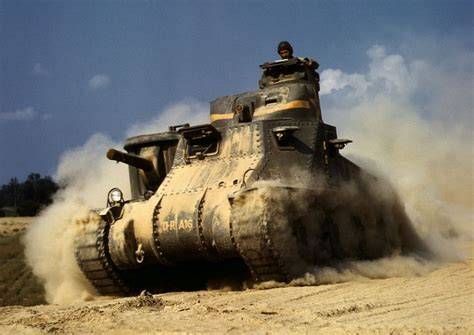
M3 Lee 75mm Gun and Gyro Stabilization
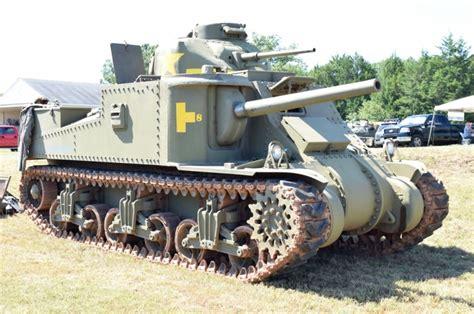
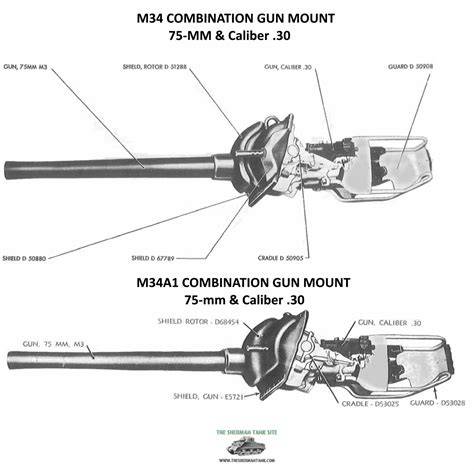
The M3’s most unusual feature was its 75mm main gun, which was mounted in a right-side hull sponson rather than inside a fully rotating turret. The weapon could traverse only about 15 degrees from its center position, forcing the entire tank to be maneuvered for larger changes in direction. A smaller 37mm gun was mounted in the turret above it.
Despite these limitations, the M3 incorporated technology that was highly unusual for the period. Early production tanks lacked the system, but by November 1941, tanks produced at the Detroit Tank Arsenal were being equipped with a vertical-axis gyroscopic gun stabilizer. The system was developed by Clinton R. Hanna of Westinghouse Electric Company in Pittsburgh.
The stabilizer used a gyroscope linked with hydraulic power and worked through the tank’s turret-drive mechanism. Its purpose was straightforward but technologically significant: it helped maintain the vertical position of the 75mm and 37mm guns as the vehicle moved across uneven ground. Instead of waiting for the tank to stop before attempting an accurate shot, the crew could keep the weapon generally aligned while moving.
Why Gun Stabilization Mattered in WWII
Before effective stabilization, firing accurately from a moving tank was extremely difficult. Vehicle movement constantly disturbed the gun’s aim, meaning crews generally had to halt before taking a carefully aimed shot. That pause could expose a tank to enemy fire and surrender an important tactical advantage.
A functioning M3 stabilizer did not transform the tank into a modern fire-on-the-move weapons platform, but it could help keep the gun close to the intended point of aim. In combat, that could improve the possibility of landing the first shot, a potentially decisive advantage in an armored engagement.
The M3 Stabilizer Had a Difficult Start
Ironically, the technology was not immediately popular with M3 crews. The tank had been rushed into production, and soldiers received limited documentation and training on how to operate and maintain the stabilization equipment. When the system malfunctioned or crews did not understand its operation, it was often simply ignored.
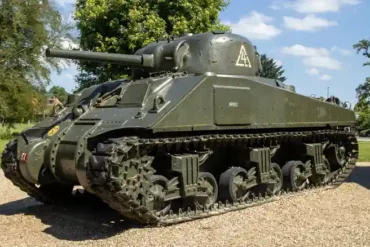
Later American tanks benefited from the lessons learned with the M3. The M4 Sherman received an improved stabilization system that was easier to operate and maintain. Although the M3 Lee itself was eventually replaced by the Sherman, its early adoption of gun stabilization represented an important step in American armored warfare.
The M3 therefore occupies a distinctive place in tank history. Its hull-mounted 75mm gun, complicated layout, and rushed development made it an imperfect machine, yet its gyro-stabilized main gun introduced a capability that would become increasingly valuable as tank warfare evolved.