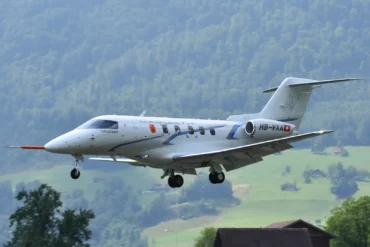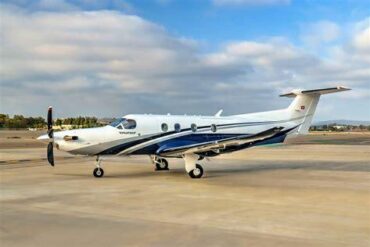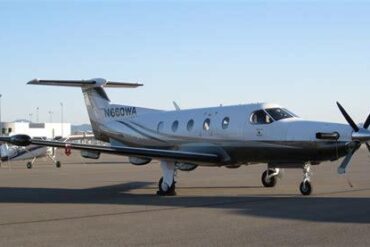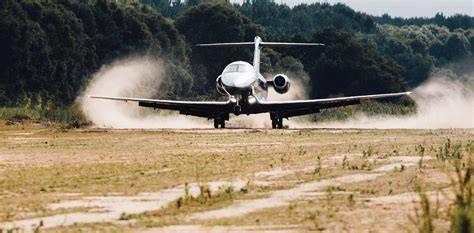
Park a conventional business jet beside a rain-soaked grass strip and the crew will almost certainly start hunting for a paved alternate. A turbofan swallows air at furious velocity, so a single loose stone or a splash of mud can convert a routine arrival into a six-figure engine repair. Yet one Swiss twinjet has been formally approved to do precisely what its competitors avoid. According to Pilatus, the Pilatus PC-24 is certified for takeoffs and landings on grass, wet soil, dry sand, gravel, and snow-covered unpaved runways.
That sentence reads like brochure copy until the certification record is opened. The meaningful question is not whether a PC-24 can touch down on turf once, in flawless weather, but how Pilatus convinced regulators to approve rough-field operation as ordinary, repeatable service. The answer runs through a flooded English field, a snowy test site in northern Canada, a main-wheel pressure of 73 to 76.5 psi, and design choices locked in years before the first prototype lifted off. First, though, it is worth asking why nearly every rival stays glued to the pavement.
Why Most Private Jets Are Built to Stay on Paved Runways
Most business jets were designed for pavement from the first sketch, and every optimization since has reinforced that assumption. Efficiency, speed, and cabin comfort dominate the aerodynamic and structural trade studies, while unpaved operations demand reinforced landing gear and specialized tires that add weight and drag. Retrofitting a finished design to tolerate turf would be expensive and, in many cases, impractical, because the load paths, gear geometry, and tire specifications are already frozen into the type certificate. Turbofans are also far less forgiving than propeller aircraft when it comes to foreign object damage, the industry term for debris drawn into an intake.
Grass imposes punishment that concrete never does. A wet turf strip stretches braking distances, ruts and soft patches hammer the nose and main gear, and a stone hidden in the grass is invisible from the cockpit until it is too late. For a pilot flying a conventional jet, each variable is another reason to divert. For an engineer, each is a design requirement that must be satisfied before the first landing, not investigated afterward.
Exceptions exist, but they arrive with asterisks. The Dassault Falcon 20 and Falcon 50 can use dirt and gravel once fitted with a special service bulletin kit, yet neither was originally engineered for it. The PC-24 began from the opposite premise. Pilatus states that the jet was developed for rough-field use from the outset, a mindset inherited from its PC-12 turboprop, and the company markets the aircraft as the “Super Versatile Jet.” The distinction matters more than it sounds. A jet that a brave crew can coax onto grass is one thing; a jet whose manufacturer has proven the maneuver to aviation authorities, surface by surface, is another thing entirely.
How Pilatus Certified the PC-24 for Grass, Gravel, Sand, and Snow
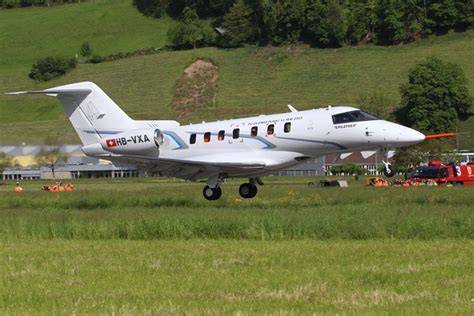
Certification unfolded in two deliberate stages. Pilatus first secured approval for dry sand and gravel in 2018, then devoted the whole of 2019 to a post-certification test campaign. In a media release dated February 7, 2020, the company announced full rough-field approval, adding grass, wet soil, and snow-covered unpaved runways to the envelope. As reported by AOPA, European regulators cleared the expanded unpaved capability first, with US approval following. The validation gave the eight-seat jet access to a far wider airport network: Pilatus’ own technical brochure claims the PC-24 can reach almost twice as many airports worldwide as competing business jets, largely because it can use strips nobody else will.
EASA requires certification tests to be flown on the actual surfaces being approved, so Pilatus carried the jet across two continents. Business Jet Traveler lists the grass-runway sites as Goodwood and Duxford in England, Kunovice in the Czech Republic, and Poitiers in France. Engineers also flooded an English field with roughly 45,000 US gallons (170,000 liters) of water to simulate rain falling at about 0.16 inches (4 mm) per hour, and the jet coped. At Kunovice, crews rehearsed single-engine takeoffs, engine failures, and the loss of ground spoilers and anti-skid, with heavy rain adding difficulty to every run.
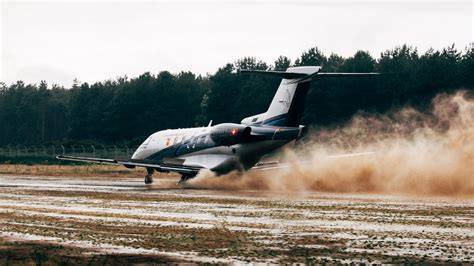
Wet soil was arguably the hardest case. Pilatus notes that the Woodbridge site in England demanded complex, partly reproduced conditions just to satisfy every specification for takeoffs and landings on wet dirt. The company then flew to Kuujjuaq, Canada, for snow-covered gravel, a surface where visibility, drag, and braking all shift simultaneously. Passing a braking check was only part of the work. Engineers also needed to know what the surface did to the airframe: whether snow packed into the flaps, whether stones reached the engines, whether brakes and steering held up. Nothing was ingested by the engines, and the jet performed better than expected.
Long-Stroke Trailing-Link Gear and Low Tire Pressure Keep the PC-24 from Sinking
The PC-24 rides on long-stroke trailing-link landing gear that smooths out uneven ground. A trailing link hangs each wheel from a pivoting arm, so the wheel can rise and fall over a bump without transferring the shock into the airframe. The geometry is not elegant for its own sake; it is what allows the aircraft to roll across ruts and soft patches at speed without punishing the crew or fatiguing the structure.
Its main tires run at 73 to 76.5 psi (5 to 5.24 bar), deliberately low so the aircraft does not sink into soft surfaces. The logic mirrors a snowshoe: lower pressure spreads the aircraft’s weight across a larger footprint, which matters when the jet weighs up to 18,700 pounds (8,500 kg) at takeoff. Most business jet main wheels carry substantially higher pressure, concentrating load into a small contact patch that cuts straight through turf.
Then comes the engine problem. The two Williams FJ44-4A turbofans, each producing about 3,400 pounds of thrust (15 kN), sit high on the rear fuselage, far from the stones and spray kicked up by the wheels. The wing flaps shield the intakes from debris as well. During the Canadian trials, one prototype carried instrumentation and cameras to show whether snow or slush built up on the flaps, fuselage, or landing gear, so engineers could compare the rough-field impact against dry gravel. Braking raised a separate set of questions: whether steering was affected, whether the brakes were sufficient, and how the anti-skid system behaved on loose surfaces. Those details determine whether a crew can stop a fast, heavy aircraft on ground that gives way underfoot, and they were verified through inspection and recorded data rather than assumption.
How a 440-Knot Jet Achieves Short-Field Landing Distances on Turf
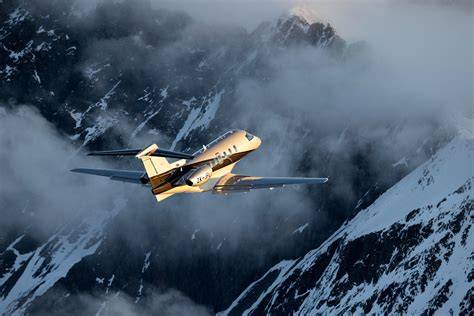
A jet cruising at 440 knots (506 mph, or 815 km/h) hardly sounds like a candidate for short, unimproved runways, yet that pairing of speed and short-field performance is exactly what separates the PC-24. Much of the credit goes to its large double-slotted flap system, which delivers the lift and drag the aircraft needs at low approach speeds. Pilatus lists a takeoff distance of 3,090 feet (942 meters) and a landing distance of 2,410 feet (734 meters) over a 50-foot (15-meter) obstacle, both measured on a dry paved runway at sea level. At the other end of the envelope, the jet cruises at 440 knots and flies up to 2,000 nautical miles (2,301 miles, or 3,704 km).
The numbers are not theoretical. In an interview with Ashley Fredricks, the first woman to fly the PC-24, one memorable stop was Valemount, British Columbia, an airport with no control tower, no fuel facilities, and a runway of just 3,900 feet (1,200 meters). Fredricks reported that the jet did not need the entire runway to land or take off. After the stop, the crew flew directly to San Jose, California, more than 1,100 miles (1,770 km) away. Jet speed and strip flexibility, combined in one airframe, raise the practical question of who actually buys an aircraft built for dirt.
Where PC-24 Grass-Runway Capability Matters Most: Air Ambulance and Government Fleets
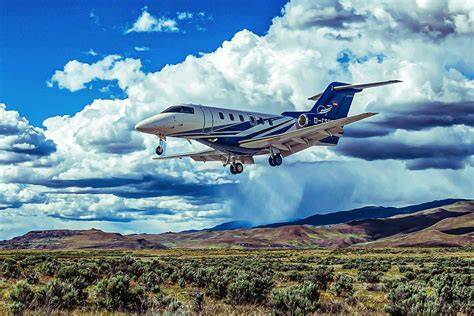
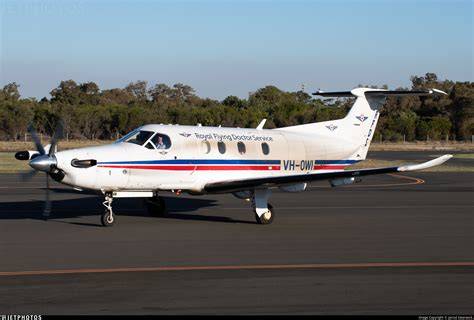
In the 2020 announcement, Pilatus chairman Oscar Schwenk noted that the Royal Flying Doctor Service of Australia, along with operators in North America and Africa, already used rough-field runways routinely. For an air ambulance serving the outback, landing close to the patient instead of at a distant paved airport can reshape the entire timeline of care, turning hours of road transfer into a short hop from a nearby strip.
The most recent confirmation comes from Indonesia. In a Pilatus release dated March 30, 2026, the Indonesian Ministry of Defense signed for twelve PC-24s to support pilot training, air transport, and liaison missions. Pilatus says the jet’s ability to use short and unpaved runways, which improves access to remote islands across a nation of roughly 17,000 islands, was a decisive selection criterion. The company adds that the PC-24 is certified for single-pilot operation and carries a standard cargo door. That combination, a jet that can haul freight, fly with one pilot, and still reach a small strip, is precisely what a government fleet wants when its territory is mostly water and secondary runways.
Why the PC-24’s Rough-Field Approval Reshapes Business Aviation Competition
The significance extends well beyond a single airframe. Because certification is evidence rather than marketing, the PC-24’s rough-field approval functions as a competitive barrier. A rival would have to repeat a multi-site, multi-surface campaign comparable to the one Pilatus flew across England, the Czech Republic, France, and Canada before making the same claim, and no manufacturer can bolt that credential onto a finished type after the fact. There is also a quieter commercial effect: every additional airport the jet can legally use is another destination reachable without a car transfer, a connecting flight, or a long drive, which can compress a three-hour road trip into a brief flight and widen the customer base for operators whose business sits far from a major runway.
The order book will supply the clearest verdict. Pilatus had delivered 100 PC-24s by the end of 2020, and the Indonesian contract shows government buyers now cite unpaved capability as a deciding factor. If more air forces, air ambulance services, and remote-region operators follow that reasoning, the grass strip stops being a curiosity and becomes a market segment. One caution belongs here. Certification describes what the aircraft is approved to do; it is not a promise that every field is suitable. Crews still evaluate each strip on the day, judging surface condition, weight, and performance margins before committing to a landing. The open question is which competitor will invest the years of testing required to follow the PC-24 onto the grass.