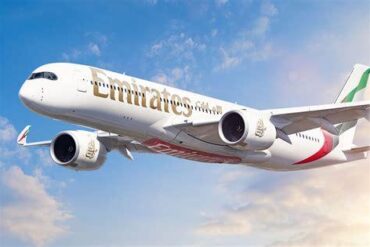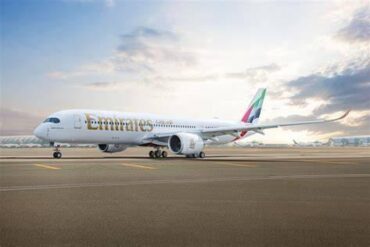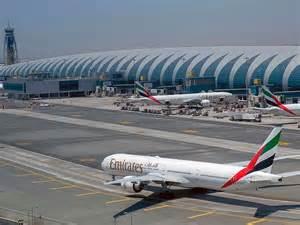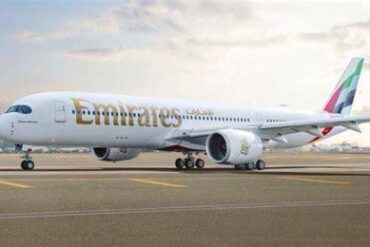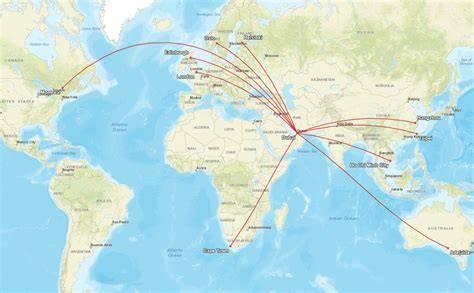
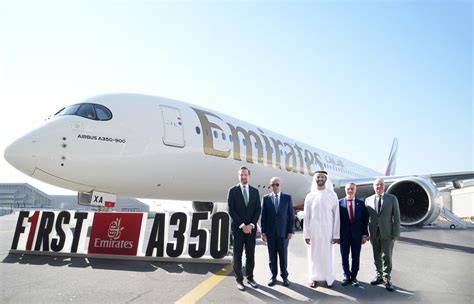
Emirates has quietly reshuffled a significant slice of its Airbus A350-900 network out of Dubai, and the pattern behind the cuts is far more revealing than the headline number. Across 2026, the Gulf carrier has withdrawn the A350 from eleven routes entirely and is preparing to end it on three more in November, a combined fourteen destinations that once relied on the twinjet’s carefully calibrated capacity. The airline’s first A350-900, registered A6-EXA, arrived on November 25, 2024, and just two years later the fleet stands at 31 aircraft, according to ch-aviation, making Emirates one of roughly 45 operators worldwide flying the type. What makes the retrenchment notable is not that Emirates is reducing the A350 — it is that the aircraft was inserted into these markets as a deliberate supply valve, and the list of dropped routes maps almost exactly onto the months when demand collapsed and then recovered.
Two Cabin Layouts Drove Where Emirates Flew The A350
Every Emirates A350 flies in one of two configurations, and the distinction shaped deployment decisions throughout the year. The 298-seat layout carries 32 business seats, 28 in premium economy and 238 in economy, making it the airline’s second lowest-capacity widebody after the Boeing 777-200LR. The alternative 312-seat version holds 32 business seats, 21 in premium economy and 259 in economy, trading premium density for total volume. When demand softened, the smaller premium-heavy frame allowed Emirates to trim seats without surrendering its high-yield cabin, a flexibility the 421-seat 777-300ER simply cannot offer. Cirium Diio schedule data reveals exactly how that logic played out between January and October 2026, and how the network will look from November onward.
The Eleven Routes That Lost Emirates A350 Service Completely
The first wave of withdrawals arrived in spring, when weak regional demand justified a smaller aircraft. Boston and Dar es Salaam each saw only twelve and nine A350 departures respectively, both restricted to April, before the 777-300ER returned. Glasgow lost the A350 after 32 departures spanning March and April, while Perth logged 72 flights between March and May. Venice accumulated 46 departures across the same spring window, and Manchester saw the type on 22 June-only flights before shifting to the 777-300ER and later the Airbus A380. Each of these markets reverted to the Triple Seven, restoring the seat count Emirates had previously sold.
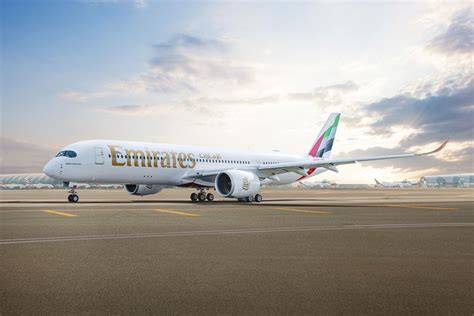
The second wave stretched through summer and autumn, and the volumes tell a sharper story. Newcastle stood out with 206 A350 departures between March and October, the heaviest concentration anywhere on the network. Dublin followed with 156 flights from June to October, Frankfurt with 136 across the same span, and Athens with 107 between July and October. Athens is the outlier on the entire list: the specific flights that carried the A350 no longer operate at all in 2026, and when they return in 2027 the schedule currently shows the 777-200LR instead. Medina recorded just five departures across July, September and October. In nearly every case, the 777-300ER has reclaimed the frequencies.
Brussels, Milan Malpensa And Cairo Close Out The A350 Chapter
Three more destinations disappear from the map at the end of November. Brussels hosted the A350 in July and again from October through November 30. Milan Malpensa first welcomed the type in August, and its final A350 departure is scheduled for November 30, after which the 777-300ER resumes. Malpensa’s three daily Emirates services illustrate the rebalancing neatly: two are flown by the A380, one of which continues onward to New York JFK, while the third has moved from A350 back to the Triple Seven. Cairo, usually described as Africa’s most populous city, saw the A350 in March through May with up to two daily rotations, then returned briefly in November on the 3rd, 16th, 19th, 20th, 21st and 22nd before the 777-300ER took over again. Cairo’s five daily flights now split three A380s and two Triple Sevens.
Newcastle Proves The A350 Was A Capacity Tool, Not A Destination Play
Newcastle deserves closer attention because it exposes the reasoning behind the entire reshuffle. Emirates flew the A350 into Northeast England from March 16 to October 31, using the 312-seat configuration on 159 of 203 departures, with the premium-heavy 298-seat version on 44 flights concentrated in May and June. Conflict involving Iran suppressed demand across the Gulf, and Emirates responded by cutting frequency to five weekly flights in April and June while substituting the A350 for the usual 421-seat 777-300ER. Across March to October, available seats fell 30% year over year, with April and June capacity down 48%.
The traffic numbers confirm that re-sizing worked, albeit not immediately. UK Civil Aviation Authority data for April shows Emirates carried 7,211 passengers to and from Newcastle, down from 21,752 a year earlier, a 67% decline that overshot the 48% seat reduction. By June, improved confidence narrowed the gap to 50% fewer passengers against a comparable capacity cut. Daily service resumed in July, and by September 15,917 passengers flew, 26% fewer than the prior year against the same 26% reduction in seats. Equilibrium returned, and the Triple Seven was back on November 1. That sequence of intentional undersupply, then recovery, then restoration explains why fourteen routes lost the A350: Emirates used the aircraft to right-size capacity during a demand shock, then restored larger equipment once demand caught up.