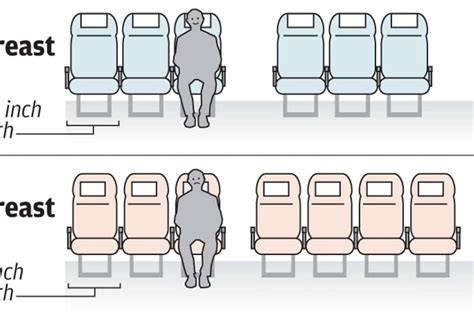
A passenger settles into a ten-abreast row on a long-haul widebody, braces a shoulder against the armrest, and wonders who decided that eighteen inches of personal space was a luxury the industry could no longer afford. That question has a precise answer, and it lives almost entirely inside two airframes: the Boeing 777 and the Airbus A350, the only cabins built to swing between nine- and ten-abreast economy configurations. Every other widebody sits outside that debate. The A380 was so wide that carriers fitted it ten-abreast as a baseline and never needed to consider anything tighter, while regulators ruled out eleven-abreast as a non-starter. The A330, the A330neo, and the 787 are nine-abreast aircraft by geometry and habit; a few early mainline Dreamliners flew eight-abreast, and Japan Airlines remains the last operator doing so. Squeezing ten seats into an A330 or 787 is not a serious engineering proposition, which is why the entire conversation about shrinking seats collapses onto two airframers and a handful of inches.
The Original Intent: Both the 777 and A350 Were Designed for Nine-Abreast
The Boeing 777 entered the market as a long-haul aircraft built around generous proportions, and its interior philosophy reflected that. The original cabin measured roughly 19 feet, 3 inches (5.86 meters) across, and every early 777 flew with a 3-3-3 economy layout delivering 18 to 18.5 inches (46 to 47 cm) of seat width. The later 777-200LR and 777-300ER retained essentially the same internal width, and for years the Triple Seven was regarded as one of the most comfortable high-capacity widebodies in the sky. The Airbus A350 arrived nearly two decades later with a similar starting point. Despite the “Xtra Wide Body” (XWB) branding, Airbus actually trimmed the fuselage relative to the 777, settling on 18 feet, 5 inches (5.60 meters) of internal cabin width — enough for a genuinely comfortable nine-abreast cabin. Both aircraft could physically and legally accommodate a 3-4-3 layout, and for a long period no airline wanted one.
The Squeeze Begins: What Ten-Abreast Actually Costs in Seat Width
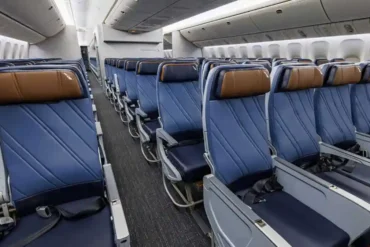
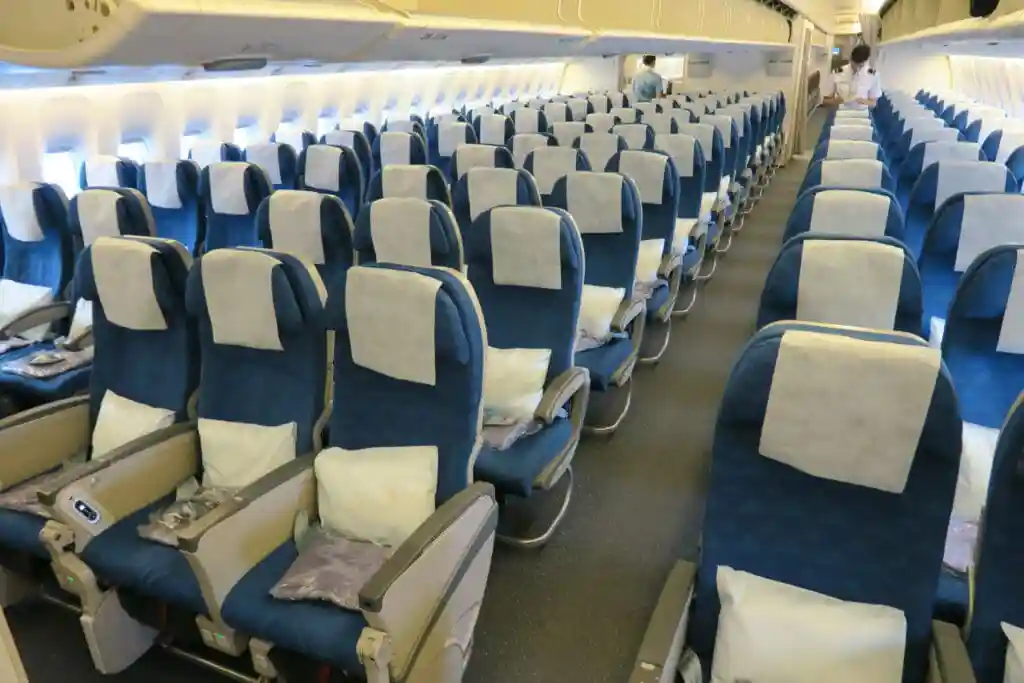
The number that matters most is the gap between the two configurations on the same fuselage. When a 777-200LR or 777-300ER moves from nine-abreast to ten-abreast, seat width falls from 18.5 inches (47 cm) to approximately 17 inches (43 cm) — a loss of roughly 1.5 inches, or just under four centimeters, per seat. On the original-production A350, the damage is noticeably worse. Nine-abreast yields 18 inches (46 cm), while ten-abreast compresses that to 16 to 16.7 inches (40.6 to 42 cm), a drop of well over an inch and a half. For context, the long-standing industry average for economy seating runs between 17 and 18 inches (43 to 46 cm), so a ten-abreast A350 effectively sits below the floor of conventional comfort rather than merely near it.
| Configuration | Internal Cabin Width | Economy Seat Width |
|---|---|---|
| 9-abreast 777-200LR/-300ER | 19 ft 3 in (5.86 m) | 18.5 in (47 cm) |
| 10-abreast 777-200LR/-300ER | 19 ft 3 in (5.86 m) | 17 in (43 cm) |
| 9-abreast original A350 | 18 ft 5 in (5.60 m) | 18 in (46 cm) |
| 10-abreast original A350 | 18 ft 5 in (5.60 m) | 16–16.7 in (40.6–42 cm) |
| 9-abreast A350 New Production Standard | 18 ft 9 in (5.72 m) | 18.7 in (47.5 cm) |
| 10-abreast A350 New Production Standard | 18 ft 9 in (5.72 m) | 17 in (43 cm) |
| 10-abreast 777-9 (777X) | 19 ft 7 in (5.97 m) | 17.6–18 in (44–46 cm) |
The Low-Cost Exception: French bee and Air Caraïbes on Ten-Abreast A350s
Long-haul low-cost operators rarely venture into widebody territory, but the sister carriers French bee and Air Caraïbes did exactly that with fleets of original-production A350s, and both fitted them 3-4-3. The decision unlocked the A350-1000’s maximum certified count of 480 seats at French bee — 40 premium and 440 economy — with Air Caraïbes matching the layout on some of its own -1000s. These remain the only airlines to have configured original-production A350s this way, despite published economy seat widths of around 16 inches (41 cm). The logic is transparent: their proposition is about reaching far-flung leisure destinations at the lowest possible fare, not about onboard comfort, and the densest viable cabin is the mechanism that makes such fares possible.
The 777-300ER Migration: Almost Everyone Went to Ten-Abreast
Market forces proved relentless on the 777-200LR and 777-300ER fleet. Most of the world’s 777-300ERs have now been delivered or retrofitted ten-abreast, cutting economy seats to about 17 inches (43 cm) and adding a full extra seat per row across the cabin. A small group of holdouts resisted — Japan Airlines, ANA, Korean Air, and Singapore Airlines among them — but the pressure never relented. Even premium-branded carriers such as Qatar Airways and Emirates operate ten-abreast Triple Sevens. The resistance has sometimes cracked under scrutiny rather than strategy: in September 2025, Korea’s JoongAng reported that Korean Air was reconsidering its plan to move economy from 3-3-3 to 3-4-3 after mounting consumer backlash. The airline has not published a final seat map for its ordered 777-9s, but a nine-abreast outcome would be a genuine surprise.
The Boeing 777-9 and 777X: More Cabin Width, Different Economics
Boeing’s answer to the width question arrives with the 777-9 and 777-8, whose thinner walls push internal cabin width to 19 feet, 7 inches (5.97 meters) — eight inches more than the original 777 grew to over its lifetime. Boeing is not subtle about the comparison, stating on its 777X product page that the cabin is “Up to 40 cm (16 inches) wider than the A350.” That extra width gives holdout airlines room to move while leaving economy passengers in roughly the same place. Singapore Airlines announced its new 777-9 cabin with 17.6 inches (44.7 cm) economy seats in 3-4-3, a figure that sits marginally above the ten-abreast 777-300ER but well below the nine-abreast standard the airline maintained for years. The 777-9’s greater length and width will not translate into dramatically higher density, because most 777-300ERs are already ten-abreast. Instead, exit-limit certification caps the 777-9 at 475 seats or 440 seats depending on door configuration, far below the 550 certified for an ultra-high-density 777-300ER, and Boeing envisions the freed space flowing into business and premium economy rather than coach.
The New Production Standard A350: A Few Inches Back in Passengers’ Favor
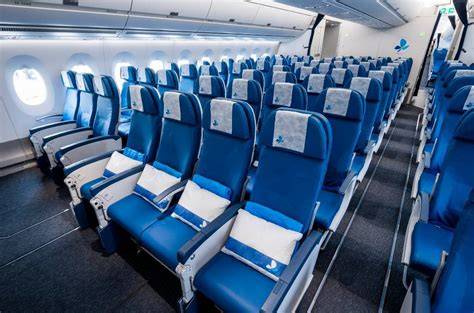
Airbus quietly improved the equation without launching a new variant. The New Production Standard (NPS) A350 thins the sidewalls and lengthens the usable cabin, lifting internal width to 18 feet, 9 inches (5.72 meters); the first NPS aircraft were delivered in 2022. Nine-abreast operators gained the most, with typical seat width rising from about 18 inches to 18.7 inches (47.5 cm). Ten-abreast became more viable too, delivering 17-inch (43 cm) seats that finally match the conventional industry standard instead of falling below it. So far, Philippine Airlines appears to be the only mainline carrier to choose ten-abreast on NPS A350s, gaining roughly an inch over French bee while surrendering more than an inch compared with nine-abreast operators. In an industry measured in marginal inches, that middle position is unlikely to remain unique for long.
The Real-World Comparison: Nine-Abreast A350 vs Ten-Abreast 777X
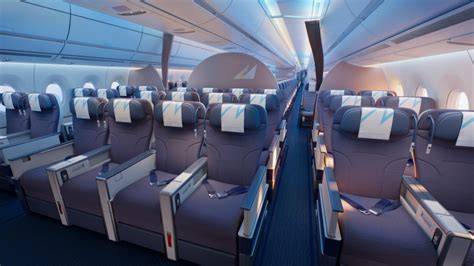
The headline contest between the two newest flagships is usually framed as 777X versus A350, but the honest comparison runs the other way. A nine-abreast NPS A350 offers approximately 1.1 inches (2.8 cm) more seat width than a ten-abreast 777-9 — roughly 6.25 percent more lateral space per economy passenger. That gap reflects how the industry actually deploys these aircraft: the 777-9 will almost universally fly ten-abreast, while the A350 overwhelmingly flies nine-abreast. The original 777 seats measured 18 to 18.5 inches, the next-generation 777-9 settles near 17.6 to 18 inches, and the A350 holds its 18.7 inches in its preferred layout. None of this is catastrophic for the Triple Seven — the airframe simply grew into a denser configuration without surrendering all of its original generosity — but for passengers choosing between the two, the nominally narrower aircraft is the one that delivers more room.
What the Numbers Mean for Passengers Booking Long-Haul Economy
Seat width in a ten-abreast cabin is not a single number but a product of airframe, production standard, and airline ambition. The widest realistic economy seat in this discussion is the 18.7-inch perch on a nine-abreast NPS A350, and the tightest is the 16-inch seat on an original-production A350 flown by a long-haul low-cost carrier. Between them sits the vast majority of the world’s long-haul economy inventory: ten-abreast Triple Sevens at 17 inches, ten-abreast NPS A350s at 17 inches, and ten-abreast 777-9s at 17.6 to 18 inches. For travelers, the practical takeaway is that configuration matters more than the aircraft name on the boarding pass, and that an inch of seat width is worth far more across a fourteen-hour flight than it looks on a spec sheet. For airlines, the arithmetic is equally clear: each additional seat per row adds capacity and revenue, and the cost is paid in a few centimeters of shoulder room that most passengers will notice but few will be able to quantify. The numbers above quantify it precisely, and they explain why the nine-abreast A350 has become the quiet benchmark that every ten-abreast cabin is measured against.