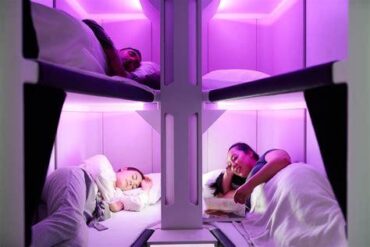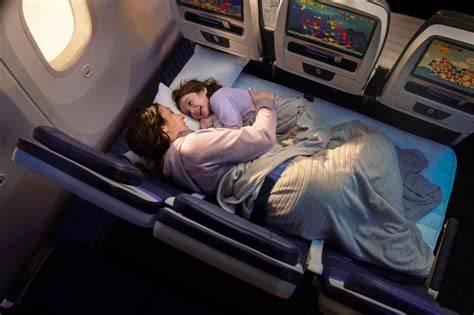
A lie-flat bed has long been the clearest symbol of business class, separating premium cabins from the cramped reality of long-haul economy. But that distinction is becoming less absolute. A growing number of airlines are finding ways to transform several standard economy seats into a shared sleeping surface, giving passengers a chance to stretch out without paying the enormous premium attached to a conventional business-class seat.
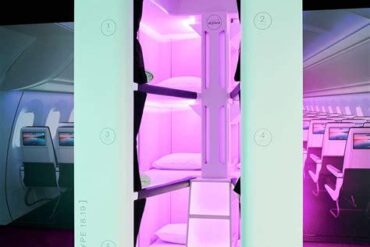
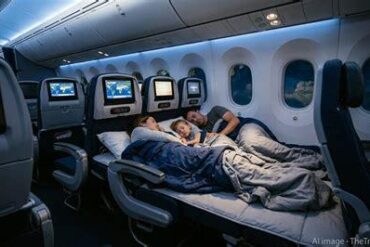
The idea is surprisingly simple. Instead of replacing economy seats with expensive lie-flat furniture, airlines reserve a small number of rows and allow travelers to purchase two or more adjacent seats. Leg rests, mattress pads, cushions, blankets, or dedicated bedding can then turn the row into something resembling a couch or bed. For passengers facing flights lasting 11, 15, or even 17 hours, the difference between sitting upright and lying down can be far more valuable than another meal or a slightly larger seat.
The products vary considerably, however. Some are inexpensive add-ons with little more than an empty row. Others include mattresses, pillows, duvets, priority services, lounge access, and additional baggage. That makes the headline price only part of the story. The real question is how close an economy bed gets to business class while still costing substantially less.
Air New Zealand Skycouch: The 29-Inch Benchmark
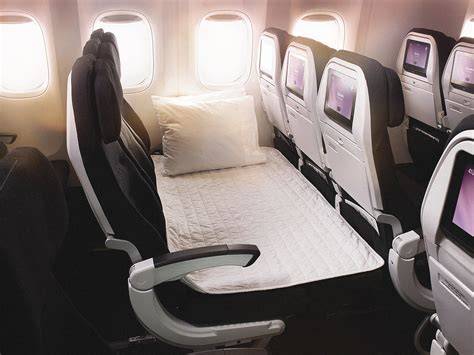
When airlines began experimenting with economy sleeping arrangements, Air New Zealand Skycouch established the template that competitors would spend years trying to improve. Introduced in 2011, the product turned a row of three economy seats into a dedicated resting area, creating a sleeping surface approximately 29 inches (74 centimeters) wide and 5 feet 1 inch (1.55 meters) long.
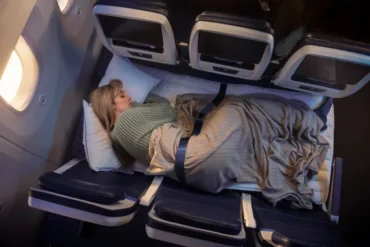
The clever part is the seat mechanism. Footrests rotate upward to bridge the space between the seats and create a continuous surface. Passengers can then use additional bedding and a seat liner to make the area substantially more comfortable than three conventional economy seats. Safety features also allow travelers to remain appropriately restrained while resting.
That distinction matters on ultra-long-haul routes. Air New Zealand operates the Skycouch on aircraft including its Boeing 777-300ER and Boeing 787-9, giving the concept meaningful network coverage rather than limiting it to one unusual aircraft or a single leisure route. The Auckland-New York service is an especially compelling example because the journey can stretch to around 17.5 hours.
A conventional business-class ticket on such a journey can cost dramatically more than economy. Skycouch therefore targets a very different calculation: rather than paying several thousand dollars for a premium cabin, travelers can spend substantially more than ordinary economy while still retaining the basic economics of the main cabin.
A solo Skycouch booking on the Auckland-New York route has been reported at around $604 one way, although actual pricing varies according to demand, dates, and booking conditions. That figure is particularly striking when placed beside premium economy and business-class pricing.
The product’s influence extends beyond Air New Zealand. The airline has also licensed the Skycouch concept to other carriers, demonstrating that the underlying idea has commercial value beyond one fleet. More importantly, it established consumer expectations for what an economy sleeping product should look like: predictable availability, dedicated hardware, bedding, and enough space to make lying down genuinely useful.
For that reason, Skycouch remains the benchmark. It does not turn economy into business class, but it addresses the single feature travelers often value most on an overnight flight: horizontal sleep.
United Airlines Relax Row: America’s Economy Bed Arrives
United Airlines is taking the concept into a much larger market with its planned Relax Row, announced in 2026. The significance is not merely the product itself. It is the scale of the rollout.
United plans to introduce Relax Row beginning in 2027 aboard Boeing 787 and Boeing 777 aircraft, with the eventual ambition of installing the product on more than 200 aircraft by 2030. That would make it one of the most widely deployed economy sleeper concepts offered by a North American airline.
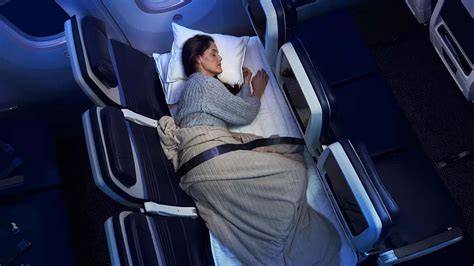
The configuration uses three adjacent economy seats. Their leg rests fold upward to create a couch-like surface, while a purpose-designed mattress pad, blanket, and two pillows are intended to turn that surface into a more practical sleeping space. United is also positioning the product toward families, with children’s travel items included as part of the offering.
The timing is important. For decades, American travelers generally faced a simple choice on long international flights: accept standard economy or pay significantly more for a premium cabin. United is effectively creating a third option.
The airline has not established final Relax Row pricing, so comparisons with existing products must remain estimates rather than promises. Air New Zealand’s pricing provides one useful reference point, with Skycouch historically costing several hundred dollars more than standard economy and potentially considerably more for solo travelers purchasing an entire row.
United’s strategy is therefore less about creating the absolute cheapest economy bed and more about bringing the concept into the mainstream American long-haul market. If Relax Row appears on hundreds of aircraft, passengers will have a much better chance of encountering the option when planning a long journey.
The biggest limitation is straightforward: Relax Row has not yet carried its first paying passenger. Until the product enters service, travelers cannot evaluate its real-world mattress comfort, sleeping width, privacy, noise environment, or value. Its potential is enormous, but potential and proven performance are not the same thing.
Air Astana Economy Sleeper: Business-Class Perks Without the Business Seat
Air Astana offers one of the most unusual versions of the economy-bed concept because it does not stop at the sleeping surface. Its Economy Sleeper product combines three economy seats with a mattress layer, business-class-style pillow, and duvet, creating a more complete overnight package.
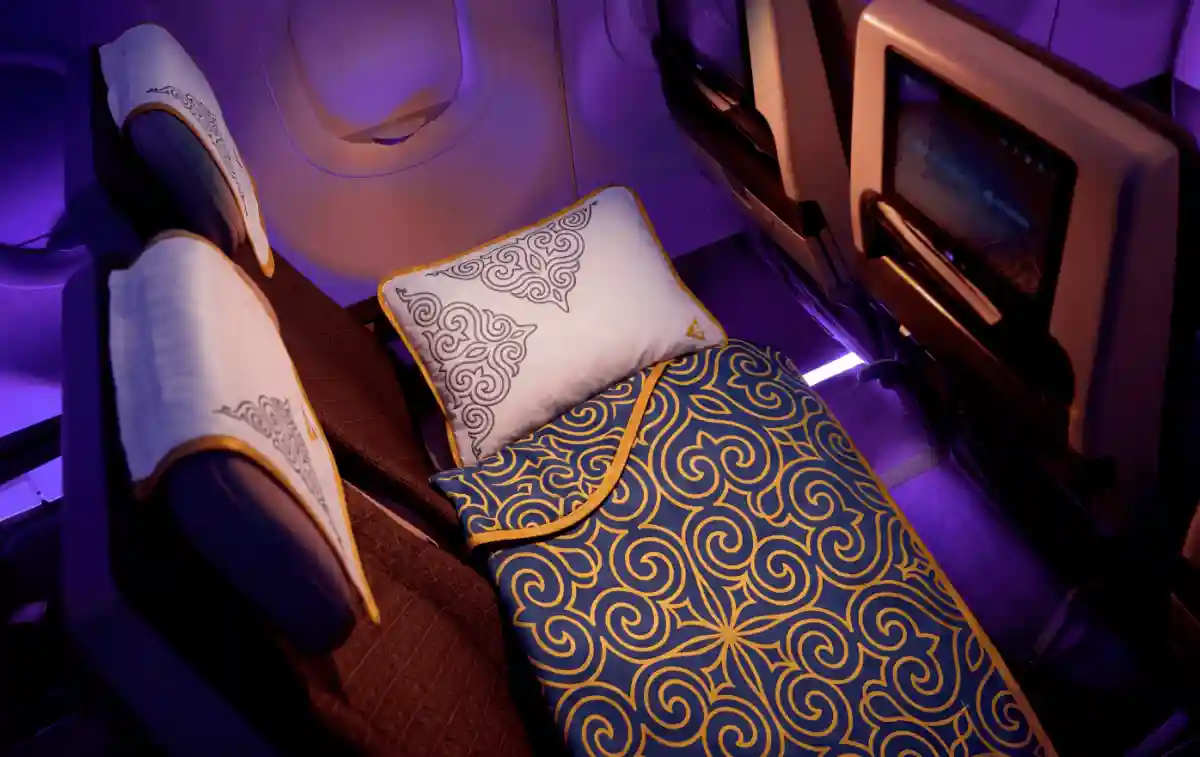
The product has been available since 2015, giving Air Astana considerable experience with the format. A partitioned section at the front of the economy cabin can contain up to 12 sleeper seats, depending on the aircraft and service.
What makes the product particularly interesting is the collection of benefits surrounding the seats. Economy Sleeper passengers can receive priority check-in and boarding, business-lounge access, additional baggage allowance, an amenity kit, and bonus Nomad Club miles. The ticket can also offer change and refund flexibility that would normally be associated with a more expensive fare.
This means the value proposition extends beyond sleeping. A passenger is effectively purchasing an economy-based premium package that borrows several conveniences from business class.
The weakness is availability. Air Astana’s Economy Sleeper is not a universal product across its network. It is offered on a relatively limited number of international services, particularly those connected with Almaty and Astana. That makes it an excellent discovery for passengers whose itinerary happens to qualify, but not an option travelers can assume will be available for any long-haul journey.
Nevertheless, in terms of what is actually included, Economy Sleeper may be the closest economy product on this list to a business-class experience without occupying a business-class seat.
Lufthansa Sleeper’s Row: The Cheapest Option Comes With a Gamble
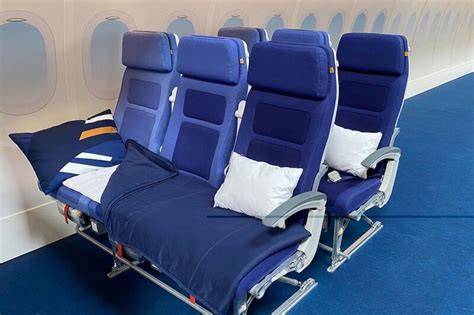
Lufthansa’s Sleeper’s Row takes a more minimalist approach. The concept was launched in 2021 after the airline tested the arrangement on its Frankfurt-São Paulo service. It allows economy passengers on eligible long-haul flights to occupy three or four neighboring seats and use a mattress topper, pillow, and blanket to create a substantially more comfortable sleeping arrangement.
The price is what immediately attracts attention. Depending on the flight, the seat block has been offered for approximately $190 to $270, making it one of the least expensive ways to obtain a horizontal sleeping surface on a long-haul commercial flight.
There is, however, a major catch.
Sleeper’s Row cannot be reserved in advance. Passengers can request it only during check-in or at the gate, and only when enough seats remain available on the specific flight. Lufthansa also limits the number of Sleeper’s Row sections available on an aircraft.
That changes the economics considerably. A traveler cannot confidently build an itinerary around the product in the same way they can with Skycouch. The opportunity exists, but it depends on the aircraft’s remaining inventory.
This makes Lufthansa particularly appealing to flexible travelers. Someone flying on a lightly booked long-haul service may discover an inexpensive path to several hours of horizontal sleep. Someone who absolutely needs a bed, however, cannot treat the product as guaranteed.
The concept also reveals an important truth about economy beds: the seat hardware is only half the equation. Availability can be just as important as comfort. A fantastic sleeper product is not particularly useful if passengers cannot secure it when purchasing their tickets.
ANA COUCHii: A Flying Honu Economy Bed
All Nippon Airways, better known as ANA, has developed one of the most specialized economy sleeper products in commercial aviation. COUCHii is installed aboard ANA’s three Airbus A380s, the aircraft famously known as the Flying Honu, which operate the Tokyo Narita-Honolulu route.
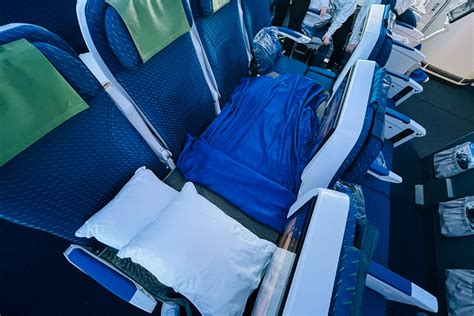
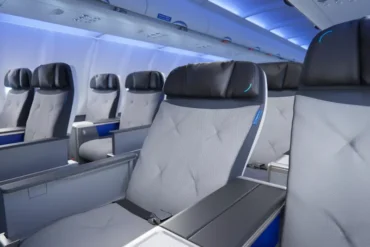
The product occupies the rear portion of the economy cabin, with around 60 seats designed for conversion into larger sleeping spaces. Travelers can combine three or four adjacent seats, raising their leg rests to create a flatter surface.
ANA supplies a dedicated mattress and duvet, which gives COUCHii a more substantial sleeping setup than a basic empty-row arrangement.
There is a price for the dedicated configuration, though. COUCHii seats have slightly less pitch than the surrounding economy cabin, dropping from approximately 34 inches to 32 inches. For passengers sitting normally, that may sound like a disadvantage. Once the seats are converted for sleeping, however, the overall configuration becomes more important than the nominal pitch figure.
ANA’s approach is also strongly oriented toward leisure travelers. Hawaii is a destination where families and couples often travel together, making a shared sleeping area especially useful. The aircraft’s enormous A380 cabin provides enough room for ANA to create additional family-oriented facilities, including a multipurpose space that can help parents with young children.
The limitation is obvious: COUCHii exists on only three aircraft serving one route. That makes it one of the least accessible products on this list.
For someone flying Tokyo to Honolulu aboard the appropriate Flying Honu, however, it can be an unusually comfortable way to transform economy into a sleeping environment without purchasing business class.
Vietnam Airlines Sky Sofa: The Bare-Bones Economy Bed
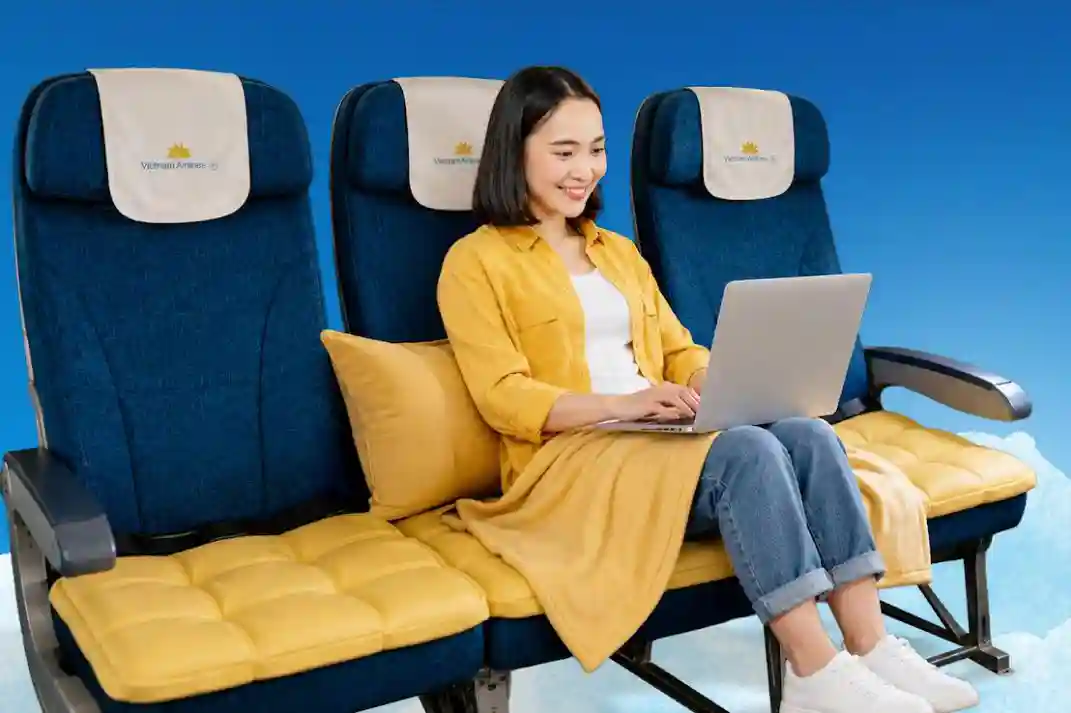
Vietnam Airlines offers the simplest concept of the six with its Sky Sofa. Passengers purchase an entire row of three economy seats, allowing them to stretch across the seats during the flight.
The product is available on selected long-haul services, including routes linking Vietnam with San Francisco, London, Paris, and Frankfurt, using aircraft such as the Airbus A350-900.
Pricing is one of Sky Sofa’s biggest advantages. Published prices have ranged from roughly $130 to $650 per package, depending on the route and ticket conditions. Travelers on the Ho Chi Minh City-San Francisco route have reported prices around $300 for the additional row, which can represent a dramatic discount compared with a conventional business-class upgrade.
But the low price comes with fewer extras.
Unlike Skycouch, the seats do not provide the same dedicated flip-up leg-rest arrangement. Passengers essentially lie across the seat cushions, and standard bedding is not necessarily included. There is no mattress topper or premium amenity package comparable with Air Astana’s Economy Sleeper.
Vietnam Airlines therefore demonstrates another side of the economy-bed market: sometimes the best value comes from removing almost everything except the extra space.
For travelers whose primary objective is simply to lie down, that can be enough. A horizontal economy row may be considerably more useful than a single premium economy seat, particularly on a long overnight flight.
Why Economy Beds Are Challenging Business Class
The rise of these products does not mean economy class is replacing business class. The two cabins remain fundamentally different.
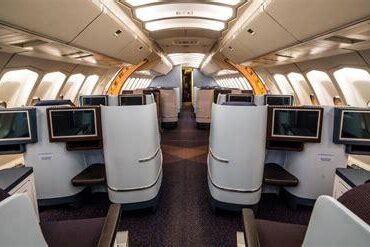
Business-class passengers generally receive a genuinely engineered lie-flat bed, greater privacy, direct aisle access on many aircraft, superior dining, premium lounges, priority services, and a substantially more refined cabin environment. Economy sleeper products usually provide more horizontal space without recreating the entire premium experience.
That distinction is actually what makes them attractive.
A passenger may not care about a premium meal when the alternative is spending the entire night sitting upright. Likewise, a family traveling together may value three connected seats more than a single business-class seat with greater personal space.
The economics are particularly compelling for travelers who can share the row. A couple can distribute the cost of the additional seats between two people, turning what initially looks like an expensive economy upgrade into a relatively reasonable sleeping solution.
For solo travelers, the calculation is more complicated because purchasing an entire three-seat row can approach the price of premium economy or other premium products.
The most important factor is therefore the length of the flight. On a two- or three-hour journey, an economy bed is largely unnecessary. On a 15-hour overnight flight, the ability to sleep horizontally can fundamentally change the experience.
The Future of Lie-Flat Economy
These six products reveal where long-haul economy travel is heading. Airlines do not necessarily need to install expensive business-class seats throughout the cabin to provide a better sleep experience. Instead, they can modify a small number of existing economy rows and sell those spaces at a premium.
The model also makes commercial sense because it creates an additional revenue stream from seats that might otherwise remain unused. Families, couples, and travelers willing to pay for sleep can spend more, while airlines avoid dedicating an entire cabin to passengers who want premium comfort.
Air New Zealand remains the clearest pioneer, with more than a decade of experience and broad network availability. Air Astana demonstrates how far an economy sleeper can go when airlines add premium ground and baggage benefits. Lufthansa shows how aggressively low pricing can work when availability is left to chance. ANA demonstrates the appeal of a highly specialized leisure product, while Vietnam Airlines focuses almost entirely on affordability.
United’s Relax Row could be the biggest development of all because scale changes consumer expectations. If hundreds of aircraft eventually carry dedicated economy sleeping sections, the concept could become a normal consideration when booking an overnight international flight rather than an unusual aviation trick.
The result is a new middle ground between economy and business class. At only about 29 inches wide, an economy bed will not replace a premium suite. But for the traveler whose priority is getting several hours of real sleep, that narrow surface can be worth far more than its dimensions suggest.