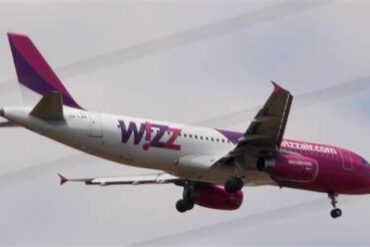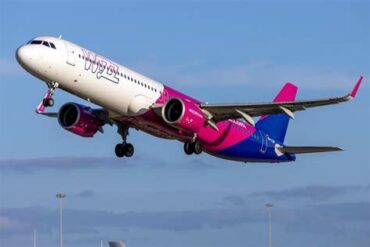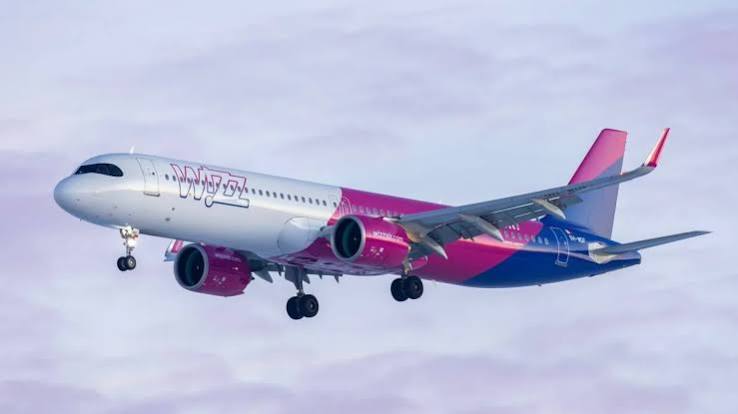
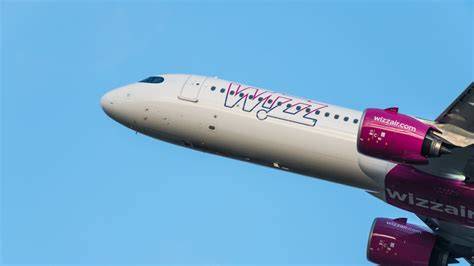
In the early hours of a London departure, a routine a few hours spent in an open cabin became a security situation. Wizz Air flight 4302, a scheduled connection from London Luton Airport (LTN) to Sofia International Airport (SOF), was diverted to Budapest after a bomb threat was sent in during the flight. The flight, operated by an Airbus A321neo, departed Luton at 8:33 AM local time (GMT) and was due to reach the Bulgarian capital at 1:25 PM local time (11:25 AM GMT). Instead, it touched down at Budapest Liszt Ferenc International (BUD) at 12:09 PM (11:09 AM GMT), under the watch of a scrambled fighter jet, with every passenger aboard present and accounted for.
Wizz Air’s Official Statement on the Luton to Sofia Bomb Threat
Wizz Air quickly confirmed that the London Luton–Sofia service had been diverted to Budapest following a bomb threat received during the flight. The carrier said the aircraft diverted and landed safely at Budapest Liszt Ferenc International Airport in line with the relevant security protocols and procedures, before taxiing to a designated stand where the relevant authorities carried out the necessary security checks on the aircraft and passengers. A communications representative for the airline said the company continues to prioritise the safety of passengers and crew members above all else, and that Wizz Air is cooperating fully with the authorities while the investigation remains ongoing. Nothing suspicious was discovered on board.
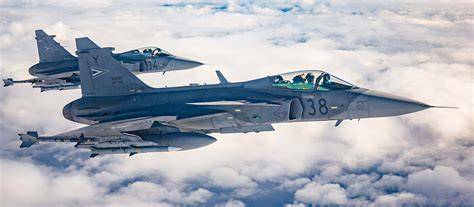
Hungarian Defence Forces Scramble a Saab Gripen
The response on the ground was matched in the air. Hungarian Defence Minister Romulusz Ruszin-Szendi confirmed the incident in a social media post and said a Saab Gripen fighter scrambled and successfully escorted the aircraft in to land. Hungary’s first five Gripen fighters arrived on March 21, 2006, and were officially handed over at a ceremony on that date; the Swedish manufacturer Saab has built around 300 of the supersonic multirole jets, a type that competes with the Lockheed Martin F-16 Fighting Falcon, the Dassault Rafale and the Eurofighter Typhoon. The Hungarian fleet’s most numerous variant, the JAS 39D, measures 48 feet 5 inches (14.8 m) in length with a 27 feet 7 inches (8.4 m) wingspan, a maximum takeoff weight of 30,900 lb (14,000 kg), a Volvo Aero Corporation RM12 engine generating 18,100 lbf (80.5 kN) of thrust, a 52,500 feet (16,000 m) service ceiling, a +9/-3 G-limit and seven hardpoints carrying wingtip short-range air-to-air missiles and an ECM or targeting pod. After its escort duty was complete, the Gripen returned safely to Kecskemét Air Base, Hungary’s largest military airfield and home of its fighter force. “Our soldiers have once again proven that they can be deployed immediately if necessary and are able to guarantee the security of Hungary’s airspace,” Ruszin-Szendi said.
Ground Operations at Budapest: No Bombs Found on Board
The Wizz Air jet landed on Runway 31R, which the airport’s authorities then shut down to deal with the aircraft, shifting traffic to 31L, according to AirLive. The aircraft was directed to a secure and isolated stand where police and counter-terrorism squads were waiting; passengers were taken off the jet and into a secure area of the terminal. Bomb disposal officers then completed a thorough search of both the cabin and cargo hold and found no hazardous or suspicious items. Hungarian law enforcement officers continue to investigate the source of the false threat.
False Alarm: The Wizz Air A321neo Completes Its Journey to Sofia
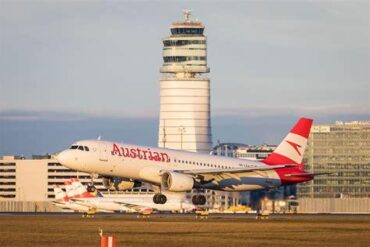
With the jet cleared, authorities gave permission for the Airbus A321neo to continue, and the plane departed Budapest at 4:48 PM local time, carrying its passengers on to Sofia roughly five hours behind schedule. The aircraft type sits at the heart of Wizz Air’s narrowbody strategy, with the airline currently holding 81 examples of the A321neo in its fleet. The episode echoes a similar hoax earlier in the year, when a bomb threat forced an Austrian Airlines A320 bound from Tel Aviv to land in Bulgaria under fighter escort, and joins a steady pattern of false alerts that test European airspace security, carrier protocols and the patience of passengers whose travel plans end on a remote stand. For the Hungarian Defence Forces, the diversion proved one point cleanly: the airspace quick-reaction capability works.