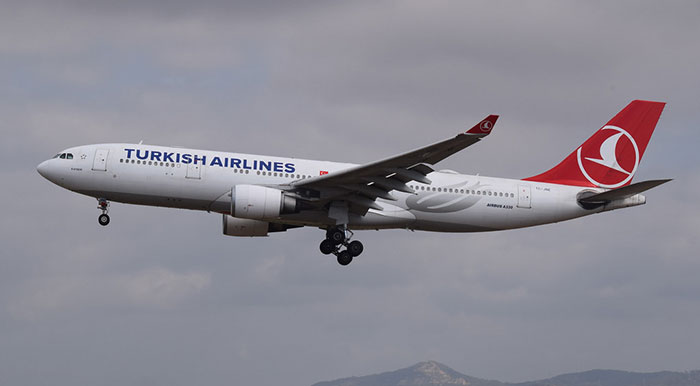
A routine mid-morning flight from Istanbul to Barcelona turned into a full-scale aviation security emergency when a fake bomb threat embedded in a passenger-created Wi-Fi hotspot name forced Turkish Airlines Flight TK1853 to divert under military escort. The Airbus A321, carrying 148 passengers and seven crew members, was approaching Spanish airspace when cockpit alerts and cabin reports revealed the alarming network name broadcasting onboard. What followed was a rapid escalation involving NATO Quick Reaction Alert protocols, fighter jet interceptions over two countries, and the temporary disruption of operations at one of Spain’s busiest airports.
The aircraft, which departed from Istanbul Airport, was one of four daily Turkish Airlines services linking Turkey’s primary aviation hub with the Catalan capital. As the flight cruised over the Mediterranean, the cabin environment was calm, with no visible signs of disturbance. The threat did not come from a verbal claim, suspicious luggage, or written note, but from something far more modern and insidious: a personal wireless hotspot labeled with a message stating that a bomb was on board. In an era where digital signals are as closely monitored as physical behavior, such an act is treated with the utmost seriousness.
Upon identification of the hotspot name, the flight crew followed strict international security procedures. The pilots declared an emergency immediately, notifying air traffic control and triggering a coordinated multinational response. This decision, while disruptive, aligned precisely with global aviation safety doctrine, which dictates that every bomb threat—regardless of perceived credibility—must be treated as real until disproven. Within minutes, the situation moved beyond civilian airspace management into the realm of military aviation.
As the aircraft crossed into European airspace, French fighter jets were scrambled, generating reports of a sonic boom over southern France as they accelerated to intercept. The escort was later transferred seamlessly to Spanish Eurofighter Typhoons once the aircraft entered Spanish-controlled airspace. Under close military supervision, the A321 performed multiple holding loops off the Catalan coast, a calculated maneuver designed to clear surrounding air traffic and ensure a controlled, isolated approach into Barcelona-El Prat Airport.
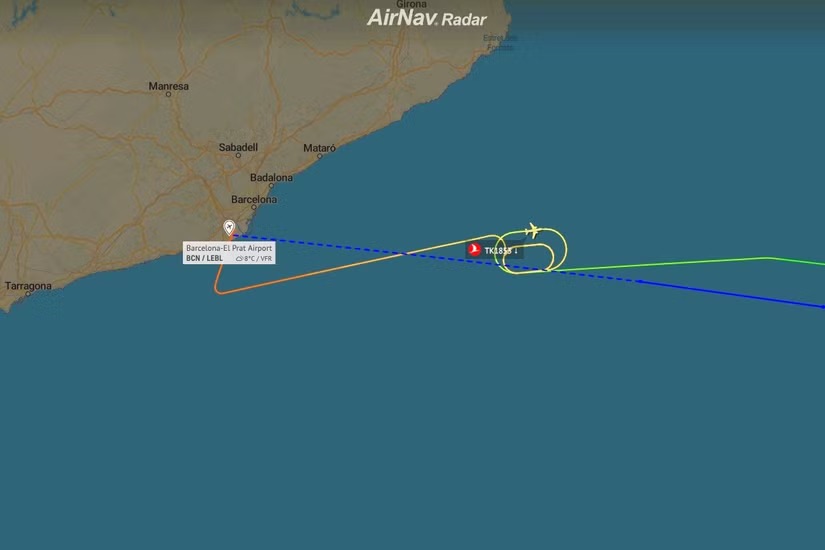
The jet touched down safely just after 11:00 a.m. local time, approximately thirty minutes behind schedule. On arrival, airport authorities directed the aircraft to a remote stand, far from terminal buildings and active runways. This isolation protocol minimizes risk to airport infrastructure and other passengers in the unlikely event that a threat proves genuine. Emergency services, armed police, and bomb disposal units were already positioned, underscoring the seriousness with which the situation was handled.
Digital Threats and Modern Aviation Security
This incident highlights how digital behavior has become a critical security vector in commercial aviation. The misuse of a Wi-Fi hotspot name may appear trivial to the perpetrator, but within an aircraft environment it constitutes a direct security threat. Airlines monitor onboard networks closely, and any anomalous or threatening digital signal is immediately escalated. The closed environment of an aircraft, combined with post-9/11 security frameworks, leaves no room for interpretation or leniency.
Turkish Airlines later confirmed that the threat originated solely from the hotspot name and that no physical evidence of an explosive device was found. The airline emphasized that the crew acted decisively and correctly, ensuring passenger safety above all else. Local authorities boarded the aircraft shortly after landing, disembarking passengers in a controlled manner before conducting a comprehensive sweep of the cabin, cargo hold, and checked luggage.
A Surge in Global Bomb Hoaxes
The Turkish Airlines episode is not an isolated case but part of a worrying global trend. Aviation authorities worldwide have recorded a sharp rise in bomb threats, most of which ultimately prove to be hoaxes. According to data from the US Bomb Data Center, reported bomb threats increased by 26% in 2023, while India’s Bureau of Civil Aviation Security documented nearly 1,000 threats in 2024 alone. The momentum has carried into 2025, with multiple high-profile diversions, evacuations, and airport shutdowns across continents.
What unites many of these cases is the method of delivery. Threats are increasingly transmitted through digital means—emails, phone calls, and now onboard wireless networks. This shift complicates prevention efforts, as perpetrators can act anonymously and remotely, often without immediate detection. Yet the operational response remains unchanged: every threat triggers costly, resource-intensive security measures.
The Operational and Financial Cost of Hoaxes
Each false bomb threat imposes a significant burden on airlines, airports, and governments. Scrambling fighter jets, diverting aircraft, halting airport operations, and deploying bomb disposal teams can cost hundreds of thousands of dollars per incident. Passengers face missed connections, extended delays, and psychological stress, while airlines absorb fuel costs, crew duty extensions, and reputational risk.
In the case of Flight TK1853, Barcelona-El Prat Airport temporarily suspended arrivals and departures until the aircraft was secured and passengers disembarked. Although operations returned to normal within a short period, the ripple effects extended far beyond the runway. Airlines must also cooperate with law enforcement investigations, provide passenger manifests, and preserve digital evidence, adding further complexity to an already strained system.
Legal Consequences for Perpetrators
Authorities have repeatedly stressed that bomb hoaxes are criminal acts with severe penalties. Recent cases demonstrate a growing willingness by courts to impose harsh sentences as a deterrent. In one notable incident, a passenger who made a false bomb threat on a US domestic flight was sentenced to 22 months in federal prison, ordered to pay $80,000 in restitution, and placed under supervised release. These penalties reflect not only the disruption caused but also the potential for catastrophic outcomes had an emergency response gone wrong.
In Spain, the passenger responsible for the Wi-Fi hotspot on the Turkish Airlines flight was identified and detained for questioning. While investigations are ongoing, legal experts note that international aviation security laws allow for prosecution even when no physical device is present, particularly when military resources are deployed in response to a threat.
Aftermath and Industry Implications
Following the all-clear from bomb disposal units and canine teams, Spanish authorities confirmed that no explosives were found on board. Passengers were eventually allowed to continue their journeys, though many faced delays and missed connections. Turkish Airlines coordinated rebooking and assistance, while cooperating fully with Spanish and international investigators.
The incident serves as a stark reminder that aviation security is only as strong as the weakest behavioral link. As technology evolves, so too must awareness among passengers about the consequences of seemingly “harmless” actions. A single line of text broadcast through a Wi-Fi signal was enough to mobilize fighter jets, disrupt international air traffic, and place hundreds of lives under emergency protocols.
In an industry built on precision, trust, and layered security, the misuse of digital tools threatens to undermine efficiency and safety alike. The emergency landing of Flight TK1853 underscores a sobering reality: in modern aviation, words—whether spoken, written, or transmitted wirelessly—can carry the same weight as physical threats, and the response will always be uncompromising.