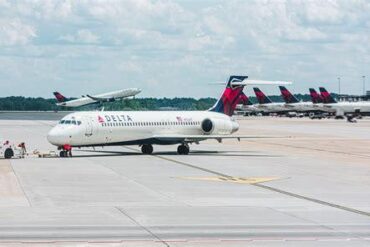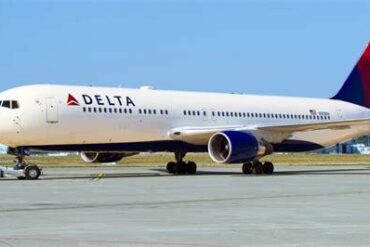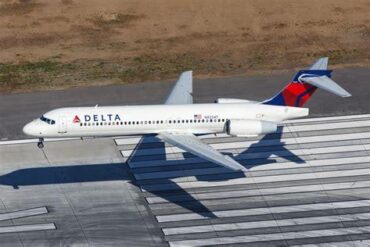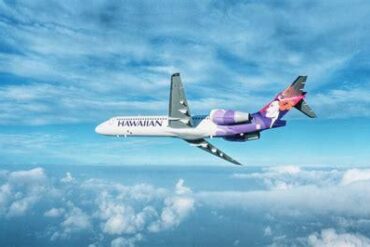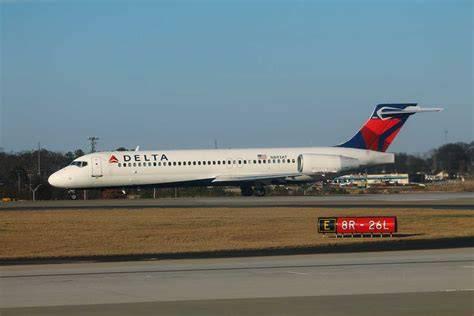
For more than a decade, the Boeing 717 has remained one of the most recognizable aircraft in Delta Air Lines’ narrowbody fleet, serving short-haul routes with a combination of reliability, simplicity, and operational flexibility. However, the aging aircraft is now entering the final stage of its service life with Delta, as the airline moves toward a more modern fleet strategy centered around the Airbus A220 family.
The transition represents more than a simple aircraft replacement program. It highlights a broader shift across the airline industry toward newer-generation jets that provide better fuel efficiency, improved passenger comfort, lower maintenance costs, and greater network flexibility. For Delta, replacing the 717 with the A220 allows the airline to preserve the role of a smaller narrowbody aircraft while upgrading its capabilities for the future.
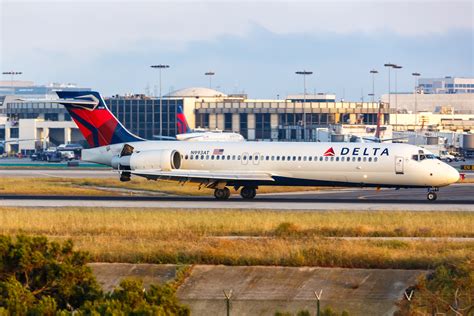
The Boeing 717 has a unique history within commercial aviation. Although it carries a Boeing name, the aircraft is actually a descendant of the McDonnell Douglas DC-9 family, a design lineage that dates back to the 1960s. Delta has deep connections with this aircraft family, becoming the launch customer of the original DC-9 in 1965 and later operating multiple generations of the aircraft, including the MD-80 and MD-90.
When Boeing acquired McDonnell Douglas in 1997, the company inherited the unfinished MD-95 program. Instead of continuing the aircraft under the McDonnell Douglas brand, Boeing renamed it the Boeing 717-200. The aircraft entered service in 1999, targeting the 100-seat market and competing against regional jets and smaller narrowbody aircraft.
Why Delta Air Lines Operated the Boeing 717 For So Long
Delta’s decision to operate the Boeing 717 was closely connected to the airline’s fleet strategy following major industry changes. In 2012, Delta acquired 88 Boeing 717 aircraft through long-term leases from Southwest Airlines after Southwest completed its acquisition of AirTran Airways.
The move made strategic sense at the time. Delta already had extensive experience operating aircraft from the DC-9 family, meaning pilots, maintenance teams, and airport operations could transition to the 717 with relatively little difficulty.
The aircraft also filled an important role in Delta’s network. With approximately 110 seats in Delta’s configuration, the 717 was ideally suited for lower-demand routes where larger aircraft such as the Boeing 737 or Airbus A320 family would not be economically efficient.
The aircraft offered a comfortable balance between capacity and operating costs. Its rear-mounted Rolls-Royce BR715 engines provided reliable performance, while the aircraft’s compact size allowed Delta to serve smaller markets while maintaining a mainline aircraft experience rather than relying entirely on regional jets.
However, the advantages of the 717 became increasingly limited as the aircraft aged. Most examples in Delta’s fleet are now more than 25 years old, and their technology reflects an earlier era of aviation design.
Fuel efficiency has become one of the biggest priorities for airlines worldwide. Older aircraft typically require more maintenance, consume more fuel, and lack the advanced systems found on modern jets. For Delta, continuing to operate the 717 indefinitely would eventually create higher ownership costs compared with investing in newer aircraft.
The Airbus A220 Becomes Delta’s Boeing 717 Replacement
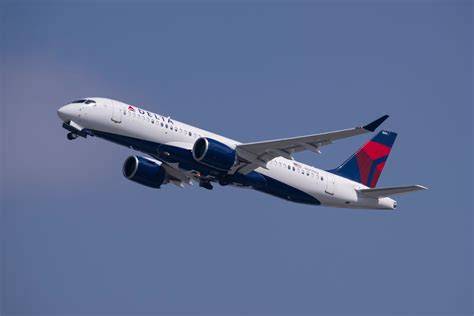
The aircraft selected to replace Delta’s Boeing 717 fleet is the Airbus A220 family, a modern narrowbody aircraft originally developed by Bombardier under the CSeries program.
Delta became one of the first major customers of the aircraft when it ordered the CSeries in 2016. The airline received its first Airbus A220 in 2018, and commercial operations began in 2019. Although Delta originally planned to retire the 717 fleet earlier, delays affecting A220 deliveries allowed the older aircraft to remain in service longer.
The A220 was designed specifically for the market segment previously occupied by aircraft such as the Boeing 717, offering seating capacity between regional jets and larger narrowbody aircraft.
Delta currently operates both versions of the aircraft family. The airline’s A220 fleet includes the smaller A220-100 and the larger A220-300, with additional A220-300 aircraft on order.
The similarities between the Boeing 717 and Airbus A220 roles are clear. Both aircraft are designed for efficient operations on shorter routes, but the A220 introduces significantly newer technology.
The A220-100 offers Delta a similar passenger capacity to the 717, with approximately 109 seats in Delta’s configuration. However, it provides a substantially longer range of more than 2,400 miles compared with the 717’s roughly 1,500-mile capability.
The larger A220-300 increases capacity further, offering around 130 seats while maintaining excellent operating economics. This gives Delta additional flexibility, allowing the aircraft to replace not only the 717 but also serve routes that previously required larger aircraft.
How The Airbus A220 Improves Delta’s Fleet Strategy
Replacing the Boeing 717 with the Airbus A220 provides Delta with several operational advantages. The most important improvement comes from fuel efficiency.
The A220 features advanced aerodynamics, lightweight composite materials, and highly efficient Pratt & Whitney geared turbofan engines. These technologies allow the aircraft to burn significantly less fuel than previous-generation aircraft.
Lower fuel consumption directly reduces operating costs while also helping Delta achieve environmental targets. Airlines are under increasing pressure to reduce emissions, and replacing older aircraft is one of the most effective ways to improve fleet sustainability.
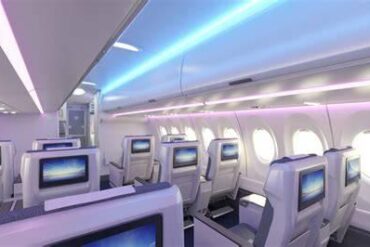
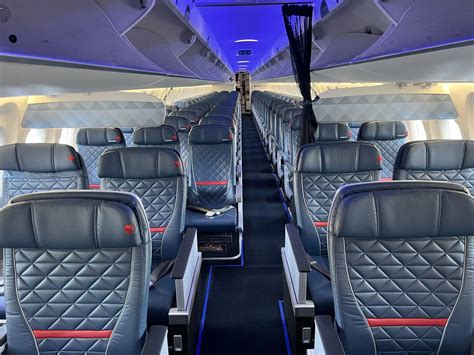
Passenger experience is another major advantage. The A220 features a wider cabin than many aircraft in its category, larger windows, higher ceilings, and improved overhead storage. The aircraft’s design provides passengers with a more spacious experience compared with older regional aircraft.
Delta has also configured the A220 with modern cabin products, including First Class, Delta Comfort+, and Main Cabin seating. This allows the airline to offer a consistent premium experience even on smaller routes.
The Interesting History Behind The Airbus A220 Program
Although the A220 is now part of Airbus’ aircraft portfolio, its origins are similar to the Boeing 717 story because it began under another manufacturer.
Bombardier launched the CSeries program in 2008 as a clean-sheet aircraft designed to compete in the 100-150 seat market. Unlike older aircraft designs that evolved from previous generations, the CSeries was built from the beginning around modern materials, advanced engines, and improved efficiency.
The aircraft attracted interest from airlines looking for alternatives to larger Airbus and Boeing narrowbody aircraft. Delta became a crucial customer because the airline was actively reshaping its fleet around newer-generation aircraft.
The program faced significant challenges, particularly after Boeing challenged Bombardier’s pricing practices and requested trade action in the United States. The dispute created uncertainty for the future of the aircraft.
Airbus eventually stepped in, forming a partnership with Bombardier and taking control of the program. The aircraft was renamed the Airbus A220, and production expanded through Airbus’ manufacturing presence in Mobile, Alabama.
This partnership helped secure the future of the aircraft and allowed airlines such as Delta to continue receiving deliveries without the same commercial concerns surrounding the original CSeries program.
Could The Airbus A220 Grow Even Larger In The Future?
The success of the A220 has created demand for a possible larger version known as the Airbus A220-500. Airlines operating the A220-300 have shown interest in a stretched aircraft that would sit between the A220 and the Airbus A320neo family.
A larger A220 could provide airlines with another option for replacing older Boeing 737 and Airbus A319 aircraft. It could offer additional seating capacity while maintaining the efficiency advantages that made the original aircraft attractive.
Several airlines have expressed interest in such a development, but Airbus has remained cautious. The company has focused on increasing A220 production rates and resolving supply chain challenges before launching another variant.
The Pratt & Whitney engine issues affecting some A220 aircraft have also created operational challenges. Until production becomes more stable, Airbus is unlikely to prioritize a major expansion of the family.
For Delta, however, the existing A220 fleet already provides the capabilities needed to replace the Boeing 717.
Other Aircraft That Could Have Replaced The Boeing 717
The market for smaller narrowbody aircraft includes several alternatives. One of the strongest competitors is the Embraer E2 family, including the E190-E2 and E195-E2.
Embraer’s aircraft offer impressive efficiency and have attracted airlines seeking replacements for older regional jets. The E195-E2, in particular, competes closely with the A220-300 in terms of passenger capacity.
However, the A220 provides Delta with several advantages. Its longer range, larger cabin, and integration into Delta’s existing Airbus fleet make it a natural choice.
Delta already operates numerous Airbus aircraft, including members of the A320 and A330 families, making Airbus support infrastructure valuable. Adding more A220 aircraft strengthens fleet commonality while reducing operational complexity.
The End Of An Era For Delta’s Boeing 717 Fleet
The retirement of Delta’s Boeing 717 aircraft marks the end of one of the final chapters of the DC-9 family in major airline operations. Few aircraft have maintained such a long connection with a single airline, and Delta’s relationship with the design stretches back more than half a century.
The Boeing 717 served Delta well, offering dependable performance and filling an important role in the airline’s domestic network. However, aviation continues to evolve, and the Airbus A220 represents the next generation of small narrowbody aircraft.
With better efficiency, greater range, improved passenger comfort, and advanced technology, the A220 is positioned to become the aircraft that carries Delta’s short-haul network into the future.
The replacement of the 717 is not simply about retiring an old aircraft. It reflects Delta’s broader strategy of building a more efficient, flexible, and modern fleet capable of meeting the demands of the next generation of air travel.