Every landing leaves a trace: a thin smear of tire rubber pressed into the pavement at the exact point where a jet’s wheels first strike the runway. A single touchdown deposits almost nothing, but at a hub handling hundreds of movements a day, those traces compound into a dark, polished band that can quietly erode the friction pilots depend on in the most critical seconds of flight. Removing that rubber has become one of the most consequential—and most carefully engineered—routines in airfield maintenance, balancing the need for grip against the risk of grinding away the very pavement that provides it.
Why Every Landing Leaves Rubber on the Runway
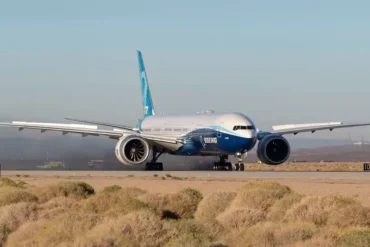
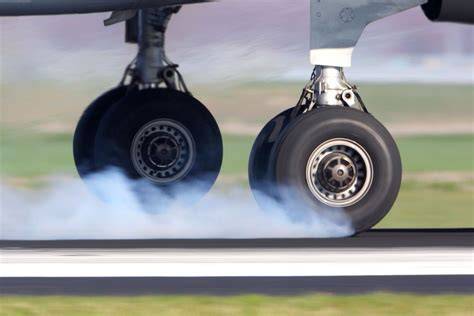
The mechanism is straightforward physics with expensive consequences. At the instant of touchdown, an aircraft’s tires are barely spinning; spooled up only by wind resistance during descent, they meet the pavement at a fraction of the aircraft’s forward speed. Within a fraction of a second, friction forces the wheels to accelerate to match ground speed, and the tire contact patch scrubs across the surface under enormous vertical load. That violent transition abrades a small quantity of rubber, which transfers onto the runway as a dark deposit. On a widebody such as the Airbus A380 or Boeing 747, the forces involved are substantial enough that each arrival contributes a disproportionately heavy layer of material.
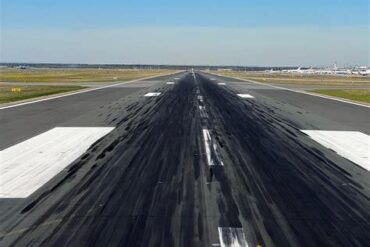
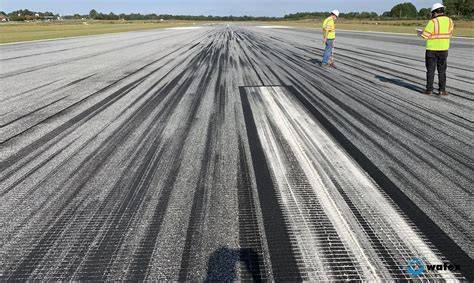
These deposits do not spread evenly. They concentrate in the touchdown zone, the stretch where main landing gear wheels first meet the pavement, generally extending roughly 150 to 450 meters beyond the runway threshold, though the precise footprint shifts with aircraft type, approach speed, landing technique, and wind conditions. Short-field landings push the contact point earlier; long, floaty flares carry it farther down the strip. Over months, the touchdown zone becomes a mosaic of overlapping rubber bands, each one a record of an individual arrival.
What makes the buildup insidious is how it interacts with pavement texture. Runway surfaces are engineered with microscopic roughness and, on many runways, saw-cut grooves that give tires something to bite into and give water somewhere to go. Rubber does not simply sit on top of this texture; the heat generated during touchdown helps bond it into the surface, and successive landings fill the small irregularities and grooves that do the gripping. The pavement has not changed, but its functional surface has been progressively buried.
How Rubber Buildup Degrades Aircraft Braking Performance
Runway friction is the product of tire rubber meeting a textured surface, and anything that smooths that interface weakens the braking equation. As rubber accumulates, it coats the microscopic texture of the pavement and clogs the grooves designed to channel water away from the tire contact patch. The result is a runway that looks intact but behaves like a much smoother surface, particularly in the touchdown zone where contamination is heaviest. Airport maintenance observations and research have documented friction levels in heavily rubbered touchdown zones running 15% to 30% lower than on cleaner sections of the same runway—a margin that matters enormously when a crew is trying to stop a fully loaded jet on a contaminated surface.
Wet weather turns this degradation into a genuine safety concern. When rain falls on a runway, the grooves and texture are what prevent a film of water from lifting the tires off the pavement. A tire that loses contact with the surface enters hydroplaning, a condition in which steering and braking authority deteriorate sharply because the rubber is effectively riding on water rather than asphalt or concrete. Rubber-clogged grooves eliminate the drainage paths that keep this from happening, so a runway that performs acceptably in dry conditions can become treacherous in a downpour. This is why rubber removal is treated as an operational safety measure rather than cosmetic housekeeping: the deposits do not just reduce grip in ideal conditions, they remove the margin that protects aircraft when conditions are at their worst.
How Airports Monitor Runway Friction Levels
Airport operators do not wait for the touchdown zone to turn visibly black before scheduling maintenance. Instead, they measure. Specialized friction-measuring equipment—continuous friction measuring devices and decelerometers towed or driven along the runway—quantify surface grip and identify where contamination or pavement wear has pushed friction toward unacceptable levels. The US Federal Aviation Administration provides the governing framework through its Advisory Circular 150/5320-12 series, which addresses the measurement and maintenance of skid-resistant airport pavement surfaces and gives operators a structured basis for deciding when intervention is required.
The guidance ties inspection frequency directly to traffic volume, because friction deteriorates in proportion to the number of landings a runway end absorbs. Runway ends receiving fewer than 15 daily jet landings warrant annual measurement; those seeing 31 to 90 move to quarterly assessments; 91 to 150 call for monthly checks; and ends handling more than 210 daily landings require weekly measurement. Aircraft size adds another variable, since widebody jets deposit rubber far more aggressively than narrowbodies. Where widebody aircraft account for more than 20% of landings on a given runway end, the FAA recommends stepping the inspection frequency up by one level. When measurements show friction has fallen below acceptable thresholds, the response is targeted rubber removal—far cheaper and faster than the pavement rehabilitation that would otherwise follow.
The Methods Used to Remove Runway Rubber
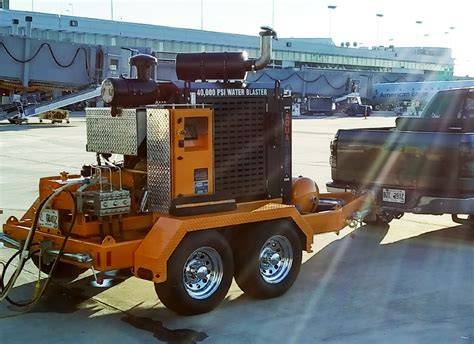
No single technique suits every runway, and the FAA recognizes several approved approaches: high-pressure water, chemical solvents, high-velocity impact using abrasive materials, and mechanical grinding. Each carries tradeoffs in effectiveness, speed, cost, and risk to the pavement beneath. High-pressure waterblasting dominates practice at major airports because it strips stubborn deposits while leaving the underlying concrete or asphalt largely intact. Purpose-built vehicles drive over contaminated areas directing powerful, tightly focused jets of water onto the surface, breaking rubber free and exposing the original texture and grooves. Chemical treatments, applied alone or in combination with waterblasting, loosen deposits before removal, but demand careful handling of runoff, environmental compliance, and compatibility with painted markings and pavement materials. Abrasive and mechanical methods can cut through the hardest deposits, yet they require strict control because aggressive treatment risks scouring the pavement itself. The governing principle across all four methods is the same: restore the existing surface texture, not remove layers of runway.
High-Pressure Waterblasting in Practice at Busy Airports
The operational reality of rubber removal is best understood through the constraints of a major airport, where the runway cannot simply be taken offline for a day. New York LaGuardia Airport (LGA) illustrates the discipline involved. In one documented operation, a contractor deployed equipment capable of spraying water at roughly 17,000 to 20,000 pounds per square inch, sometimes pairing the water with chemical solvents to improve removal. Crews worked within approximately five-hour overnight windows, when reduced traffic allowed sections of runway to be closed without disrupting the flight schedule. In a single night, a team could clean one touchdown zone measuring around 50 feet (15.24 meters) wide and 3,000 feet (914.4 meters) long—a substantial swath of pavement restored before the first morning arrival.
LaGuardia’s traffic profile explains the intensity of that schedule. The airport is dominated by narrowbody and regional jets, with Delta Air Lines holding a 42.8% market share, followed by American Airlines at 24.7%, Southwest at 9.2%, and United at 8.5%. Even without heavy widebody traffic, the sheer volume of arrivals generates enough rubber that the airport runs roughly five to seven cleaning events annually. Once a treated area is cleaned, maintenance teams inspect it and verify that friction has been restored to acceptable levels before the runway returns to full service.
Why Rubber Removal Must Not Damage the Runway Itself
Removing rubber is essential, but the process introduces its own maintenance hazard: protecting the pavement from the treatment. High-pressure water is remarkably effective, yet repeated blasting can gradually erode the surface, especially when equipment runs at unnecessarily high pressures or lingers in one spot. A December 2025 study conducted through Iowa State University’s Airport Concrete Pavement Technology Program examined best practices for runway rubber removal, weighing cleaning effectiveness against the cumulative wear that repeated treatments can inflict on pavement condition.
The study underscored that equipment calibration is decisive: water pressure, vehicle speed, nozzle positioning, and the number of cleaning passes all shape the final outcome, and procedures must be tailored to specific pavement types. Crucially, effective cleaning means removing rubber from within the grooves, not merely clearing it from the exposed surface, since surface-level cleaning leaves the drainage paths clogged while still abrading the pavement. The research also explored reducing operating pressures while maintaining cleaning effectiveness—an efficiency gain with real financial weight for airports that treat the same touchdown zones year after year. Preserving pavement integrity extends the life of existing runway infrastructure and defers expensive reconstruction, making calibrated, conservative rubber removal as much a capital-planning tool as a safety measure.
Balancing Safety, Pavement Life, and Operational Continuity
Runway rubber removal sits at the intersection of three competing pressures: the uncompromising need for braking friction, the long-term health of expensive pavement, and the operational reality of airports that cannot afford extended closures. The solution is a data-driven cycle—measure friction, clean the touchdown zones before degradation becomes critical, calibrate equipment to protect the surface, and verify restoration before reopening. Every dark band under an arriving jet’s wheels is a small subtraction from the runway’s grip, and every disciplined cleaning operation is the correction that keeps it safe. What looks like routine blacktop maintenance is, in functional terms, the difference between a jet that stops where it should and one that does not.