Two European carriers have turned the narrowbody jet into a genuine transatlantic workhorse, and in 2026 their nonstop US legs show how far that experiment has advanced. Iberia and Aer Lingus both deploy the Airbus A321XLR and the slightly shorter-legged A321LR across the Atlantic, and the longest of these services now stretches beyond nine hours of block time. What makes the deployment notable is not simply endurance but intent. The single-aisle jet lets an airline enter larger US markets without committing a widebody, or sustain a route to a smaller city whose demand would never fill a twin-aisle cabin. The aircraft has become a route-opening instrument rather than a compromise forced by fleet shortage.
The two airlines pursue visibly different strategies with the same pair of airframes. Aer Lingus uses its jets to open underserved markets, launching nonstop Irish links to cities that previously required a connection. Iberia has concentrated on slot-constrained gateways, flying the narrowbody into some of the world’s busiest airports where widebody capacity is difficult to secure and often unnecessary. That divergence is the real story of the 2026 schedule, because it shows the same technology being bent to two distinct commercial philosophies. One airline chases headcount; the other chases white space.
Iberia’s A321XLR Strategy Targets Hub Airports Rather Than Secondary Cities
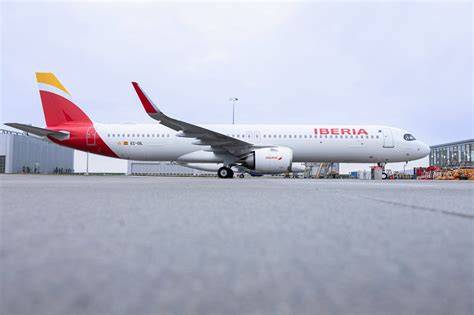
Iberia operates a fleet of eight A321XLRs, and its transatlantic strategy rests on using them to break into major US gateways. The carrier’s longest narrowbody service is the run from Adolfo Suárez Madrid-Barajas Airport (MAD) to Washington Dulles International Airport (IAD), a route with a block time of nine hours and 40 minutes. Operations began in April at three times weekly before accelerating to daily. Rather than merely substituting for a widebody, the Madrid–Washington corridor positions Iberia squarely inside the United States’ capital region, a market where frequency and timing matter more than raw seat count.
Another long Iberia service following the same gateway model is its route from Madrid to John F. Kennedy International Airport (JFK). The flight carries a block time of nine hours and 15 minutes, operates three times weekly, and accelerates to daily during the summer season. Competition on this corridor is understandably stiff: American Airlines, Delta Air Lines, and Air Europa all fly it nonstop. Iberia’s answer is not to match widebody capacity but to offer a tailored, high-frequency product on a route where the A321XLR’s economics allow it to compete profitably against larger rivals.
The aircraft also unlocks a broad set of destinations across South and Central America, particularly within the Spanish-speaking world. The carrier’s second-longest A321XLR route reaches Las Américas International Airport (SDQ) in Santo Domingo, Dominican Republic, with a block time of nine hours and 35 minutes, served daily year-round. A further example is the daily, year-round service from Madrid to Luis Muñoz Marín International Airport (SJU) in San Juan, Puerto Rico, the busiest airport in the Caribbean. These routes confirm that the jet is not a niche US-only tool but a flexible long-haul asset across the carrier’s entire network.
The Madrid–Toronto Corridor Shows a Hybrid Commercial Philosophy
Iberia’s strategy contains a hybrid element: using the A321XLR to reach large markets where its absence was genuinely surprising. The clearest demonstration is the new route from Madrid to Toronto Pearson International Airport (YYZ), with a nine-hour block time launching on June 13 this year. Toronto is hardly a secondary city, which makes the decision to serve it with a narrowbody all the more instructive. The plan called for five weekly departures and roughly 37,000 seats across the summer season, over a route of approximately 3,775 miles (6,075 km).
The schedule was engineered for connectivity rather than convenience alone. The inaugural flight departed at midday and arrived in Toronto in the afternoon, while the aircraft left Canada in the evening and reached Madrid the following morning. That timing allows passengers to connect onward from Madrid into Spain, Europe, and Africa, effectively turning a point-to-point service into a feed for Iberia’s hub. The route also restored Iberia’s presence in Canada after an absence of three decades, a milestone that underscores how the narrowbody reopened a market the airline had abandoned with widebodies.
On the Toronto corridor, Juan Cierco, Corporate Director at Iberia, said the route “also demonstrates how innovation can help bring new markets closer together and create new opportunities for travelers and businesses alike.” The competitive picture is formidable: Air Canada operates the same city pair with the higher-capacity Boeing 787-9 and Airbus A330-300. Iberia’s reply is not more seats per departure but a schedule built around connections, and a cabin that refuses to treat narrowbody long-haul as a concession.
Aer Lingus Opens Secondary US Cities That Widebodies Could Never Sustain
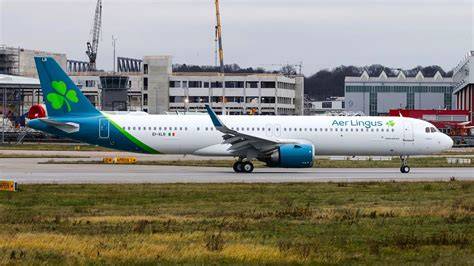
As the launch customer for the A321XLR, Iberia is obliged to be ambitious and pioneering in how it deploys the jet. Aer Lingus, the other European carrier flying the narrowbody transatlantic, takes the opposite approach, using the aircraft primarily to reach secondary cities. Its combined fleet of six A321XLRs and eight A321LRs opens markets that would not be sustainable with a higher-capacity, higher-operating-cost airliner. Every one of these jets is named after an Irish saint, a detail that lends the fleet a distinctly national identity.
The November schedule, drawn from Cirium aviation analytics data, shows how far those secondary markets extend. From Dublin (DUB), the longest route is to Nashville International Airport (BNA) at 3,906 miles (6,286 km) with 16 rotations, followed by Indianapolis International Airport (IND) at 3,717 miles (5,982 km) with 17. Raleigh-Durham International Airport (RDU) follows at 3,602 miles (5,797 km) and 18 rotations, with Cleveland Hopkins International Airport (CLE) at 3,466 miles (5,578 km) on the same frequency. Pittsburgh International Airport (PIT) adds 3,444 miles (5,543 km) across 16 rotations. These are precisely the markets a widebody could not fill on a daily basis.
The busier Dublin departures reveal where the Irish carrier leans on volume. Washington Dulles (IAD) sees 50 rotations, with Toronto (YYZ), Newark (EWR), and John F. Kennedy (JFK) each recording 30, and Philadelphia (PHL) 29. Dublin–Nashville carries the longest maximum block time at nine hours and 20 minutes, while Dublin–Barbados runs to nine hours and 10 minutes three times weekly. Lynne Embleton, Chief Executive of the airline, described the first arrivals as “a significant milestone,” adding that “the long-range capabilities of the XLR enable us to travel deeper into North America, offering previously unserved markets greater connectivity to Europe through our Dublin hub.”
Lie-Flat Business Class Redefines the Single-Aisle Atlantic Crossing
Long-haul narrowbody flying is often associated with a cramped cabin, closer to a cross-country bus journey than to long-haul aviation. Both carriers have pushed back against that expectation by installing lie-flat business class seats. Iberia’s A321XLRs offer 14 business class seats in a herringbone format suited to a narrow fuselage, based on the Thompson VantageSOLO platform. Economy seats measure 18 inches (45.7 cm) wide with 30 to 31 inches (76.2 to 78.7 cm) of pitch, while business class offers 23 inches (58.4 cm) of width and 76 inches (193 cm) of lie-flat space, across 168 economy seats.
Aer Lingus goes further, offering two more lie-flat seats than Iberia for a total cabin capacity of 184 seats: 16 business class and 168 economy class. These seats are made by Recaro, and the carrier uses the same layout on its A321LRs, although the Collins Aerospace Meridian is fitted instead. The result is a product that removes the principal objection to narrowbody transatlantic travel. Passengers on a nine-hour Dublin–Nashville crossing can recline fully, which matters enormously in a market where the competition for premium demand is as fierce as it is at the hubs.
The Aircraft Built for Low-Risk Long-Haul Route Openings
Airbus positions the A321XLR as a fusion of long-haul range and single-aisle economics. On its marketing pages, the manufacturer calls the jet “the perfect route opener with lower risk for point-to-point operations,” adding that it “opens new opportunities for nonstop flights linking primary and secondary cities all around the globe.” It also “complements widebody aircraft by serving the same routes at off-peak times,” which explains why Iberia can accelerate Madrid–JFK to daily in summer without disturbing its larger aircraft allocations.
The technical case is compelling. The A321XLR offers a range of up to 4,700 nautical miles (8,700 km) and a maximum capacity of 244 seats, compared with 4,000 nautical miles (7,400 km) for the A321neo and 3,400 nautical miles (6,300 km) for the A320neo. Departing Paris, for instance, it can reach West Coast destinations such as Vancouver. Airbus cites 30% lower fuel burn and CO2 emissions per seat and a 50% lower noise footprint, and the jet is already capable of operating on 50% sustainable aviation fuel, with the manufacturer aiming for 100% by 2030 across its output.
Iberia was the launch customer, and upon receiving the first jet in October 2024, Marco Sansavini, CEO and Chairman, said the airline was “very proud to be the launch airline for this new Airbus aircraft,” adding that “the A321XLR will allow us to reach new destinations, operating transoceanic routes and doing so in a more efficient way.” That ambition now plays out in a 2026 schedule where Madrid–Recife at nine hours and Madrid–Fortaleza at eight hours and 55 minutes sit comfortably within the jet’s envelope. The narrowbody has stopped being the future of transatlantic travel and become its present.