A scheduled Airbus A380 flight typically carries 20 to 30 crew members in total, split between the flight deck and a cabin team that dwarfs anything seen on a twin-engine widebody. Strip away the passengers, the premium suites and the service choreography, and the legal floor drops dramatically: 16 cabin crew for the aircraft as certified, plus a minimum of two pilots for piloting duties. The gap between that floor and the real-world staffing numbers is where the A380’s unusual labour economics live, shaped by exit-door geometry, installed seat counts, duty-time law, cabin segmentation and the service promises each operator has made to its customers.
The question resists a single headline answer because the superjumbo is not flown by a fixed crew complement in the way a smaller jet is. Crew numbers on the type are mission-contingent, meaning they scale with flight duration, seat density, the number of service cabins, and the rest facilities required for flights that stretch toward fifteen hours or beyond. Every one of the world’s A380 operators is a mainline long-haul carrier with a heavy premium cabin mix, and none of them runs the aircraft anywhere near the regulatory minimum. Understanding why requires walking through the aircraft’s certification, the arithmetic regulators use, the relief provisions for long sectors, and the commercial instincts that push staffing higher.
The A380 Was Certified as a Two-Pilot Aircraft
Airbus designed the A380 after the flight engineer’s station had been retired across the industry, so the type entered service as a two-crew fly-by-wire aircraft, flown by a captain and a first officer. Aircraft size does not enter into the pilot-count calculation; a 575-tonne double-decker needs no more pilots to operate than a narrowbody, because the regulatory framework counts time, not mass. The variable that changes flight-deck staffing is the flight duty period and the associated rest requirements, so the pilot count climbs from two to three or four as sector length grows.
Under FAA rules, flights of up to roughly eight hours can be flown by the standard two-pilot crew. Sectors lasting beyond that threshold require one relief pilot, and the longest missions, those extending past thirteen hours and toward seventeen, call for four pilots, typically one captain and three first officers or two captains. India’s Directorate General of Civil Aviation applies a subtly different standard, demanding at least two fully qualified captains on extended sectors, which is one illustration of how national authorities diverge on flight-deck composition even when the basic arithmetic is similar. In practice, the A380’s most demanding routes, such as Emirates’ services from Dubai to Sydney or Los Angeles, routinely carry an augmented crew of three or four so that pilots can rotate into the aircraft’s dedicated crew rest compartments without breaching fatigue limits.
Exit Doors, Not Soft Beds, Set the Cabin Crew Floor
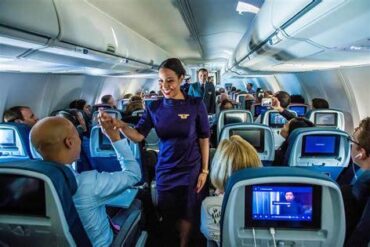
The statutory minimum for cabin crew on an A380 has almost nothing to do with the number of people on board and everything to do with certification for evacuation. Airlines must carry flight attendants whenever passengers are present in an aircraft with more than 19 passenger seats, and the count is driven by the 90-second evacuation rule, which demands that every exit be manned quickly enough to clear the aircraft. Because the A380 has two full passenger decks and main-deck gates at both ends, that door geometry produces a floor of 16 cabin crew, considerably higher than the eight or nine that a simple seat-count formula would suggest for Singapore Airlines’ 379-seat layout.
The one-flight-attendant-per-fifty-seats rule still applies as a parallel baseline. Under FAA logic, aircraft with 20 to 50 installed seats need one attendant, those with 51 to 100 need two, and one more is added for each additional fifty seats. Emirates’ densest configuration, seating 615 passengers, would need at least thirteen attendants on that formula alone, while a theoretical maximum-density A380 at 853 seats would require eighteen. Regulators also treat each deck as an independent cabin zone and insist that attendants be uniformly distributed so evacuation flow is not compromised, which prevents an airline from satisfying the minimum by clustering its crew in the premium cabins and leaving economy thin. Crew may move around the aircraft to serve meals, but when the seat belt sign illuminates they must return to their assigned door stations, and that spatial obligation keeps the effective minimum above the bare arithmetic.
Long-Haul Duty Limits Add Relief Cabin Crew
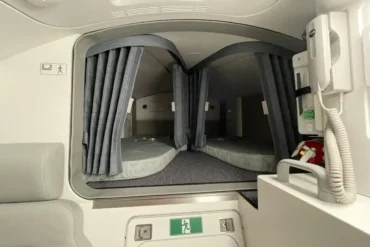
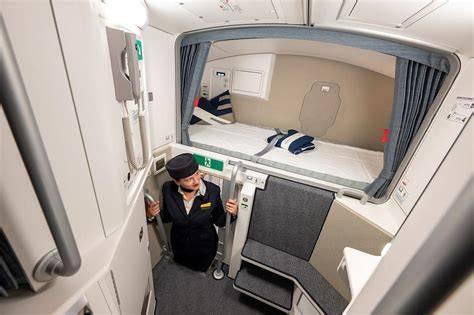
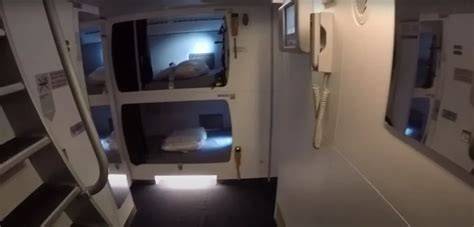
Flight duration governs the flight duty period, the maximum window from pre-flight check-in to post-flight release during which a crew member may work. For cabin crew, FAA rules in 14 CFR § 121.467 set a standard scheduled duty cap around fourteen hours, with graduated additions beyond that: one extra attendant for duty periods between fourteen and sixteen hours, two more between sixteen and eighteen, and three more between eighteen and twenty. The A380’s route network, dominated by ultra-long sectors, sits comfortably in that territory, so carriers routinely roster augmented cabin crew alongside relief pilots and couple the extra bodies with dedicated rest facilities, including the windowless bunk modules tucked into the rear of the main deck.
European rules under EASA follow the same basic philosophy with a different set of fatigue-management parameters, and national authorities worldwide rarely stray far from the fifty-seat ratio in their base requirements. The meaningful divergence appears in duty-time limits, rest provisions, and labour agreements: in the United States and Europe, union contracts frequently add crew beyond the FAA or EASA floor as a bargaining term, while in the UAE carriers negotiate no such collective arrangements and rely directly on regulatory minimums plus their own service standards. That structural difference matters because more than half the global superjumbo fleet is based in the Emirates, where the General Civil Aviation Authority writes rules tailored to 24/7 hub-and-spoke waves, late-night departures and vast time-zone jumps.
Why Emirates, British Airways and Etihad Staff the A380 So Differently
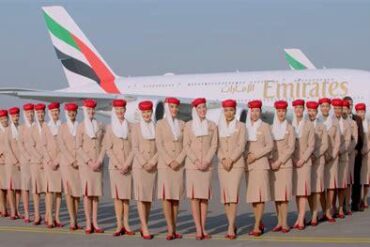
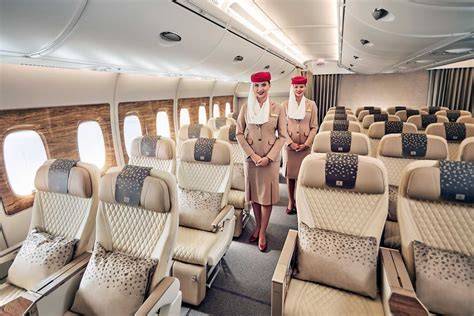
Real A380 crew numbers are rarely published by airlines, but the operator with the largest fleet has had its staffing documented more thoroughly than most. Emirates is generally understood to fly its A380s with roughly 26 cabin personnel, often described as two pilots and 24 cabin crew, with the split shifting according to configuration and sector. On ultra-long-haul services to Sydney, two relief pilots are added while cabin crew numbers typically stay constant, pushing the total toward 28 crew. British Airways takes a leaner approach on the same aircraft, with crew reporting about 22 cabin crew on the A380 against eight to thirteen on its 787, 777 and A350 widebodies, and a flight deck of two to four pilots depending on the route.
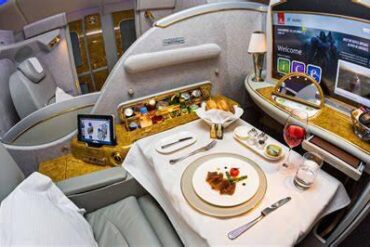
The reconciliation between those figures and the 16-person legal minimum lies in cabin segmentation. A mainline long-haul carrier typically allocates one attendant per 35 to 50 economy passengers, one per 12 to 18 business class passengers, and one per three to six first class passengers. Etihad goes further still with The Residence, its three-room apartment on the A380 upper deck, which comes with a personal butler and is advertised on the strength of that individualised service. Singapore Airlines, whose 379-seat A380 layout includes twelve suites and 86 business seats, faces the same premium-heavy arithmetic. When an operator sets aside a floor of attendants for economy to satisfy the distribution principle, every additional premium cabin adds its own complement, and the total climbs past twenty without anyone exceeding the service brief.
| Cabin crew figure | What it represents |
|---|---|
| 16 | Statutory minimum set by A380 exit-door certification |
| 18 | Seating-based minimum for a hypothetical 853-seat layout |
| 20–26 | Typical range across mainline operator service standards |
| 24 | Reported Emirates cabin crew complement, A380 |
| 22 | Reported British Airways cabin crew complement, A380 |
The Flight-Deck and Cabin Totals in Practice
Pulling the pieces together, a standard Emirates A380 long-haul flight carries two to four pilots and roughly 24 cabin crew, landing at 26 to 28 people in total, while British Airways pairs two to four pilots with about 22 cabin crew for a total of 24 to 26. Ferrying an A380 without passengers, or moving it on a test flight, legally requires only the two-person flight deck, which is why flight-tracking sites sometimes show a superjumbo operating with fewer crew than a scheduled A320. The moment passengers board, however, the exit-door minimum and the duty-time framework take over, and the aircraft becomes one of the most crew-intensive airliners in service relative to its passenger capacity.
That economics explains why the A380 has never made sense for a low-cost operating model and why only mainline carriers with dense premium cabins ever ordered it. The aircraft demands a crew complement of between twenty and thirty people on a typical long-haul mission, and that number reflects three separate regulatory systems layered on top of one another: the evacuation-driven door minimum, the seat-count ratio, and the fatigue framework that governs how long each person may work. Mission, service standard, national law and labour contract each push the figure, and the superjumbo’s answer to the question of how many crew members it takes to fly it is, in the end, always a range.