The Airbus A350-1000 is widely recognized for its advanced aerodynamics, fuel efficiency, and exceptional passenger comfort, yet one of its most fascinating features remains almost completely invisible to travelers. Hidden behind discreet doors and tucked inside spaces few passengers ever notice are dedicated crew rest compartments designed to support the demanding realities of ultra-long-haul flying.
These concealed areas are far more than simple sleeping quarters. They represent an essential component of modern airline operations, allowing flight crews to remain alert throughout journeys that can exceed fifteen hours. Carefully engineered to maximize every available cubic inch of space, the crew rest facilities on the A350-1000 demonstrate how aircraft designers balance safety, efficiency, comfort, and operational flexibility within one of the world’s most sophisticated commercial airliners.
Unlike passenger cabins that showcase premium seats, mood lighting, and expansive entertainment systems, these secluded compartments prioritize something far more valuable to a working crew: uninterrupted rest.
Why Modern Long-Haul Aircraft Need Dedicated Crew Rest Areas
Commercial aviation regulations around the world recognize that fatigue represents one of the greatest risks to flight safety. Operating an aircraft for more than a dozen hours requires sustained concentration from pilots while cabin crew continue serving passengers, responding to emergencies, and maintaining cabin security throughout the flight.
Rather than expecting crews to remain continuously awake, airlines schedule augmented crews on longer sectors. Additional pilots and flight attendants rotate through structured rest periods, ensuring that every operational position remains staffed by alert personnel.
The concept extends well beyond simple convenience. Scientific research into fatigue has shaped international regulations that specify duty limits, mandatory rest periods, and acceptable onboard sleeping facilities. Dedicated crew rest compartments enable airlines to operate non-stop routes linking cities separated by thousands of miles without compromising operational safety.
These hidden spaces effectively transform the aircraft into a self-contained workplace capable of supporting human performance over exceptionally long durations.
How Crew Rest Compartments Differ Between Pilots and Cabin Crew
Although passengers rarely see either facility, pilot and cabin crew rest compartments serve different operational purposes and therefore feature different layouts.
Pilot rest areas are intentionally compact and exceptionally quiet. Located near the front of the aircraft, they usually contain two lie-flat bunks alongside a comfortable seat where one pilot can remain awake while another sleeps. Their proximity to the flight deck allows rapid access should operational conditions require an immediate crew change.
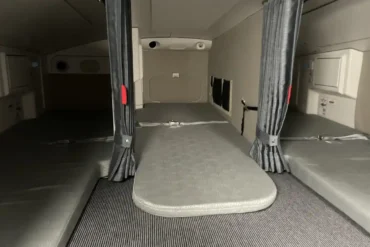
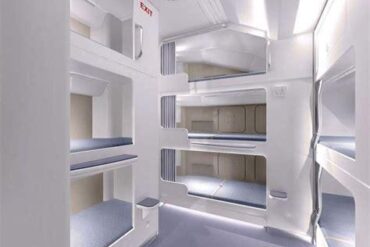
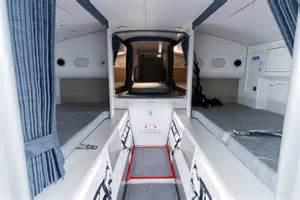
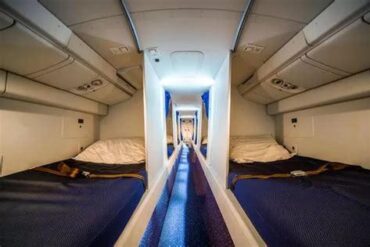
Cabin crew rest modules are designed quite differently. Flight attendants rotate in larger groups, requiring multiple sleeping spaces arranged efficiently within the aircraft. Instead of private rooms, airlines generally install stacked bunk arrangements separated by curtains that provide privacy while maximizing available volume.
Each bunk typically includes:
- Individual reading lights
- Adjustable ventilation outlets
- Personal storage pockets
- Safety restraints for turbulence
- Oxygen equipment
- Crew communication systems
These amenities may appear modest compared with passenger accommodations, yet every feature has been carefully selected to promote meaningful sleep at cruising altitude.
The Airbus A350-1000’s Hidden Overhead Crew Rest Compartment
One of the most ingenious design features of many Airbus A350-1000 aircraft is the use of the crown area above the passenger cabin.
Rather than allowing the curved upper fuselage to remain unused, Airbus transformed this otherwise inaccessible volume into functional accommodation for cabin crew. From the passenger perspective, the compartment is almost impossible to detect. Access usually occurs through a discreet staircase concealed near a galley or service door, allowing crew members to enter and leave without disturbing passengers.
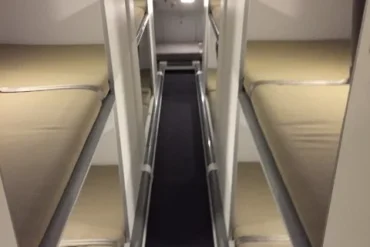
Inside, the geometry immediately reveals the aircraft’s distinctive fuselage shape. Because the compartment follows the curvature of the upper fuselage, ceilings gradually taper toward the sides while central walkways provide sufficient headroom for movement.
Sleeping bunks line both sides of the compartment in an efficient stacked arrangement. Heavy curtains separate each berth, reducing light and providing visual privacy. Soft lighting replaces the brighter illumination found in the passenger cabin, while sound insulation helps reduce engine noise and cabin activity below.
Although compact, the atmosphere feels purpose-built rather than improvised. Every available surface contributes to functionality without wasting valuable space.
Why Some Airlines Choose Lower-Deck Crew Rest Modules
Not every airline configures its A350-1000 in exactly the same manner.
Depending on mission requirements, cabin layouts, and cargo priorities, some operators install crew rest compartments beneath the main passenger deck instead of within the overhead crown.
This arrangement offers several operational advantages. Because the module sits below the passenger cabin, it benefits from improved acoustic isolation, fewer disturbances from passenger movement, and more consistent environmental conditions.
The trade-off is cargo capacity.
Every cubic meter allocated to crew accommodation beneath the cabin reduces available freight volume, an important consideration for airlines carrying high-value cargo alongside passengers. Operators therefore evaluate their route structures carefully before selecting one configuration over another.
Ultra-long-haul services where crew recovery becomes especially critical often justify sacrificing a portion of cargo space in exchange for superior sleeping conditions.
Inside the Pilot Rest Area Near the Flight Deck
Separate from the cabin crew facility lies another hidden compartment reserved exclusively for flight crew.
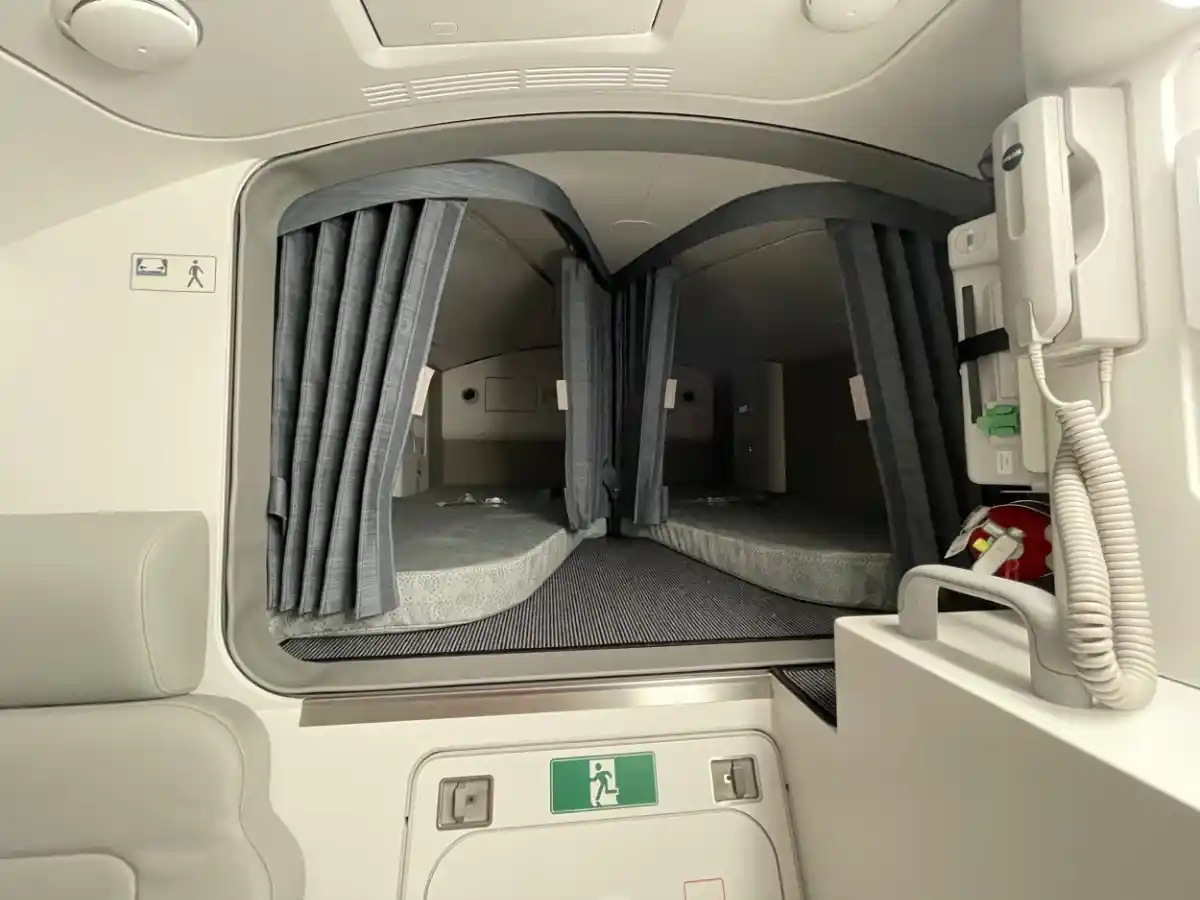
Positioned near the cockpit, the pilot rest area allows rapid access to the flight deck while maintaining complete separation from passenger activity. Although considerably smaller than the cabin crew compartment, its design emphasizes quietness above all else.
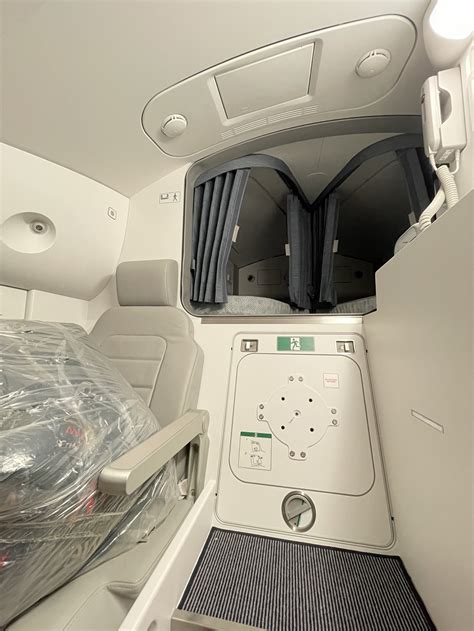
Typically, the compartment contains two bunk-style beds fitted with thin yet supportive mattresses. Curtains surround each berth, minimizing light exposure while providing privacy. A comfortable seat allows one pilot to remain awake if necessary while another sleeps.
Unlike passenger seating, these bunks permit genuine horizontal rest. For pilots managing demanding flight phases over oceans or polar routes, restorative sleep significantly improves alertness during later stages of flight.
The environment is intentionally simple. Decorative elements are absent because functionality remains the overriding objective.
Engineering Hidden Space Inside the Aircraft
Creating concealed living space within an aircraft presents significant engineering challenges.
Every additional compartment affects structural loads, wiring routes, environmental control systems, emergency evacuation procedures, and aircraft weight distribution. Airbus therefore integrates crew rest facilities into the airframe from the earliest stages of aircraft development rather than treating them as optional additions.
Environmental systems continuously circulate conditioned air through the compartment while maintaining appropriate temperature and humidity. Emergency oxygen systems remain immediately accessible should cabin pressure decrease unexpectedly.
Fire detection sensors monitor enclosed spaces constantly, while communication systems connect resting crew directly with active crew members.
The result is an integrated system that supports both operational efficiency and regulatory compliance without compromising passenger space.
How Crew Rest Rotations Work During Ultra-Long-Haul Flights
A successful crew rest strategy depends on careful scheduling rather than spontaneous breaks.
Following departure, cabin crews usually complete the initial meal service before rest rotations begin. One group continues serving passengers while another proceeds to the designated sleeping area.
After several hours, responsibilities reverse.
This rotation ensures continuous cabin coverage while allowing every crew member sufficient recovery before the next major service period.
Pilots follow a similarly structured schedule determined by flight duration, expected workload, weather conditions, and regulatory requirements. One or more pilots remain on the flight deck while colleagues rest according to carefully planned intervals.
These rotations are coordinated well before departure and remain flexible enough to accommodate operational changes if necessary.
Sleeping at 35,000 Feet Is Harder Than It Sounds
Possessing a comfortable bunk does not automatically guarantee quality sleep.
Aircraft remain noisy environments despite extensive insulation. Engine vibrations, airflow, occasional turbulence, and changing cabin pressures all influence sleep quality. In addition, crossing multiple time zones disrupts natural circadian rhythms, making it difficult for many crew members to fall asleep on command.
Some individuals use eye masks and earplugs to improve rest, while others rely on relaxation techniques developed through years of long-haul flying.
When sleep proves impossible, quiet activities such as listening to music or simply resting with closed eyes still provide valuable recovery before returning to duty.
Professional crews become remarkably skilled at maximizing whatever rest opportunity their schedule allows.
Fatigue Management Extends Beyond the Aircraft
Crew rest compartments represent only one element of a much broader fatigue management strategy.
Before departure, many crew members deliberately adjust their sleep schedules to match expected duty periods. Following arrival, recovery often becomes the highest priority, particularly after overnight flights spanning multiple continents.
Hydration remains equally important, as cabin humidity at cruising altitude can contribute to dehydration. Nutritious meals, moderate physical activity, and exposure to natural daylight all help accelerate adaptation to new time zones.
Some crews attempt to synchronize immediately with local time, while others remain aligned with their home schedule during shorter layovers. Individual approaches vary depending on route structure and personal preference.
Airlines increasingly incorporate fatigue science into operational planning, recognizing that human performance directly influences flight safety.
How the Airbus A350-1000 Compares with Other Widebody Aircraft
Most modern long-haul aircraft feature dedicated crew accommodations, but layouts differ considerably.
The Boeing 787 typically positions its cabin crew rest area near the rear of the aircraft with overhead access, while pilot accommodations remain near the cockpit. Earlier Airbus A330 and A340 aircraft often locate cabin crew facilities beneath the passenger floor.
Aircraft lacking dedicated compartments adopt alternative solutions. Certain Boeing 767 operators reserve specially configured passenger seats for resting flight attendants, while pilots may occupy premium-class seats during scheduled breaks.
These arrangements satisfy regulatory requirements but cannot match the privacy or sleeping quality provided by purpose-built bunks.
The A350-1000 therefore occupies a particularly advanced position among contemporary long-haul aircraft, combining efficient use of internal space with highly refined crew accommodations.
The Airbus A380 Raises Crew Comfort to Another Level
If the A350-1000 demonstrates intelligent use of limited space, the Airbus A380 showcases what becomes possible when space is abundant.
The world’s largest passenger aircraft accommodates substantially larger crew complements, requiring correspondingly larger rest facilities. Many A380 configurations include ten to twelve bunk spaces for cabin crew, far exceeding the capacity available aboard most twin-engine widebody aircraft.
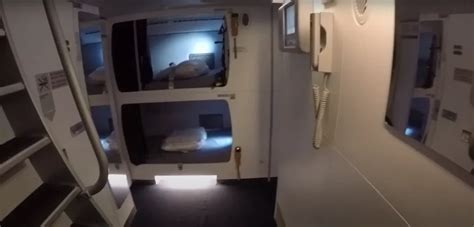
Additional room allows wider passageways, improved storage, and greater separation between bunks. Individual reading lights, electrical outlets, communication systems, oxygen equipment, and safety features remain standard throughout the compartment.
Although more spacious, the underlying philosophy remains identical to that of the A350-1000: provide crews with an environment that supports meaningful rest, enabling them to perform demanding duties safely throughout some of the world’s longest commercial flights.
Hidden Spaces That Make Ultra-Long-Haul Aviation Possible
Passengers boarding an Airbus A350-1000 rarely realize that an entire secondary environment exists just beyond the visible cabin. Above their heads or beneath their feet, carefully engineered compartments quietly support the professionals responsible for operating the flight.
These hidden spaces rarely appear in airline marketing campaigns, yet they represent one of the aircraft’s most important operational innovations. Every discreet staircase, insulated bunk, ventilation outlet, and communication panel contributes to a sophisticated fatigue-management system that enables airlines to connect distant continents nonstop.
As airlines continue expanding ultra-long-haul networks, crew wellbeing will remain inseparable from operational safety. The Airbus A350-1000’s concealed rest areas demonstrate that aviation innovation is not always measured by what passengers can see. Sometimes the most remarkable engineering achievements are the ones deliberately hidden from view, working silently behind the scenes to ensure that every long-haul journey concludes as safely as it began.