Long-haul aviation is as much about managing human endurance as it is about moving an aircraft across continents. On flights that stretch well beyond twelve hours, the physical and cognitive performance of cabin crew becomes a decisive factor in safety, service quality, and operational reliability. The Airbus A350 was conceived in an era when ultra-long-haul routes were no longer niche experiments but a growing part of global networks, and its approach to crew rest reflects that reality in meticulous detail.
While passengers experience quieter cabins, improved air quality, and smoother pressurization, an entirely separate ecosystem operates out of sight. This ecosystem exists to manage fatigue, preserve alertness, and ensure that cabin crew can perform complex safety-critical tasks even at the end of a demanding duty cycle. Understanding how cabin crew rest and sleep on the Airbus A350 reveals how aircraft design, regulation, and human factors engineering intersect behind the scenes.
On modern long-haul operations, cabin crew are not simply “off duty” when they are not visible in the aisle. Their rest is planned, protected, and embedded into the aircraft itself. The A350 does not rely on improvisation or blocked seats to manage fatigue. Instead, it integrates purpose-built rest facilities that allow real sleep, aligning aircraft architecture with the biological realities of long-duration flight.
Fatigue in the cabin environment is uniquely challenging. Unlike pilots, whose workload fluctuates with phases of automation and monitoring, cabin crew remain physically active for much of the flight. Meal services, cabin checks, passenger assistance, and safety monitoring continue for hours, often during circadian low points when the human body is naturally primed for sleep. Without structured rest, performance degradation is inevitable. The A350’s crew rest concept exists to prevent that outcome, not merely to soften it.
Why Rest Is a Safety System, Not a Luxury
Cabin crew rest on the Airbus A350 is governed by the same safety logic that underpins flight deck rest. Extended wakefulness directly affects reaction time, decision-making, and situational awareness, all of which are critical in abnormal or emergency scenarios. A medical event over the Pacific or turbulence at cruise altitude demands immediate, composed action, regardless of how many hours the crew has already been awake.
The length of typical A350 missions magnifies this challenge. Routes regularly exceed twelve hours, with some approaching the upper limits of commercial endurance. Over these durations, cumulative fatigue becomes a risk factor unless actively managed. This is why aviation authorities treat in-flight rest as a regulatory requirement rather than an operational preference.
What makes the A350 particularly relevant is that it was designed with these missions in mind from the outset. Rather than adapting an older airframe to new operational realities, Airbus integrated crew rest provisions into the aircraft’s baseline architecture. This ensures that rest is effective, compliant, and repeatable across fleets and operators.
The emphasis is on horizontal sleep, not passive rest. Research consistently shows that meaningful recovery requires the ability to lie flat in a low-stimulation environment. The A350’s crew rest compartments exist to deliver exactly that, shielding cabin crew from light, noise, and interruption during scheduled rest periods.
Where Cabin Crew Sleep On The Airbus A350
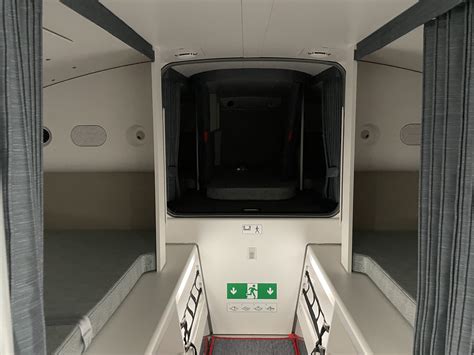
Unlike short- and medium-haul aircraft, the Airbus A350 incorporates dedicated cabin crew rest compartments that are physically separated from passenger seating. These areas are not visible during normal operations and are accessed discreetly from galley or service zones.
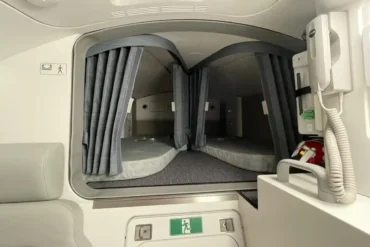
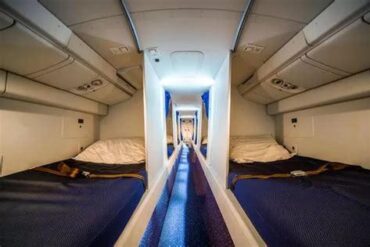
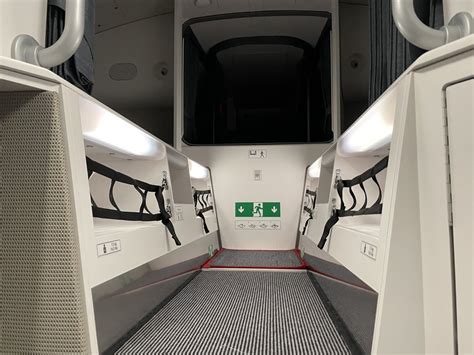
On many A350-900 and A350-1000 aircraft, the most common configuration places the cabin crew rest area in the overhead crown space above the economy cabin. This region, unused for passengers, is transformed into a compact but carefully engineered sleeping module. A narrow staircase or ladder leads upward, keeping crew movement unobtrusive and preserving cabin calm.
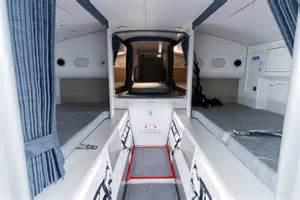
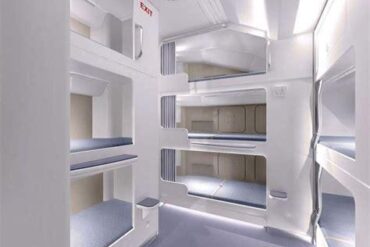
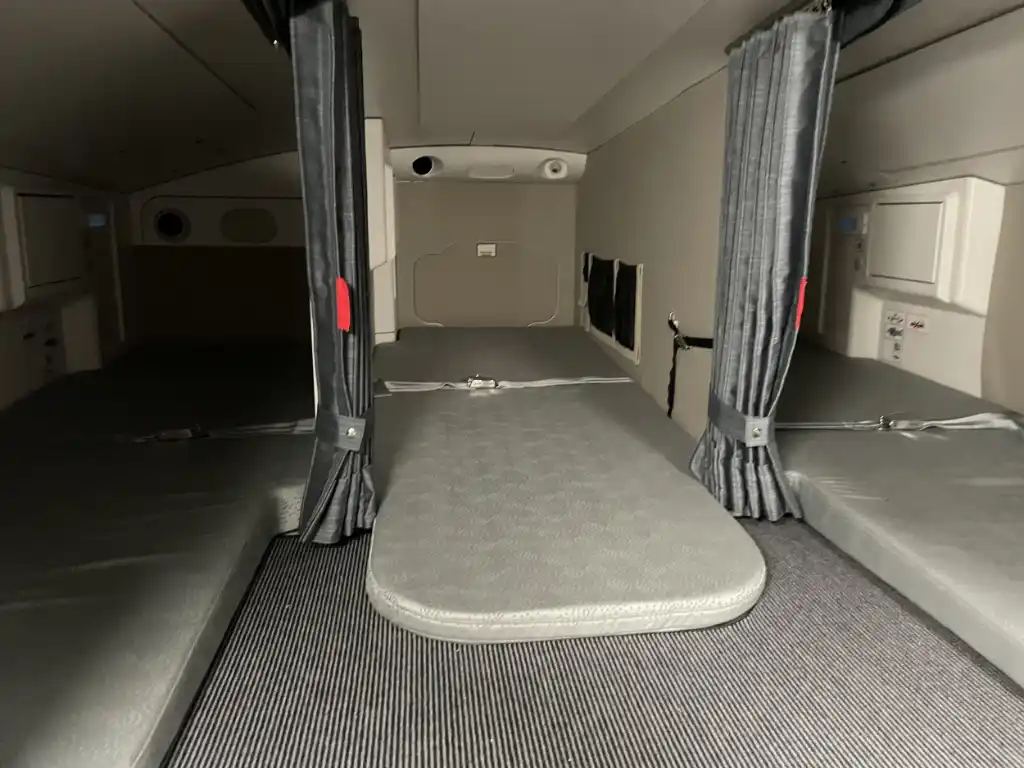
Inside, the environment is purpose-built for sleep. Individual bunks are arranged in a staggered layout to maximize space efficiency while maintaining privacy. Each bunk typically includes a proper mattress, restraint system, adjustable ventilation, reading light, and small storage compartments. Privacy curtains and subdued lighting create a cocooned atmosphere that allows crew to disconnect from the operational rhythm of the cabin below.
Some airlines opt for lower-deck crew rest compartments, accessed via stairs leading beneath the main cabin floor. These installations offer even greater isolation from cabin noise and vibration, though they come at the cost of reduced cargo volume. For ultra-long-haul routes, the trade-off is often justified by the quality of rest achieved.
Regardless of location, the philosophy remains consistent. These are not improvised sleeping areas but certified rest environments designed to support real sleep cycles. Every aspect, from airflow to lighting, is optimized for recovery rather than convenience.
How Rest Rotations Are Planned During Flight
Cabin crew on the Airbus A350 do not rest randomly or opportunistically. Rest is managed through structured rotation systems that are planned before the flight ever departs. Airlines roster more cabin crew than the minimum required, allowing a portion of the team to be off duty while the remainder maintains full cabin coverage.
Typically, the crew is divided into at least two groups. These groups rotate through duty and rest phases, ensuring that experienced staff are always present in the cabin while others recover in the rest compartment. The timing of these rotations is carefully chosen, often aligning with quieter phases of the flight such as post-meal cruise periods or overnight segments.
Rest is taken in extended blocks rather than short naps. This approach allows crew members to enter deeper stages of sleep, which are essential for cognitive recovery. A fragmented rest strategy would offer little protection against fatigue on flights of this length.
The return from rest is equally deliberate. Crew members are given time to reorient, hydrate, and prepare before resuming duties. This transition period helps ensure alertness and situational awareness when they re-enter the operational environment of the cabin.
The effectiveness of these rotations lies not only in their duration but in their timing. Aligning rest with circadian low points maximizes recovery, enabling cabin crew to perform effectively during critical phases such as turbulence encounters or pre-arrival preparation.
Regulations That Shape Crew Rest Design
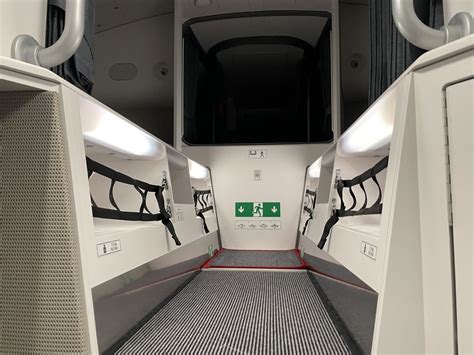
Behind every aspect of cabin crew rest on the Airbus A350 is a dense regulatory framework. Aviation authorities worldwide impose strict limits on duty time and mandate minimum rest provisions to prevent fatigue-related performance degradation.
These regulations do not simply specify how long a crew member may work. They also define the quality of rest required. Rest facilities must allow meaningful sleep, not merely the absence of duties. This is why airlines cannot rely on empty passenger seats or curtained-off cabin areas for long-haul operations.
Many operators supplement regulatory minimums with Fatigue Risk Management Systems (FRMS). These systems use scientific data, operational experience, and crew feedback to refine rest strategies based on route length, time zone crossings, and reporting times. On the A350, FRMS often informs how rest compartments are used and how rotations are scheduled.
The presence of certified crew rest compartments simplifies compliance. Airlines can demonstrate that their crews have access to environments specifically designed for sleep, reducing regulatory risk and enhancing operational resilience. In this sense, the A350’s rest architecture is not just a comfort feature but a compliance enabler.
Why Passengers Rarely See Crew Rest Areas
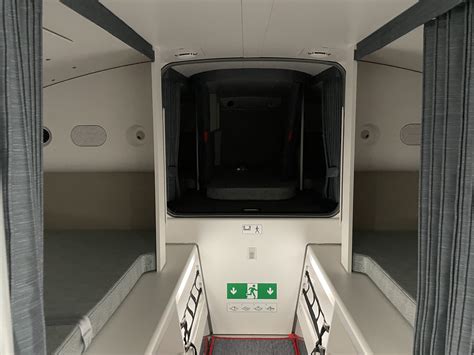
For passengers, the existence of crew rest compartments on the Airbus A350 often remains abstract. These spaces are intentionally hidden from view, with access points located near galleys or service doors rather than passenger aisles. Movement to and from rest areas is kept discreet to maintain a calm cabin environment.
Access restrictions are also a matter of certification and safety. Crew rest compartments have specific occupancy limits, emergency equipment, and procedures that differ from passenger areas. Allowing passenger access would disrupt rest schedules and compromise fatigue management plans.
Occasional glimpses of these compartments usually come from aircraft factory tours or maintenance videos, not from commercial flights. In everyday service, they function as controlled operational zones, much like avionics bays or flight deck rest bunks. Their invisibility is a feature, not an oversight.
The Airbus A350 As A Long-Haul Standard
Cabin crew rest on the Airbus A350 represents a broader shift in how the industry approaches long-haul operations. Rather than treating fatigue as an operational inconvenience, the aircraft embeds fatigue mitigation directly into its design. Dedicated rest compartments, structured rotations, and regulatory alignment work together as a cohesive system.
As airlines continue to expand ultra-long-haul networks, these systems become increasingly important. Flights spanning multiple time zones and operating overnight demand more than endurance; they require carefully engineered recovery strategies. The A350 delivers this through a combination of thoughtful design and operational flexibility.
For passengers, these hidden systems translate into consistent service, calm responses to unexpected events, and a cabin crew that remains attentive even after many hours in the air. For airlines, they enable sustainable long-haul operations without compromising safety or crew wellbeing.
Looking ahead, the principles demonstrated by the Airbus A350 are likely to influence future widebody designs. As commercial aviation continues to push geographic boundaries, the ability to support human performance over extreme durations will remain central. Cabin crew rest and sleep, once an afterthought, now stand as a defining feature of modern long-haul aircraft architecture.