The romance of long-haul flight is usually sold from a passenger’s point of view: dimmed cabin lights, movies on demand, and the gentle hum of engines crossing oceans. For cabin crew, the same journey is a carefully choreographed endurance exercise. On ultra-long sectors flown by the Boeing 777X, rest is not a luxury or a perk—it is a regulated, engineered, and safety-critical system designed into the aircraft itself.
Long before passengers board, the question of how and where cabin crew will rest and sleep has already shaped aircraft architecture, certification rules, and operational planning. The 777X represents the most advanced expression of this thinking yet, blending decades of long-haul experience with new regulatory flexibility and smarter cabin design. Understanding how crew rest works on this aircraft means peeking behind doors most travelers never notice.
Modern aviation accepts a simple truth: alert crews save lives. The longer the flight, the more structured rest becomes. On routes stretching well beyond ten or even sixteen hours, rest is not improvised with empty seats and blankets. It is purpose-built, certified, and hidden in plain sight.
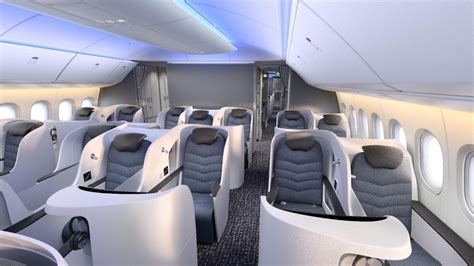
What a Crew Rest Area Really Is—and Why It Exists
A crew rest area is a dedicated, access-controlled space designed exclusively for off-duty flight or cabin crew during a flight. These compartments are strictly prohibited to passengers and are treated, from a regulatory standpoint, almost like miniature cabins within the aircraft.
On widebody jets such as the Boeing 777X, two separate rest zones exist: one for the flight crew and one for the cabin crew. Their separation is deliberate. Pilots must remain close to the flight deck to return to duty quickly, while cabin crew rest areas are positioned farther aft to minimize disturbance and make efficient use of space.
Rest periods are allocated based on flight length and crew augmentation. On ultra-long-haul flights, individual rest breaks can range from roughly one hour to more than three hours per crew member. The scheduling is precise, designed to ensure that fresh crew are always available during critical phases of service and emergencies.
Every detail inside these spaces serves a purpose. Bunks are fitted with seatbelts, not for comfort but for turbulence safety. Intercom systems connect resting crew to the active team. Seatbelt signs, oxygen masks, smoke detectors, and fire extinguishers are mandatory. Even sleep, at 40,000 feet, is regulated.
FAA Crew Rest Classifications and Where the 777X Fits
The Federal Aviation Administration defines three classes of crew rest facilities, a framework that explains why the 777X looks the way it does behind the scenes.
Class One facilities are fully enclosed rest areas with bunks. These are the gold standard for long-haul operations and the primary solution used on the 777X for both pilots and cabin crew. They offer horizontal sleep, sound insulation, and controlled lighting and temperature.
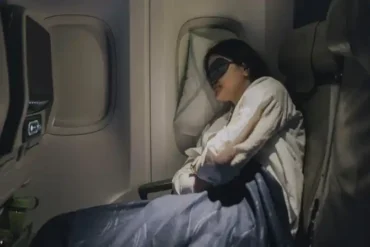
Class Two rest is limited to flat-bed business-class seats and is reserved for flight crew only. These seats can recline fully but lack the privacy and isolation of a true rest compartment.
Class Three rest consists of economy seats with additional recline and curtains, typically used for cabin crew on older aircraft where space constraints prevent dedicated bunks.
The Boeing 777X relies almost entirely on Class One crew rest, a recognition that its mission profile includes some of the longest commercial routes on Earth. Airlines operating this aircraft are not planning short hops; they are planning endurance flights that demand genuine sleep, not strategic napping.
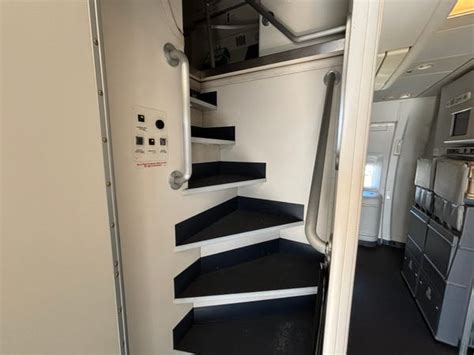
Inside the Cabin Crew Rest Area on the Boeing 777X
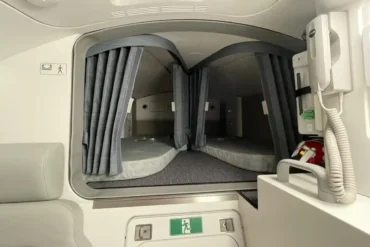
For cabin crew, the rest area on the 777X is typically located at the rear of the aircraft, often integrated above or adjacent to the cargo hold. Access is discreet: a concealed door and a narrow, steep staircase that feels more like a ship’s ladder than part of a luxury airliner.
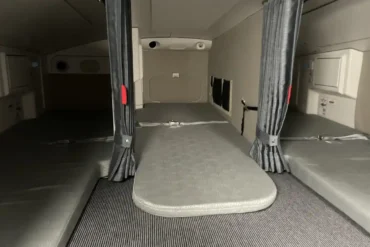
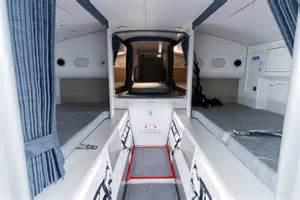
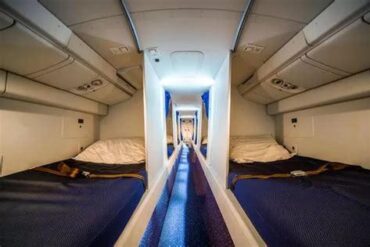
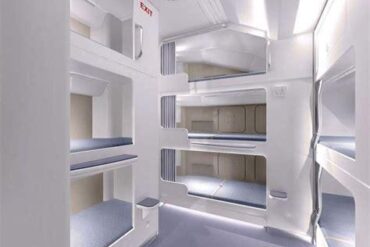
Inside, the space is compact but purposeful. Depending on airline configuration, the cabin crew rest area usually contains eight to ten bunk beds arranged either in a staggered “one-up, one-down” layout or in the narrow, aisle-separated configuration informally nicknamed “coffin style.” The term sounds grim, but it reflects efficiency rather than discomfort.
Each bunk includes a padded mattress, a reading light, airflow control, and a privacy curtain. Blankets and pillows are standard, and sound-dampening materials help isolate the space from galley noise and engine hum. The result is surprisingly quiet, a crucial factor when trying to sleep during daylight hours over the Pacific.
Compared to passenger cabins, the rest area can feel claustrophobic. There are no windows, and headroom is limited. Yet for crew working a fourteen-hour duty day, horizontal rest in darkness is vastly more restorative than reclining in a seat surrounded by passengers.
The Flight Crew Rest Area and a Quiet Regulatory Revolution
The flight crew rest area on the Boeing 777X sits overhead, closer to the cockpit, embedded in the aircraft’s crown. This location minimizes response time if pilots are needed urgently, while keeping the space acoustically isolated from the main cabin.
What makes the 777X especially notable is not just the design, but the rules governing its use. Traditionally, crew rest compartments could not be occupied during taxi, takeoff, or landing. The logic was straightforward: evacuation complexity and risk.
On the Boeing 777-9, however, the FAA introduced special certification conditions allowing the overhead flight crew rest area to be occupied during these critical phases—under strict limitations. Only the seats, not the bunks, may be used, and only by a maximum of two crew members.
This change reflects a broader shift in aviation reality. Aircraft like the 777X are designed for missions so long that crew rotation begins almost immediately after departure. Allowing limited occupancy during taxi and landing improves scheduling flexibility without compromising safety, provided evacuation routes, signage, and training meet enhanced standards.

Safety Systems That Never Sleep
Rest areas may feel secluded, but they are among the most heavily monitored spaces on the aircraft. Smoke detection systems continuously sample the air. Emergency oxygen masks are installed not just at bunks, but also in small lavatory or sink areas when fitted. Fire extinguishers are mounted within arm’s reach.
Seatbelt signs apply just as strictly here as in the passenger cabin. In turbulence, sleeping crew must be restrained. Communication lines ensure that a resting crew member can be summoned instantly, and that they can monitor announcements or alarms if needed.
Emergency evacuation planning goes even further. On the 777X, overhead rest compartments include secondary escape hatches that open directly into the passenger cabin. Rescue and firefighting crews are briefed that these compartments may be occupied, even during emergency landings, a procedural adjustment driven by the aircraft’s new certification status.
Why Ultra-Long-Haul Flights Demand Better Rest
The driving force behind all this complexity is range. The Boeing 777X is designed to connect city pairs that previously required stops or crew changes. Flights approaching or exceeding sixteen hours are no longer theoretical; they are commercially planned.
To operate such routes legally and safely, airlines use augmented crews, meaning more pilots and more cabin crew than on shorter flights. This increases the need for high-quality rest spaces that allow genuine recovery, not just downtime.
Fatigue science plays a central role here. Studies consistently show that horizontal sleep in a dark, quiet environment dramatically improves alertness compared to upright rest. The 777X’s crew rest design acknowledges this reality, embedding fatigue mitigation into the aircraft rather than leaving it to scheduling alone.
How the 777X Compares to Other Widebody Crew Rest Designs
Crew rest concepts vary widely across aircraft types, shaped by fuselage size and airline philosophy. The Airbus A380, for example, places its flight crew rest above the passenger deck and its cabin crew rest beneath it, with up to twelve bunks and a dedicated escape hatch.
The Airbus A350 features a forward flight crew rest near the cockpit and a six-bunk cabin crew area at the rear. The Boeing 787 Dreamliner uses a similar arrangement, with its cabin crew rest sometimes disguised externally by a false overhead bin.
The Boeing 777X sits comfortably among the most advanced of these designs. While it may not offer the sheer volume of the A380, it benefits from newer materials, improved acoustics, and regulatory flexibility that older aircraft lack. Many crew consider the 787 and A350 slightly more comfortable due to cabin pressure and humidity, but the 777X narrows that gap significantly.
Cabin Environment: A Hidden Advantage for Crew Sleep
Beyond the rest compartments themselves, the overall cabin environment of the 777X improves crew rest indirectly. The aircraft features higher humidity, lower cabin altitude, and quieter interiors than earlier generations. These factors reduce dehydration, fatigue, and sleep disruption.
The wider fuselage and redesigned sidewalls also allow for better insulation around rest areas, minimizing vibration and noise transfer. While passengers experience this as comfort, crew experience it as the difference between shallow dozing and meaningful sleep.
Even lighting systems matter. Programmable, spectrum-tuned lighting helps align rest periods with circadian rhythms, a subtle but powerful tool on flights that cross multiple time zones in one stretch.
Why Crew Rest Will Matter Even More in the Future
As aircraft range increases and airlines chase efficiency, nonstop ultra-long-haul flights will become more common. This trend places unprecedented demands on human endurance, making well-designed crew rest areas not just desirable, but essential.
The 777X signals where the industry is headed: more integrated rest solutions, smarter certification rules, and greater acknowledgment that crews are not interchangeable components, but human operators with biological limits.
Future regulations are likely to evolve further, possibly expanding when and how rest areas can be used, or refining standards for comfort and accessibility. What will not change is the underlying principle: safe flight begins with rested people.
A Quiet Space That Carries the Weight of the Flight
Passengers may never see the cabin crew rest area on a Boeing 777X, but its existence shapes every long-haul journey. Behind a hidden door and up a narrow staircase, sleep becomes part of the aircraft’s safety system.
In an age of nonstop routes and global connectivity, these compact, windowless rooms carry enormous responsibility. They ensure that when the cabin lights come back on and service resumes, the people guiding the experience are alert, focused, and ready.
The next time a 777X arcs across the globe without stopping, remember that somewhere above or behind the cabin, crew members are resting in carefully engineered silence—because modern aviation understands that endurance is not about pushing harder, but about resting smarter.