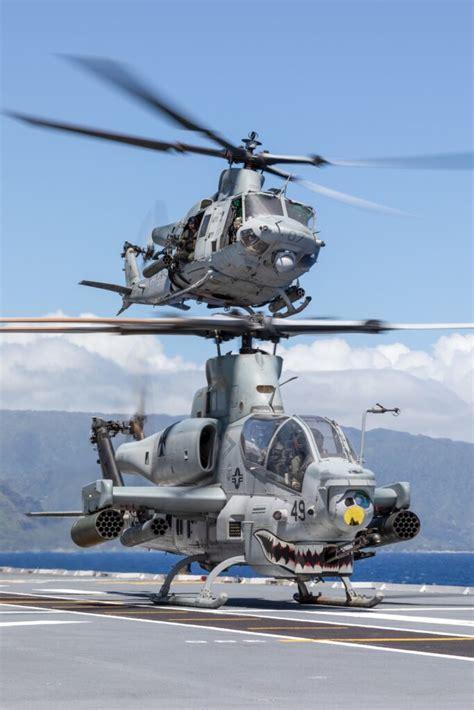
The AH-1Z Viper and UH-1Y Venom were never designed for the highly connected battlespace that now surrounds the F-35 Lightning II. Yet the U.S. Marine Corps plans to keep these helicopter families relevant well into the 2040s, and one of the most important steps is surprisingly basic: giving them more electrical power. Bell Textron’s latest SPINE Phase 3.0 and NextGen Effects upgrades are intended to provide the power generation, wiring, control systems, and digital infrastructure needed to accommodate modern networking equipment and weapons.
That may sound less dramatic than adding a new missile or radar, but electrical power has become a combat capability of its own. Modern sensors, communications equipment, electronic warfare systems, targeting devices, and high-speed data links all compete for electricity. On a compact helicopter derived from an older design, there simply is not enough spare capacity to operate every new system simultaneously. The generator upgrade therefore addresses a fundamental limitation that could otherwise prevent the Marines from fully integrating their legacy rotary-wing aircraft into a modern network-centric force.
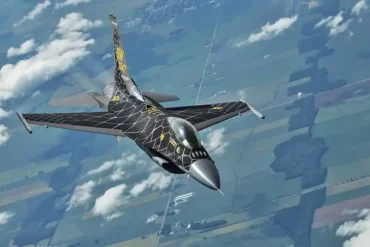
The significance becomes clearer when the Viper and Venom operate alongside the Marine Corps’ F-35B and F-35C. The fifth-generation fighters can collect enormous amounts of information, process it onboard, and distribute useful targeting information through advanced communications networks. A helicopter operating beside them does not need to possess identical sensors or stealth characteristics to contribute. It does, however, need the ability to receive, interpret, transmit, and act upon information quickly. That is where the upgraded electrical and digital architecture becomes critical.
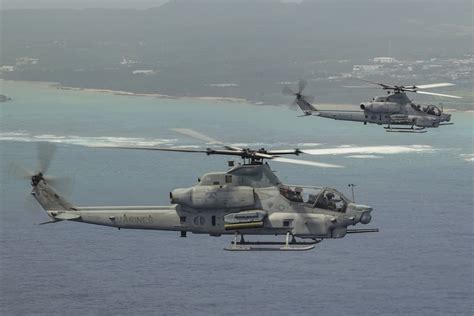
The AH-1Z Viper Is Carrying a Cold War Legacy Into a Digital Battlefield
The story of the AH-1Z Viper begins with a much older helicopter concept. Bell developed the original AH-1 Cobra in the 1960s by drawing heavily from the proven UH-1 Huey architecture. The approach allowed the company to produce a dedicated attack helicopter rapidly, and the Cobra entered combat during the Vietnam War in 1971. Its narrow fuselage, tandem seating arrangement, and emphasis on close air support became defining characteristics of Marine attack aviation.
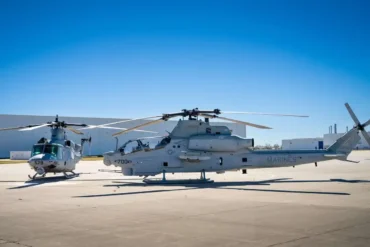
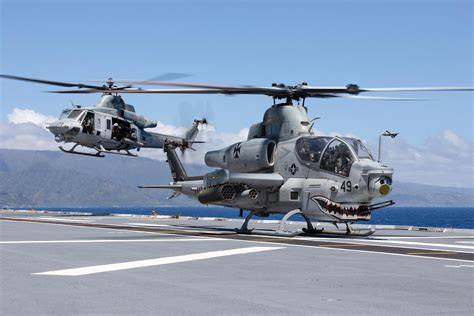
The modern AH-1Z is far removed from that original Cobra, but the lineage remains important. The Viper emerged from the Marine Corps’ H-1 upgrade program, which also produced the UH-1Y Venom. More than 84% parts commonality between the two aircraft was retained, allowing the Marines to operate a highly related pair of attack and utility helicopters. The program ultimately produced 349 aircraft, including 189 AH-1Zs and 160 UH-1Ys.
The result is a fleet that has received extensive modernization without abandoning its established airframe architecture. The Viper features sophisticated avionics, modern targeting equipment, digital cockpit systems, advanced rotor technology, and the ability to employ precision-guided weapons. The Venom similarly provides modern utility and transport capabilities. But modernization has a physical limit: the airframe’s electrical generation capacity.
That limitation becomes increasingly important as more equipment moves from mechanical or relatively simple electronic systems toward sophisticated digital hardware. A helicopter carrying additional communications equipment, networking terminals, sensors, electronic warfare systems, and future weapons interfaces needs substantially more electrical power than its original architecture anticipated. The problem is not simply whether a new system can be installed. It is whether the helicopter can continuously power that system while simultaneously operating everything else required for a combat mission.
Why the Generator Upgrade Matters More Than It Sounds
The Marines’ NextGen Effects program addresses this problem directly. Bell received a $300 million firm-fixed-price contract to retrofit 28 AH-1Z Vipers and 21 UH-1Y Venoms with structural and power improvements. The objective is to prepare these aircraft for higher-powered systems, including Link 16 combat networking equipment.
Link 16 is particularly important because it provides a common tactical communications architecture used across numerous U.S. and allied platforms. It allows participating aircraft, ships, and ground forces to exchange information about tracks, locations, threats, and other battlefield data. For an older helicopter, being able to participate in this network can fundamentally change its role.
The electrical side of the upgrade is therefore closely connected to the information side. Improved generators provide additional power, while new wiring, control units, and data-bus architecture provide the infrastructure needed to distribute that power and information efficiently. SPINE Phase 3.0 builds on earlier work with improved generators, wiring, control systems, and a modern data bus designed to support net-enabled weapons and communications.
In practical terms, the upgrade creates the infrastructure upon which future capabilities can be installed. The Marines do not have to redesign the helicopter every time a new sensor, communications system, or weapon becomes available. Instead, the aircraft gains a stronger digital and electrical foundation capable of supporting successive generations of equipment.
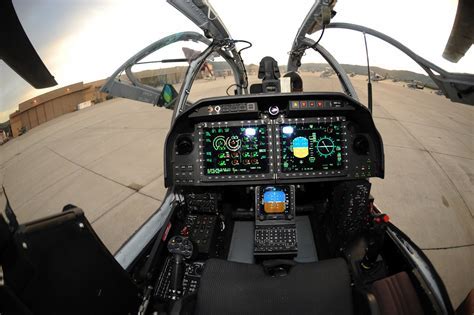
From a Close-Air-Support Helicopter to a Networked Combat Node
The most interesting aspect of the modernization is that the Marines are not simply trying to make the AH-1Z a better version of the aircraft it was originally intended to be. The service is changing how the helicopter fits into the broader fight.
Traditional attack-helicopter doctrine placed enormous emphasis on direct observation, close air support, and relatively short-range weapons. The aircraft would identify or receive a target, approach the engagement area, and use onboard sensors and weapons to attack it. That model remains useful, but it becomes increasingly dangerous in an environment filled with long-range missiles, integrated air defenses, and persistent surveillance.
The emerging Marine concept is different. The Viper can become a mobile node in a distributed kill web, receiving targeting information from other platforms and using that information to engage targets from greater distances. Instead of needing to discover every target independently, it can potentially exploit information gathered by aircraft, ships, unmanned systems, or ground units.
This is where the F-35 becomes especially relevant. The F-35B possesses sophisticated sensors and networking capabilities designed to give pilots an unusually broad picture of the battlespace. If that information can be passed through appropriate gateways to legacy platforms, the F-35 does not need to destroy every target itself. It can effectively help other weapons and platforms become more effective.
The upgraded AH-1Z is therefore valuable not because it suddenly becomes a fifth-generation aircraft, but because it can become a more capable participant in a fifth-generation combat network.
SPINE and the Long-Range Wolf Pack Concept
The electrical upgrade becomes even more significant when paired with the Marine Corps’ emerging long-range strike capabilities. The Red Wolf missile is part of the service’s Precision Attack Strike Munition effort and is associated with the broader Wolf Pack concept. The system combines explosive Red Wolf missiles with electronic-warfare-oriented Green Wolf missiles, creating a family of weapons intended to reach targets at dramatically greater distances than the Hellfire missiles traditionally associated with the AH-1Z.
Red Wolf has already been tested from the AH-1Z, including low-altitude launches supported by beyond-line-of-sight communications. The reported range of more than 200 nautical miles represents a fundamental change in how the helicopter could contribute to a maritime fight. The aircraft would no longer need to fly deep into a contested engagement area simply to deliver an attack.
That range also makes external targeting information far more valuable. A missile capable of traveling hundreds of miles needs accurate information about where the target is and how that target is moving. A helicopter’s own sensor does not necessarily need to find the target if another platform can provide the required targeting data.
This is precisely why networking and electrical capacity matter together. A long-range weapon without a reliable information architecture is far less useful. Conversely, an advanced network becomes more valuable when additional shooters can receive its information and convert that information into physical effects.
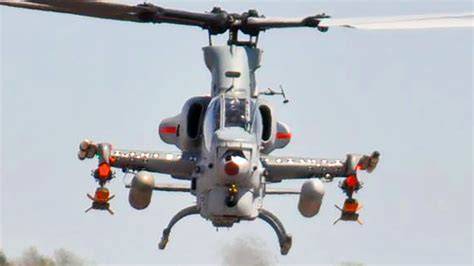
Why the F-35B Is Central to the Marine Corps’ Kill Web
The Marine Corps’ F-35B is particularly important because it combines fifth-generation sensing and networking with short takeoff and vertical landing capability. Unlike conventional carrier aircraft, the F-35B can operate from amphibious assault ships and suitable austere locations, supporting the Marine Corps’ increasingly distributed operating concept.
The service is moving toward smaller and more dispersed forces across the Indo-Pacific. Instead of concentrating combat aviation at a handful of major bases, Marine units can operate from temporary or austere locations, complicating an adversary’s targeting problem. In such an environment, every platform becomes more useful when it can share information with the rest of the force.
The AH-1Z and UH-1Y fit naturally into this architecture. Their relatively small size and expeditionary utility make them suitable for operating alongside dispersed Marine formations. The Viper can provide armed overwatch and strike capability, while the Venom can move personnel, equipment, and casualties. When connected through modern communications, these helicopters become participants in a much larger system rather than isolated aircraft.
The distinction between a kill chain and a kill web is important. A traditional kill chain implies a sequence in which one sensor detects a target, information moves through designated nodes, and a predetermined shooter conducts the engagement. A kill web is more flexible. Information can move between many participants, allowing the platform best positioned to engage a target to act.
For the Marines, that flexibility could be especially valuable across the enormous distances of the Indo-Pacific.
The Technical Bridge Between the F-35 and Legacy Helicopters
There is, however, an important qualification. It would be inaccurate to suggest that an upgraded AH-1Z simply plugs directly into every F-35 communication system and instantly gains access to the fighter’s complete sensor picture. The F-35 uses Multifunction Advanced Data Link (MADL) for high-speed, low-probability-of-intercept communications among compatible platforms, while legacy aircraft can use systems such as Link 16.
The two architectures require appropriate gateway and translation capabilities. Experiments have demonstrated ways of passing information between different networks, but that does not mean every Marine helicopter will possess unrestricted access to every F-35 data stream. The practical architecture is considerably more complicated.
Previous exercises nevertheless demonstrate the direction of travel. During Talisman Sabre 2023, AH-1Z Vipers operated alongside F-35Bs, AC-130 gunships, and allied ground forces. The Marines have also experimented with systems such as MAGTAB to pass targeting information between UH-1Y Venoms and AH-1Z Vipers.
These demonstrations are important because they show that the concept is not purely theoretical. The service has already tested ways to make legacy helicopters function as components of a broader network. SPINE takes that concept further by addressing the physical infrastructure required to support more sophisticated networking equipment.
The Indo-Pacific Makes Connectivity More Important
The geographic realities of the Indo-Pacific make this modernization particularly significant. Distances between islands, bases, ships, and potential operating areas can be enormous. A platform may be hundreds of miles from the unit that possesses the best sensor or the most appropriate weapon.
The Marine Corps’ answer is increasingly based on distribution. F-35Bs and F-35Cs provide advanced sensing and strike capabilities, amphibious ships provide mobile bases, helicopters support maneuver forces, and long-range weapons extend the reach of relatively small formations. The effectiveness of that structure depends heavily on information moving between its components.
The growing regional F-35 fleet strengthens this architecture. Japan operates F-35As and is acquiring F-35Bs for operations from its modified Izumo-class ships. Australia operates F-35As, South Korea fields F-35As, and Singapore is acquiring both F-35A and F-35B variants. The United Kingdom also operates the F-35B, creating additional opportunities for interoperability during coalition operations.
For the Marines, that means an upgraded helicopter may eventually operate inside a multinational information environment containing American, Japanese, Australian, South Korean, Singaporean, and British assets. The helicopter does not need to be the most sophisticated aircraft in that environment. It needs to be able to contribute useful effects to it.
Keeping 40-Year-Old Concepts Relevant Through the 2040s
The most remarkable part of the program may ultimately be its philosophy. The Marine Corps does not currently have a clearly defined replacement that makes the AH-1Z and UH-1Y obsolete in the near term. Instead, it is investing in the aircraft already available and giving them the infrastructure necessary to absorb new technology.
That approach can be considerably more practical than replacing an entire helicopter fleet. A new combat aircraft requires years of development, testing, procurement, training, infrastructure investment, and logistical transition. A targeted modernization program can deliver useful capability sooner while preserving established maintenance and operational systems.
The result is an unusual combination of old and new. The basic design philosophy traces its ancestry to helicopters developed during the Vietnam era, yet the latest upgrades are intended to support digital networking, long-range precision weapons, beyond-line-of-sight communications, and distributed maritime warfare.
The generator is therefore much more than a replacement component. It is an enabler for the helicopter’s next phase of service life. More electrical capacity allows more computing and communications equipment. Better wiring and control systems make that equipment easier to integrate. A modern data bus allows information and weapons systems to interact more effectively. Together, those improvements allow an aging airframe to participate in a battlefield increasingly dominated by connected sensors and precision effects.
The AH-1Z will never become an F-35, and that is not the objective. The smarter goal is to make the Viper and Venom useful teammates for the F-35. In a distributed force, combat power does not come only from the most advanced aircraft. It comes from connecting different platforms so that each can contribute what it does best.
For a helicopter fleet descended from one of the most recognizable aircraft families of the Vietnam era, that represents a remarkable technological evolution. The Marines are effectively extending the life of a proven airframe by rebuilding the invisible infrastructure around it. And in modern warfare, those invisible connections may matter almost as much as the aircraft itself.