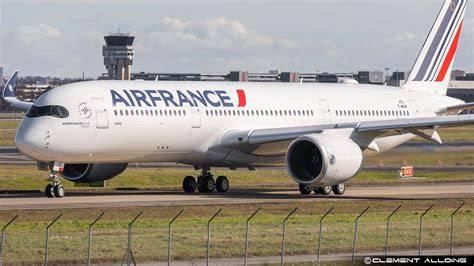
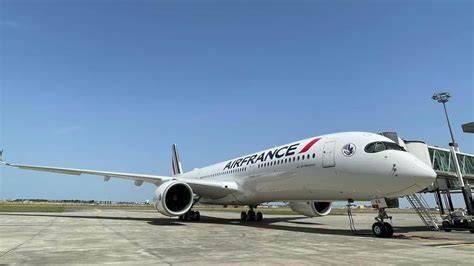
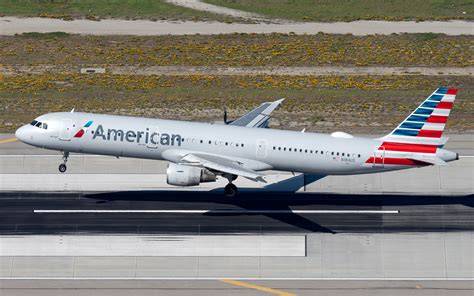
Two widebody-era jets lifted off from Los Angeles International Airport in the dead of night, their departure slots barely a minute apart, and for several seconds on Saturday, November 7, they flew on paths that should never have intersected. Air France Flight 28, an Airbus A350-900 bound for Papeete, and American Airlines Flight 1660, an Airbus A321-200 bound for Dallas/Fort Worth, closed to within roughly 400 feet (121 meters) of vertical separation after the French widebody abandoned its assigned departure route and swung left into the American jet’s climb corridor, according to initial accounts of the incident. Neither aircraft collided, neither crew declared an emergency, and both flights ultimately landed safely at their destinations, but the event is now the second serious loss of separation at California’s busiest airport in barely a year, and it has revived hard questions about how much margin protects departures from LAX’s tightly packed parallel runways.
The Departure Sequence That Set the Stage at LAX
The mechanics of the conflict matter because they explain how two aircraft following clearance can still end up on a collision course. AF28, operating with registration F-HUVK, received clearance to depart Los Angeles on the SUMMR2 departure procedure, a published route that Federal Aviation Administration charts describe as requiring aircraft leaving Runways 24L, 24R, 25L, and 25R to climb straight ahead before turning onto their assigned track. The purpose of that straight-ahead segment is simple and unforgiving: it buys altitude and horizontal distance before westbound departures bank out over the Pacific Ocean, keeping them clear of traffic rotating off the airport’s other active runways. American Flight 1660, registration N191UW, lifted off from Runway 25R roughly one minute after the Air France jet, having been instructed by departure control to hold at 2,000 feet so the heavier A350 could complete its turn and climb toward FL270. That instruction created a deliberate altitude buffer. It depended entirely on the A350 turning where the procedure said it would.
Where the Air France A350 Deviated From Its Cleared Route
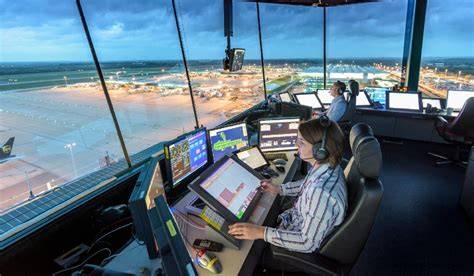
Instead, according to accounts circulating from aviation trackers and reported by The Aviation Herald, the A350 began a left turn while climbing through approximately 1,800 feet, well short of the 5,000-foot point at which the SUMMR2 profile permits the turn. Aviation observer TurbineTraveler, posting on X, characterized the maneuver as an unauthorized turn that placed the French jet directly across the trajectory of the American narrowbody. The deviation turned a sequence of two clean departures into a conflict alert in the tower, and the departure controller is credited with spotting the geometry within seconds, issuing immediate turn instructions that pushed both aircraft apart. The controller then challenged the Air France crew over the radio about the departure from their cleared route. Flight data reviewed through the Simple Flying Flight Tracker confirms the timing: AF28 departed at 12:15 AM local time on November 7, AA1660 at 12:16 AM, a sixty-second gap that offers almost no room for error once one aircraft moves off its wire.
Why 400 Feet Is a Crisis, Not a Comfort
Loss of separation in terminal airspace is measured against minimum standards designed to keep aircraft far outside the range at which wake turbulence, navigation error, or a single distraction can close the gap. A vertical split of 400 feet between two jets climbing on crossing tracks sits far below those minima and leaves virtually no recovery time if either crew hesitates. What magnified the danger is that the two aircraft together could have been carrying more than 500 passengers, and the event unfolded over densely populated Los Angeles rather than open ocean. Reports so far indicate that neither cockpit received a Traffic Collision Avoidance System resolution advisory, the automated climb or descend command that TCAS issues when it calculates an imminent threat. The absence of such an advisory does not mean the crews were unaware, but it suggests the geometry, as TCAS computed it, never crossed the threshold that triggers the most urgent warning available in the cockpit.
The ITA Airways Echo: A Pattern Over Runway 24L
The parallel to October 2025 is difficult to ignore. In that incident, an ITA Airways Airbus A330-900 departing Los Angeles on Runway 24L turned left toward an American Airlines A321 that had just rotated from Runway 25R, triggering a loss of separation as both climbed out. The runway pair involved in Saturday’s event is the same, the airline pairing is the same on the American side, and the failure mode — a left turn executed earlier or wider than the procedure allows — is strikingly similar. Together, the two events point to a structural pressure rather than a freak coincidence: LAX’s closely spaced parallel runways and its compressed nighttime departure banks leave little buffer for deviations, and when a crew turns early, the error propagates instantly across another aircraft’s flight path.
What Comes Next for AF28, AA1660, and LAX Traffic
Simple Flying contacted Air France for comment on the incident, but no airline spokesperson was immediately available. Both flights continued to their intended destinations without reported injuries. Federal investigators are expected to examine the cockpit voice and flight data recorders from the A350 to establish whether the early turn stemmed from a programming error, a misread clearance, a navigation database discrepancy, or a manual input, and whether the crew received and acknowledged the SUMMR2 straight-ahead restriction. The answers will determine whether this becomes a single-crew lapse or another data point in a broader review of departure procedure adherence at one of the world’s most congested airports. For now, the record shows what nearly happened on a clear November night, and how narrow the distance was between a routine takeoff bank and something far worse.