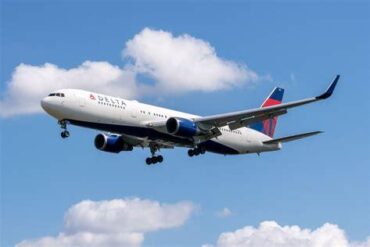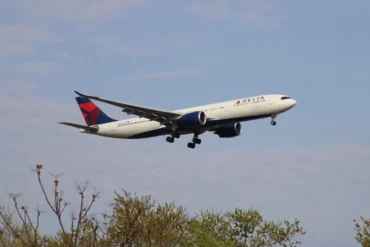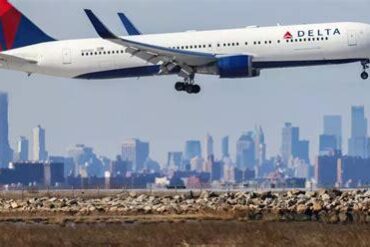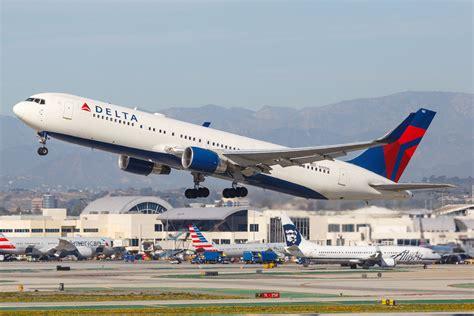
In the early hours of November 19, 2025, passengers aboard Delta Air Lines flight DL357 experienced an unexpected and urgent diversion as their Boeing 767-300ER aircraft rerouted to Los Angeles International Airport (LAX) due to a critical issue with one of its engines. The aircraft, registered as N190DN, was cruising at 35,000 feet when flight crew identified a loss of oil pressure in the number two engine, prompting a swift emergency response.
Originally scheduled to fly from Honolulu’s Daniel K. Inouye International Airport (HNL) to Salt Lake City International Airport (SLC), the red-eye service took off at 11:25 PM, operating just ten minutes behind schedule. With a flight time planned for six hours and eleven minutes, the Boeing 767 was set to touch down at 8:26 AM local time. Instead, four hours into the journey, the right-side Pratt & Whitney PW4060 engine began signaling a serious oil issue.
Engine Alert Triggers Mid-Air Emergency
The first indication of trouble came through the EICAS (Engine Indicating and Crew Alerting System), a standard alert system in Boeing aircraft designed to monitor engine health and other critical systems. When the crew noticed the oil pressure dropping, they followed procedural checklists to assess the severity. Ultimately, they opted to shut down the affected engine and divert to Delta’s West Coast hub, LAX, a strategic decision that enabled the airline to manage the operational fallout effectively.
Declaring a 7700 squawk code emergency, the pilots guided the aircraft safely to Runway 7R, landing at 6:26 AM. The emergency response team from the Los Angeles Fire Department was on standby to inspect the aircraft, though no fire or visible damage was immediately reported. The aircraft then taxied to the gate under its own power, demonstrating the Boeing 767’s capacity to handle engine-out procedures smoothly.
Passenger Reaccommodation and Aircraft Replacement
Delta rapidly initiated passenger reaccommodation procedures. Approximately six hours after the emergency landing, the airline deployed an Airbus A319-100 from LAX to SLC, keeping the same DL357 flight number, though this route is not typically scheduled for that flight ID. Given the A319’s smaller capacity — 132 seats compared to the 767’s 216-seat layout — some passengers were likely redistributed onto alternative flights.
Here’s a quick seat comparison for reference:
- Boeing 767-300ER: 26 DeltaOne, 18 Premium Select, 21 Comfort+, 151 Economy
- Airbus A319-100: 12 First, 24 Comfort+, 96 Economy
Delta’s proactive response minimized delays for travelers while ensuring aircraft availability despite the short notice.
Maintenance and Fleet Safety Considerations
Aircraft N190DN, a 28-year-old widebody, remains grounded at LAX. Technicians are currently inspecting the affected PW4060 engine, one of the most widely used and historically dependable turbofans in commercial aviation. The issue is presumed to be isolated to this particular engine unit rather than a systemic problem with the PW4000 series, which continues to power numerous aircraft globally.
Delta’s operational scale — with a fleet approaching 1,000 aircraft — naturally exposes it to a higher frequency of mechanical events simply by volume. However, its safety culture and maintenance rigor consistently rank among the industry’s highest.
A Pattern of Recent Engine Incidents
This event follows other recent engine-related diversions involving Delta aircraft:
- February 2025: A Boeing 767-300ER (N16065) flying the reverse route — from Salt Lake City to Honolulu — suffered a similar engine fault mid-flight, returning safely to its origin after a prolonged delay.
- October 2025: A Delta 737-900ER aborted takeoff at Minneapolis-St. Paul International Airport due to an engine failure during its high-speed roll. The crew executed a rejected takeoff, and passengers were transferred to another aircraft.
Each of these aircraft returned to service after thorough repairs and validation, illustrating both the reliability of the fleet and Delta’s strict adherence to FAA-mandated safety standards.
Final Thoughts: Robust Response to a Critical Situation
This emergency diversion highlights the professionalism and preparedness of Delta’s flight crew, maintenance protocols, and logistical capabilities. The seamless execution — from in-flight shutdown and emergency descent to rapid passenger reaccommodation and aircraft substitution — reflects Delta’s ability to manage high-stress scenarios with minimal disruption.
While rare, such technical malfunctions reinforce the importance of redundancy, system checks, and trained personnel. Passengers onboard DL357 may have experienced an early landing, but they were delivered safely thanks to swift decision-making and procedural excellence.
As N190DN awaits repairs at LAX, it serves as a reminder that even aging airframes, when well-maintained, can continue to operate safely within a high-performance commercial environment.