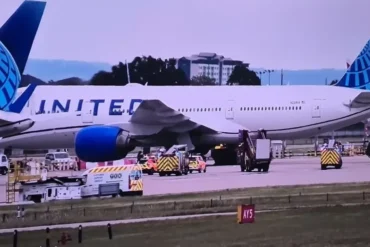
United Airlines Flight 934, a Boeing 767-300ER operating a scheduled morning transatlantic service from Newark Liberty International Airport to London Heathrow, was forced into a precautionary U-turn on November 27, 2025 after its flight crew detected unreliable airspeed indications shortly after reaching cruise altitude. The interruption unfolded just as the aircraft settled into its climb near Boston, prompting a swift operational decision that prioritized safety over schedule.
The aircraft, registered N665UA, pushed back at 8:25 AM and departed roughly nine minutes behind schedule, ascending as planned toward the North Atlantic corridor. Within minutes at approximately 30,000 feet, the crew identified a discrepancy in the aircraft’s airspeed indicators—an issue that instantly elevates workload and removes any margin for complacency. Instead of continuing across an ocean with a system that pilots treat as a hard-stop safety concern, the cockpit crew secured the airplane, executed the necessary checklists, and turned the twin-aisle jet back toward Newark. Passengers later recounted that the pilots directly referenced airspeed indication problems when briefing the cabin.
Airspeed is the backbone of nearly every decision an airliner makes in flight: stall protection, overspeed limits, automated flight behavior, climb performance, and descent stability all rely on precise readings. In modern jets like the Boeing 767, these values are generated by pitot-static pressure inputs routed through air-data computers. When one or more sensors provide contradictory information, crews must assume the data is unreliable. Procedures require pilots to establish the aircraft using known pitch-and-power settings, cross-check alternate and standby instruments, stabilize the jet, and simplify operations.
Unreliable airspeed demands immediate, conservative judgment. Crossing the Atlantic with compromised instrumentation is out of the question. Because Flight 934 was still relatively close to its departure airport, Newark represented the safest and most operationally efficient option for landing. Once on the ground, the jet paused briefly while emergency services and maintenance technicians evaluated the aircraft and prepared it for inspection.
What Maintenance Teams Face After an Event Like This
A return-to-field event involving airspeed anomalies becomes a significant behind-the-scenes undertaking. Air-data components require verification, recalibration, or replacement. Maintenance crews must run troubleshooting procedures, conduct pitot-static system checks, and update dispatch documentation. None of this can be rushed: regulatory compliance demands precision, and transatlantic operations require every system to perform at its certified standard.
During this process, the aircraft remains out of service, which cascades into operational challenges for the airline. United must reposition equipment, rebook passengers on later departures, and coordinate with Heathrow arrival slots—an increasingly scarce resource during the heavy holiday travel period. Hotel plans, connections to European destinations, and onward itineraries all fall into a complex web of adjustments.
Passenger Experience and Operational Fallout
While the incident created delays and frustrating schedule reshuffles, its early turnback spared passengers a far more difficult scenario: diverting mid-Atlantic to a foreign airport with limited maintenance support. This outcome also mitigated potential crew duty-time violations and kept the aircraft within United’s primary maintenance ecosystem. In aviation operations, not all disruptions are equal; this one, while inconvenient, was comparatively manageable.
Passengers were reaccommodated on later flights or partner services, and United’s operations center coordinated the full recovery plan. The airline emphasized that no injuries were reported and that the flight’s return was executed purely as a precautionary measure.
Why Airspeed Issues Receive Zero Risk Tolerance
Airspeed unreliability carries historical weight within aviation safety culture. Several high-profile accidents over past decades have been traced to failures within pitot systems, icing incidents, or misleading indications interpreted under stress. Modern training programs teach pilots to recognize these symptoms instantly and revert to manual pitch-and-thrust flying—an old-school yet dependable method that removes dependence on misbehaving instruments.
This event fits comfortably within the category of “precaution executed correctly.” The crew followed procedure, communicated crisply, and chose the safest outcome long before the situation escalated. For an industry designed around redundancy, this was the system doing exactly what it is built to do.
A Minor Disruption in Exchange for Maximum Safety
Flight 934’s mid-journey reversal underscores a familiar theme in commercial aviation: small anomalies trigger decisive actions. United’s team avoided the complications of an international diversion, ensured a smooth landing back at Newark, and enabled maintenance crews to diagnose the problem under optimal conditions. Passengers may have lost time, but they gained certainty.
Events like this highlight the precision-driven culture that underpins long-haul operations. Even a single instrument’s inconsistency is enough to pause a transatlantic crossing, and that level of caution is exactly why the global air travel system maintains its remarkable safety record.