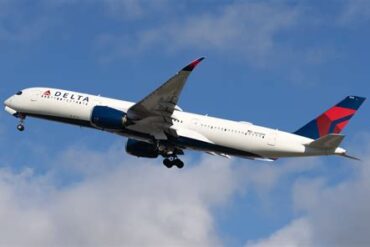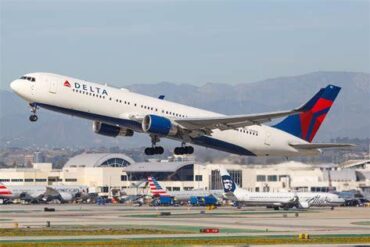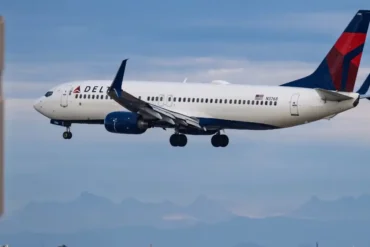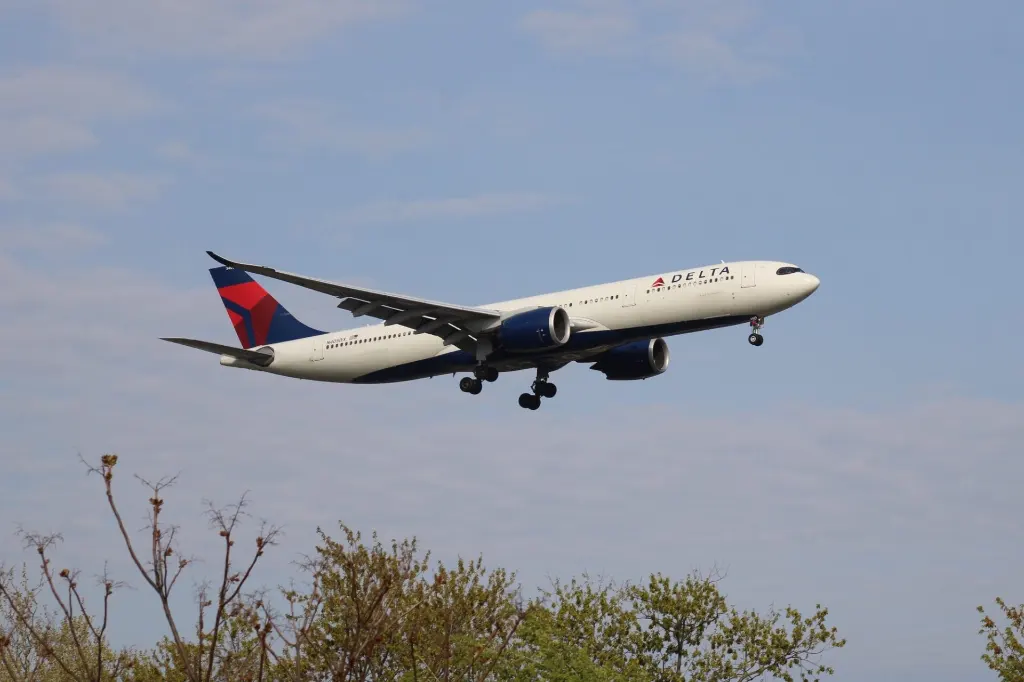
Delta Airlines found itself at the center of a dramatic in-flight emergency on July 31, 2025, when Flight DL9923, en route from Salt Lake City to Amsterdam, encountered severe turbulence over South Dakota. The incident, occurring approximately two hours into the transatlantic journey at 37,000 feet, prompted a swift and decisive diversion to Minneapolis–Saint Paul International Airport, where 25 passengers were subsequently hospitalized.
Shocking Altitude Turbulence Triggers Medical Crisis
The aircraft, a Delta-operated widebody jet, was cruising steadily on a nine-hour international route when it encountered an intense and abrupt zone of atmospheric instability. The turbulence was described by multiple onboard sources as “violent,” throwing unsecured passengers and objects into the cabin walls and ceiling. Eyewitness reports confirmed that some passengers were lifted out of their seats despite being advised to remain buckled.
According to flight data and air traffic monitoring, the jet was flying over South Dakota when the sudden vertical air movements began. The turbulence persisted long enough to cause blunt force trauma, fractures, and in some cases, concussions. A total of 25 individuals required urgent hospitalization upon landing, while several others were treated for minor injuries at the airport.
Emergency Landing in Minneapolis: Fast Action Saves Lives
Faced with the rapidly deteriorating condition of some passengers, the flight crew immediately declared a medical emergency. With the assistance of Delta’s operational command center, the pilots diverted the aircraft to the nearest suitable airport equipped to handle a large-scale medical response: Minneapolis–Saint Paul International. Within 45 minutes of turbulence onset, the plane touched down safely in Minneapolis.
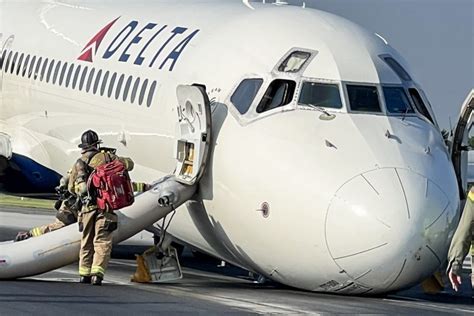
Upon arrival, a full contingent of emergency medical responders, paramedics, and airport fire crews were on standby. They boarded the aircraft promptly to assess injuries, stabilize passengers, and facilitate transport to local medical centers. According to Minneapolis emergency services, the coordinated response was executed “within minutes” and prevented what could have become a mass-casualty scenario.
Delta’s Response: Medical Support and Care Teams Mobilized
Delta Airlines issued an official statement within hours of the landing, confirming the emergency and detailing the medical response. The airline emphasized that its Care Team was deployed to Minneapolis to support the affected passengers, ensuring access to accommodation, communication, and continued medical attention where necessary.
Delta’s spokesperson stated:
“We express our deepest concern for those affected by this unforeseen turbulence. Our crews acted swiftly and professionally to prioritize the safety and care of everyone on board. We’re grateful to the Minneapolis emergency teams for their rapid response.”
Behind the scenes, Delta’s Customer Care division and corporate medical advisors worked around the clock, coordinating with local hospitals and providing direct outreach to families of those injured. Some passengers have since been released, while a few remain under observation due to more severe trauma.
Safety First: A Testament to Training and Preparedness
Aviation experts note that while turbulence is common, the kind encountered on DL9923 falls under the category of severe clear-air turbulence (CAT) — sudden and unpredictable, often undetectable by radar. The fact that the aircraft remained structurally intact and landed safely is seen as a testament to both the crew’s training and the aircraft’s design integrity.
Dr. Michael Torrence, an aviation safety analyst, commented:
“This wasn’t just a bumpy ride. It was a high-stress emergency at cruising altitude. The flight crew’s quick assessment, decision-making, and coordination with air traffic control likely saved lives.”
Technology and Communication: Crucial in Real-Time Crisis Management
Real-time communication technology aboard modern aircraft played a critical role in enabling the Delta cockpit crew to alert both the airline’s operational center and Minneapolis authorities in record time. Systems such as ACARS (Aircraft Communications Addressing and Reporting System) and SATCOM enabled seamless coordination with air traffic control, ensuring runway availability, emergency vehicle positioning, and medical team preparation even before the aircraft descended.
The aircraft’s onboard flight data monitoring systems also played a role in documenting the turbulence event for subsequent safety analysis. Early reports suggest that vertical accelerations exceeded normal tolerances, supporting the classification of the incident as a rare but serious weather anomaly.
Delta’s Safety Commitment Reaffirmed Amid Crisis
Delta Airlines, consistently rated among the safest carriers globally, used the incident to reaffirm its core philosophy: “Safety above all.” In follow-up communications, the airline emphasized that it would continue reviewing its operational protocols, including passenger briefings and cabin securement procedures, to reduce risk during similar high-altitude disturbances.
Although some online speculation pointed to possible gaps in safety belt compliance, Delta has since clarified that standard pre-turbulence warnings and seatbelt indicators were active. Nonetheless, the incident raises broader industry questions about how to handle unforeseen atmospheric hazards, especially on long-haul flights.
Broader Aviation Community Reacts
News of the Minneapolis emergency quickly circulated through aviation watchdog groups, safety forums, and regulatory agencies. The Federal Aviation Administration (FAA) is conducting a routine post-incident investigation, with a particular focus on the turbulence’s intensity and the aircraft’s performance during the ordeal.
The National Transportation Safety Board (NTSB) has not announced a formal probe, but sources confirm that the agency is closely reviewing Delta’s incident logs and passenger injury reports.
Meanwhile, several aviation advocacy groups have reiterated calls for improved passenger education regarding seatbelt use throughout the flight, not just during taxi, takeoff, and landing.
A Complication for Delta: Legal Troubles Elsewhere
In a development unrelated to the turbulence incident, Delta Airlines is concurrently facing legal scrutiny due to a lawsuit involving an outsourced employee accused of misusing a lost iPad to record explicit content. Delta clarified that the individual was not directly employed by the airline, but by a contracted vendor. Nonetheless, the case has attracted media attention.
While this legal matter is separate, it has added an additional layer of public relations complexity for the carrier. Delta has reiterated its zero-tolerance policy toward inappropriate conduct, emphasizing that it is fully cooperating with ongoing legal proceedings.
Lessons from Flight DL9923: Why Emergency Preparedness Matters
Flight DL9923’s ordeal serves as a compelling case study in aviation risk management. Airlines are bound by stringent international protocols to ensure preparedness for medical emergencies, but real-world execution — as seen here — is the true test. Delta’s ability to divert swiftly, coordinate with emergency responders, and care for injured passengers demonstrates the multi-layered approach required in crisis situations.
Moreover, it underscores the need for better forecasting tools and data modeling to predict clear-air turbulence more effectively. Advances in AI-powered weather analysis and machine learning flight mapping may soon enhance crew awareness in time to avoid such zones altogether.
Final Thoughts: A Wake-Up Call for the Skies
As air travel returns to pre-pandemic volumes and transatlantic routes fill up once again, incidents like Delta’s emergency landing in Minneapolis serve as important reminders of aviation’s unpredictability. Despite technological advancements and rigorous safety training, nature still holds sway in the upper atmosphere.
Delta’s incident will likely result in a formal safety audit and internal review, but early indications suggest that the airline and its crew responded decisively and responsibly, preventing what could have been a far more tragic outcome. With multiple passengers recovering and investigations underway, the aviation community is watching closely — not to assign blame, but to learn how to better protect lives at 37,000 feet.