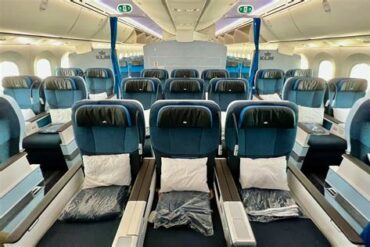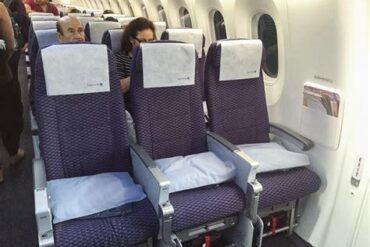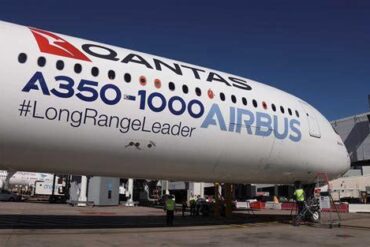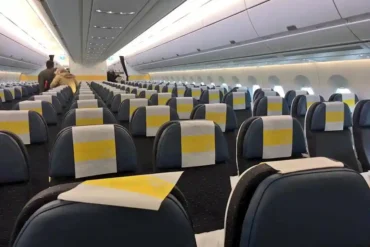
The race to squeeze more passengers into economy class has split into two very different contests. On narrowbody aircraft, where every carrier from Ryanair to Delta seats six abreast on the Boeing 737 or Airbus A320 family, density is a one-dimensional game measured almost entirely in seat pitch. On widebodies, the rules change entirely: airlines can tighten the rows front to back and simultaneously add a tenth seat per row across the cabin, wringing out capacity in two directions at once. The result in 2026 is a small club of carriers whose economy cabins approach — and in one case exactly match — the absolute limits written into the aircraft’s type certificate.
Why Narrowbody Density Is Almost Entirely About Seat Pitch
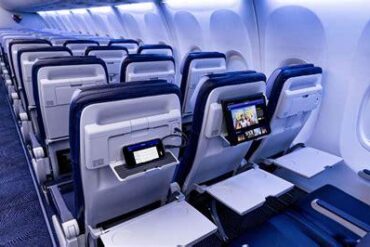
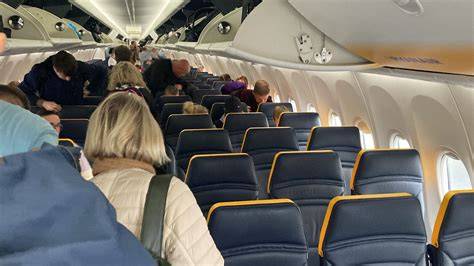
Mainline and low-cost operators alike share an identical six-abreast economy layout on the 737 and A320 families, so side-to-side space is effectively fixed across the industry. Ryanair may have slightly less room between armrests, but that comes from wider armrests and a marginally wider aisle, not from a fundamentally different layout. Every passenger on a 737 shares the same lateral envelope whether the operator is Ryanair or United. What Ryanair does control is seat pitch, cut to roughly 28 to 29 inches so that more rows fit inside the fuselage, and it eliminates premium cabins whose extra legroom would otherwise consume floor space.
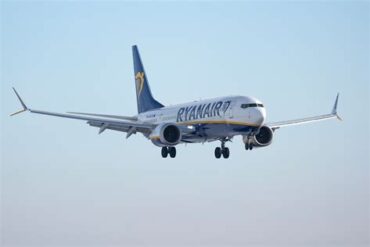
That strategy runs into a hard regulatory wall. An aircraft must prove it can evacuate all occupants in 90 seconds, and exit limits on the standard 737 MAX 8 cap how many low-pitch seats can legally be sold. Boeing’s answer was the 737 MAX 8-200, a variant with additional exits that lets carriers pack in more passengers while still meeting the evacuation standard. Boeing advertises 210 occupants including crew, but EASA certification does not actually extend that far; Ryanair configures its MAX 8-200s with 197 seats plus six to eight crew. That makes it the densest narrowbody operation in routine service today — and a template other low-cost airlines have since adopted.
The Airbus A350 Was Never Designed for Ten Abreast
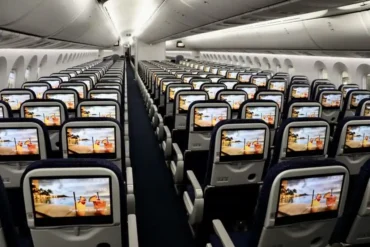
Airbus engineered the A350 for comfortable nine-abreast economy seating, though the airframe can physically accommodate ten. Boeing’s wider 777 was designed for the same nine-abreast standard but has since migrated almost universally to ten, simply because its fuselage has the girth to absorb the extra column of seats more gracefully. To close that gap, Airbus introduced a new production standard adding four inches of internal cabin width, taking the A350 cabin from roughly 5.61 to 5.71 meters. Those few inches make ten-abreast configurations meaningfully less punishing — and only three airlines currently fly the A350-1000 that way, two of them on the older, narrower production standard where the squeeze is genuinely severe.
The competing pressures behind these layouts pull in opposite directions. Passengers want the lowest possible fares, which fueled the rise of low-cost and ultra-low-cost carriers, while a separate market demands comfort without luxury, giving rise to premium economy. Ultra-dense cabins are the purest expression of the first demand.
French bee and Air Caraïbes: The Ten-Abreast Pioneers
The only two carriers flying old-standard A350-1000s at ten abreast are French bee and Air Caraïbes, both low-cost French leisure operators owned under Groupe Dubreuil. They are also the only airlines to configure the shorter but equally wide A350-900 ten abreast. Both fly transatlantic routes between Paris and the Caribbean, across the Pacific to Tahiti, and to other long-haul leisure destinations where fare trumps comfort.
French bee fits its four A350-900s with 411 seats, comprising 376 economy and 35 premium economy, against a certified maximum of 440. Air Caraïbes, operating three pre-new-standard A350-900s, seats 389 passengers: 326 economy, 45 premium economy and 18 business. The A350-1000s are where the density becomes extreme. French bee’s are configured with 480 seats — 440 economy and 40 premium economy — making them the only A350-1000s in the world operating at the type’s maximum certified seating configuration. Air Caraïbes’ four -1000s carry 429 total: 360 economy, 45 premium economy and 24 business.
| Airline | Aircraft | Total Seats | Economy Seats |
|---|---|---|---|
| Ryanair | Boeing 737 MAX 8-200 | 197 | 197 |
| French bee | Airbus A350-1000 | 480 | 440 |
| Air Caraïbes | Airbus A350-900 | 389 | 326 |
| Philippine Airlines | Airbus A350-1000 | 382 | — |
| Cebu Pacific | Airbus A330-900 | 459 | 459 |
Philippine Airlines: The Only Flag Carrier Flying Ten Abreast
For a low-cost leisure operator to configure aircraft ultra-densely is unsurprising; for a flag carrier to do so is genuinely unusual. Philippine Airlines is the only full-service national airline to fly the A350-1000 ten abreast. Its A350-900s remain at the standard nine abreast, and critically, its -1000s are new production standard aircraft first delivered in late 2025, giving them those four extra inches. Seat widths on French bee and Air Caraïbes run roughly 16 to 16.7 inches, while Philippine Airlines can offer about 17 inches — a small difference that matters enormously in a cabin where seating is a game of inches.
The new production standard also optimizes cabin layout, allowing more rows and roughly 30 additional seats in typical configurations. The A350-900 is less commonly ten abreast partly because its shorter length yields a smaller capacity gain from the extra column — fewer rows multiplied by one seat.
Cebu Pacific: The Densest A330 Ever Flown
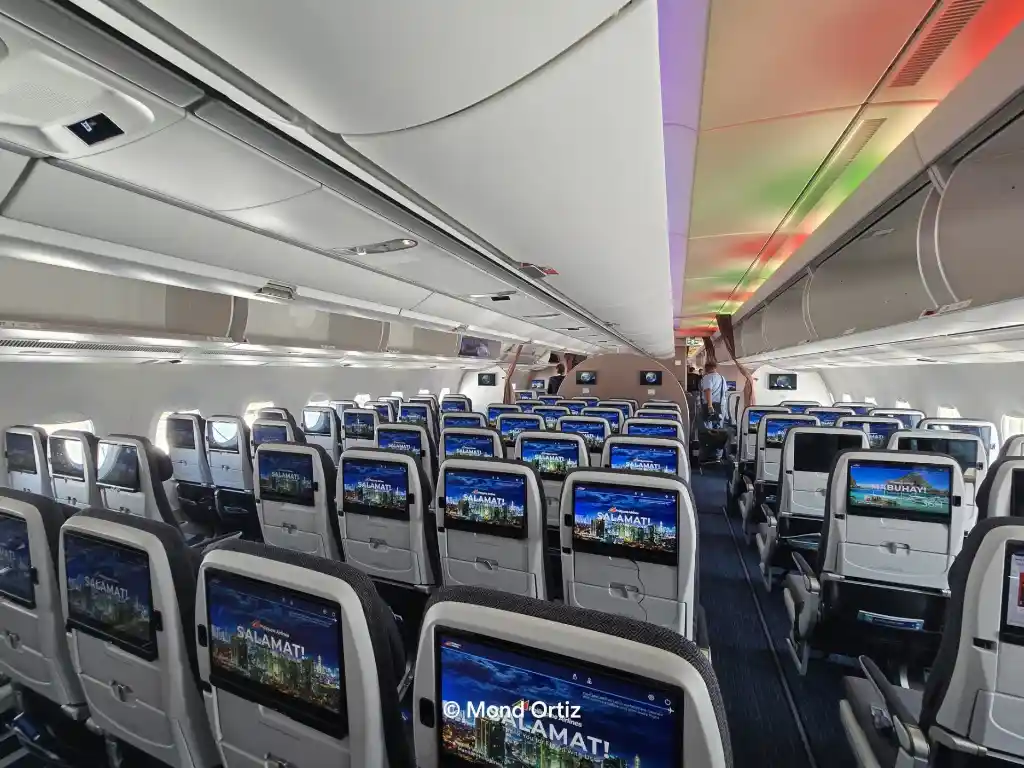
The highest-density A330 in service also belongs to a Philippine carrier. Cebu Pacific operates eight A330-900 aircraft in an all-economy layout of 459 seats, the most densely seated A330s ever put into commercial operation and close to the type’s certified maximum of 465. The A330’s narrower fuselage rules out ten abreast, so these remain nine across, deployed on domestic and international leisure routes where passengers prioritize low fares. Notably, 459 seats exceeds the capacity of many A380s in service, which are typically configured with a heavy premium emphasis.
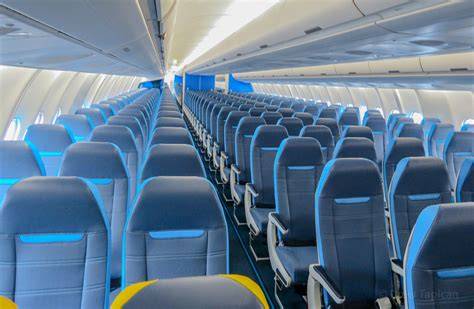
Other dense A330 operators include Lion Air at up to 440 seats, charter A330-300s at 400 to 430, and AirAsia‘s A330-300s at up to 367. By contrast, Delta Air Lines configures its A330-900s with just 281 seats across three classes.
Why the Boeing 777-9 Will Never Be This Dense
Boeing built the 777X to compete with the A350-1000, but the two pursue opposite philosophies. The 777-9 will be the largest commercial aircraft on the market, designed for thick long-haul trunk routes flown by mainline carriers, while the A350-1000 is smaller and more flexible across leisure markets. Boeing is reducing exits on the 777-9, cutting its maximum certified passenger count. While the 777-300ER is certified for up to 550 passengers, the stretched 777-9 is estimated to certify at only around 475 — potentially below the much smaller A350-1000.
The contrast is stark: Airbus designed the A350-1000 with the flexibility to serve as a high-density long-haul airliner for low-cost operators, while Boeing engineered the 777-9 as a premium trunk-route aircraft. In that sense, the 777X is the exact opposite of the 737 MAX 8-200 concept — and the densest economy cabins of 2026 will remain the domain of airlines that treat certification limits as targets rather than ceilings.