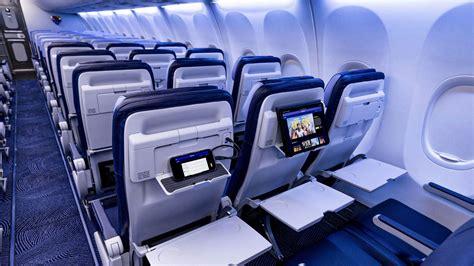
The modern airline industry is divided between two competing priorities: giving passengers more comfort and offering the lowest possible fares. As ticket prices become a major factor in travel decisions, many airlines have turned to high-density economy cabins to reduce operating costs and maximize revenue from every flight. In 2026, several carriers stand out for operating aircraft with some of the most tightly packed passenger cabins in commercial aviation.
Aircraft seating density depends on several factors, including seat pitch, cabin width, aircraft type, and the number of seats installed across each row. On narrowbody aircraft such as the Boeing 737 and Airbus A320 families, airlines have limited flexibility because these aircraft are already designed around a six-abreast economy layout. The biggest difference comes from how closely seats are placed from front to back.
Widebody aircraft create a more complex situation. Larger aircraft such as the Airbus A350, Airbus A330, and Boeing 777 offer airlines opportunities to increase capacity by changing the number of seats across each row. While premium airlines often use wider seats and fewer passengers, low-cost carriers frequently choose maximum-density configurations designed for affordable long-distance travel.
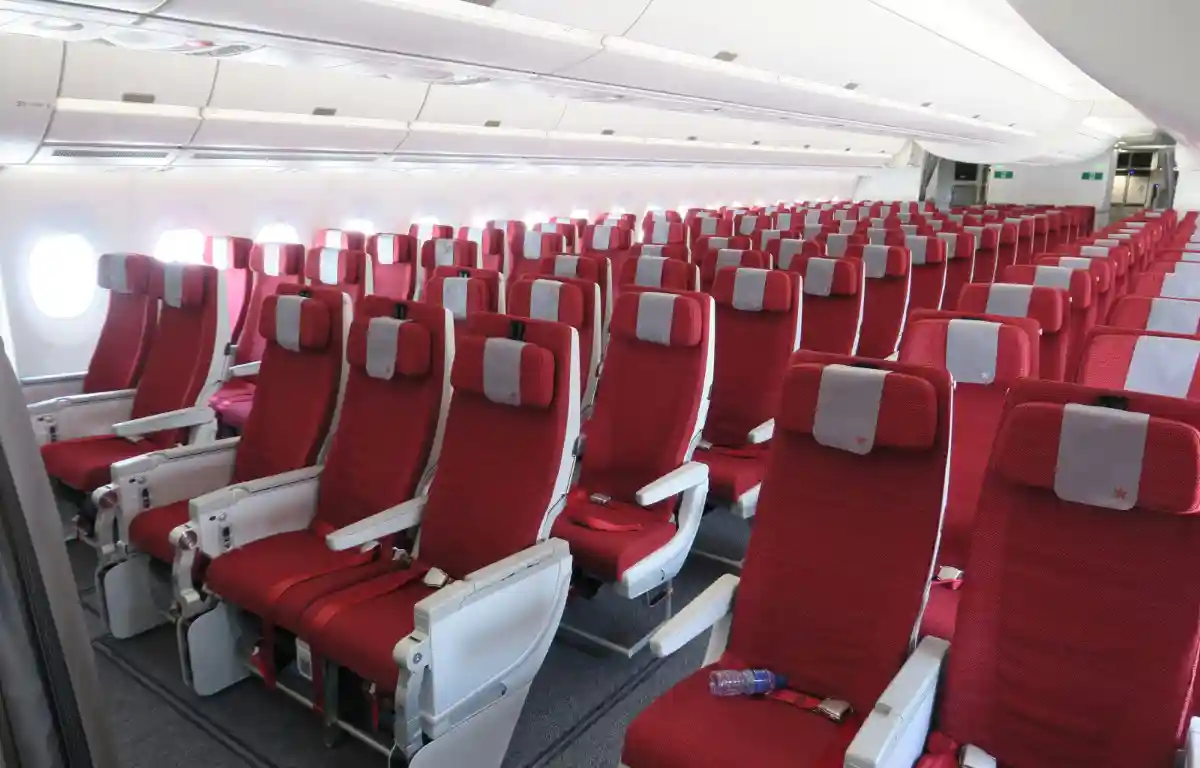
Among the world’s densest economy cabins, airlines such as Ryanair, French bee, Air Caraïbes, Philippine Airlines, and Cebu Pacific represent different approaches to maximizing passenger numbers. Some focus on short-haul efficiency, while others transform long-range aircraft into high-capacity machines capable of carrying hundreds of economy passengers across continents.
Ryanair Boeing 737 MAX 8-200: The Narrowbody Density Leader
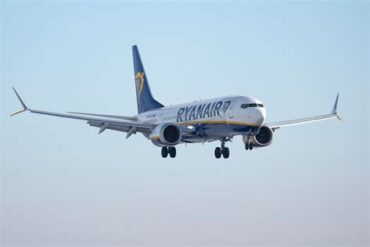
When discussing the world’s most densely configured aircraft, Ryanair’s Boeing 737 MAX 8-200 is one of the first examples that comes to mind. The Irish low-cost carrier has built its business model around operational efficiency, and its aircraft interiors reflect that philosophy.
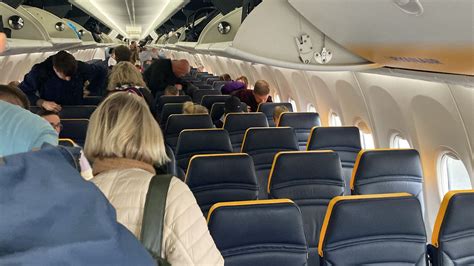
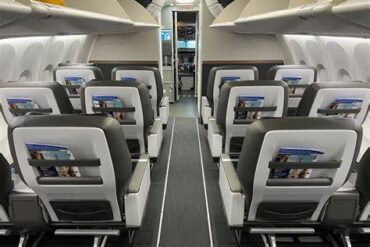
The Boeing 737 MAX family normally carries six passengers per row in economy class, arranged as three seats on each side of the aisle. Unlike widebody aircraft, there is no realistic way to add another seat across the cabin. Therefore, the key factor for narrowbody density is the distance between rows, known as seat pitch.
Ryanair reduces this spacing to approximately 28–29 inches, allowing the airline to install more rows of seats compared with traditional full-service carriers. The airline also removes space-consuming features such as large premium cabins, creating an aircraft almost entirely dedicated to standard economy passengers.
However, increasing seating capacity is not simply a matter of adding more chairs. Aviation regulations require commercial aircraft to demonstrate that all passengers can evacuate within 90 seconds during an emergency. The standard Boeing 737 MAX 8 does not have enough exit capacity for extremely high-density layouts.
To solve this issue, Boeing developed the 737 MAX 8-200, a special high-capacity version featuring additional emergency exits. The aircraft can technically accommodate around 210 people, including crew, although regulatory certification and airline configurations result in slightly lower numbers.
Ryanair operates these aircraft with approximately 197 passenger seats, making it one of the densest narrowbody commercial aircraft configurations in service. The design allows the airline to transport more passengers per flight while maintaining the low-cost structure that has made it one of Europe’s largest budget carriers.
French bee Airbus A350-1000: The World’s Densest Widebody Cabin
Widebody aircraft create a completely different challenge because airlines can increase density both vertically and horizontally. The Airbus A350-1000 represents one of the most flexible aircraft designs for high-capacity long-haul operations.
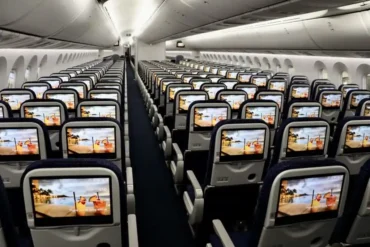
Airbus originally designed the A350 with a comfortable nine-abreast economy configuration. This arrangement provides passengers with wider seats and more personal space compared with older aircraft designs. However, the aircraft’s cabin width also allows airlines to install ten seats per row.
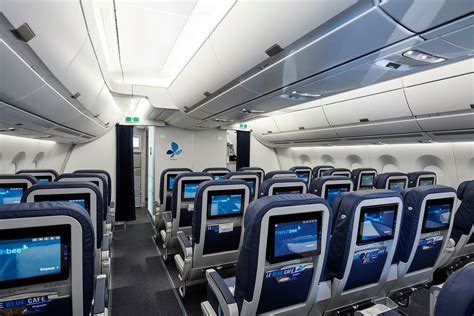
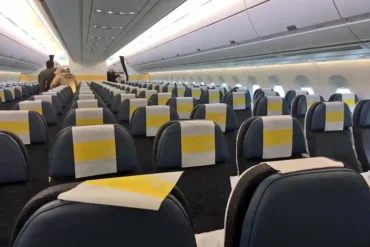
Only a small number of airlines choose this extremely dense arrangement. Among them, French bee operates one of the most remarkable examples. The French low-cost long-haul airline configures its Airbus A350-1000 aircraft with a total capacity of 480 seats, making it one of the highest-capacity passenger aircraft configurations currently flying.
The airline installs 440 economy seats and 40 premium economy seats. This configuration reaches the aircraft’s maximum certified seating capacity and demonstrates how far manufacturers can push cabin efficiency when airlines prioritize affordability over spaciousness.
French bee operates long-haul leisure routes connecting France with destinations such as the Caribbean, French Polynesia, and other vacation markets. These routes are particularly suitable for high-density layouts because many travelers are willing to accept tighter seating in exchange for lower ticket prices.
The A350-1000’s ability to carry nearly 500 passengers highlights a major shift in the aviation industry. Traditionally, large aircraft were associated with premium service and luxury travel. Today, some airlines are using the same aircraft types as high-capacity transportation tools.
Air Caraïbes: Another Ultra-Dense Airbus A350 Operator
Air Caraïbes, a sister airline of French bee under Groupe Dubreuil, also operates some of the densest Airbus A350 cabins in commercial aviation.
The airline configures its Airbus A350-1000 aircraft with a total of 429 seats, including 360 economy seats, 45 premium economy seats, and 24 business class seats. While slightly less dense than French bee’s maximum configuration, it still represents an aggressive approach to long-haul capacity.
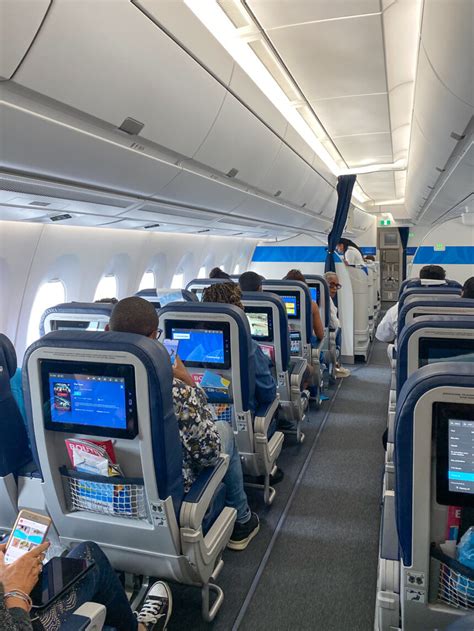
Air Caraïbes also operates the Airbus A350-900 in a high-density layout. Its aircraft feature 389 seats, including 326 economy seats, 45 premium economy seats, and 18 business class seats.
The A350-900 is shorter than the A350-1000, meaning the total benefit of adding an extra seat across each row is smaller. Nevertheless, Air Caraïbes demonstrates that even smaller widebody aircraft can become extremely efficient when configured for leisure-focused operations.
The airline’s Caribbean network makes this approach practical. Many passengers flying between France and overseas destinations prioritize competitive fares, making maximum seating capacity a valuable advantage.
Philippine Airlines: The Only Flag Carrier With Ten-Abreast A350-1000 Economy
Most high-density aircraft configurations come from low-cost carriers. However, Philippine Airlines represents an unusual case because it is a traditional national flag carrier operating a highly dense A350 layout.
The airline became the first flag carrier to configure its Airbus A350-1000 aircraft with ten seats across in economy class. Unlike French bee and Air Caraïbes, Philippine Airlines uses the newer A350 production standard, which provides approximately four additional inches of cabin width.
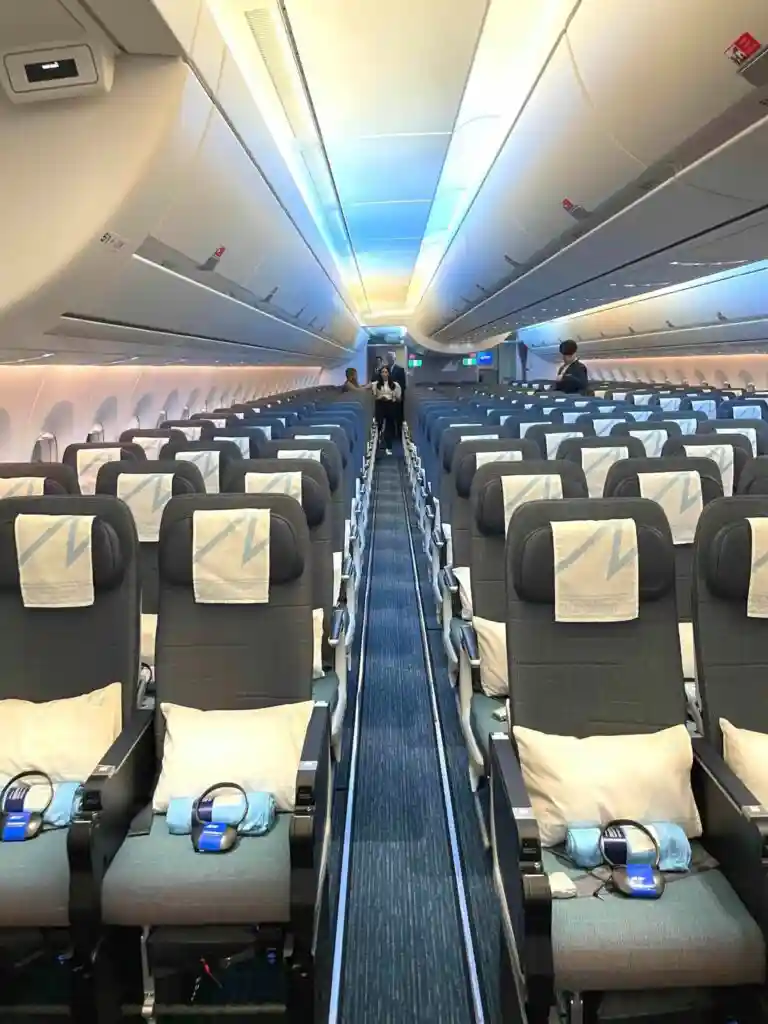
In aircraft interiors, small measurements can have a major impact. The extra width allows Philippine Airlines to provide seat widths of around 17 inches, slightly more generous than some earlier ten-abreast A350 layouts.
The airline’s A350-1000 aircraft were delivered beginning in late 2025 and represent a balance between capacity and passenger comfort. While the aircraft remains highly dense, the newer cabin standard reduces some of the compromises associated with squeezing ten seats into a row.
This configuration shows that high-density seating is not limited to ultra-low-cost airlines. Even full-service carriers may adopt higher-capacity layouts when operating long-haul routes with strong demand.
Cebu Pacific Airbus A330-900: The Highest-Density A330 In Service
The Philippines appears repeatedly among the world’s densest aircraft operators, and Cebu Pacific holds one of the strongest records in widebody seating density.
The airline operates Airbus A330-900neo aircraft configured with an impressive 459 seats. Unlike the A350, the A330 cabin is narrower and cannot realistically accommodate ten seats across. Instead, Cebu Pacific uses a nine-abreast layout to maximize capacity.
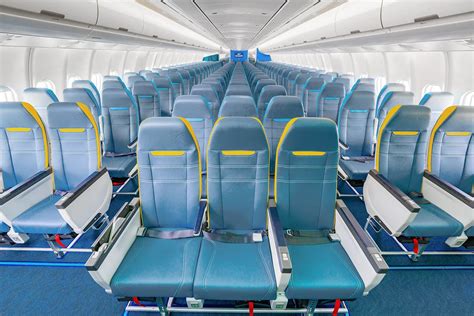
The all-economy configuration places these aircraft close to the maximum certified passenger capacity of approximately 465 seats. Remarkably, some Cebu Pacific A330neos can carry more passengers than many Airbus A380 aircraft operated by premium airlines.
The difference comes from the purpose of the aircraft. Airlines operating the A380 often install large business class cabins, premium suites, lounges, and spacious seating areas. Cebu Pacific takes the opposite approach by using the aircraft as a high-volume passenger transport platform.
These aircraft operate domestic and international leisure routes where affordable fares are the primary selling point. For many travelers, the ability to reach another country at a lower price outweighs the reduced personal space inside the cabin.
Why Boeing 777X Will Not Become The Density Champion
The upcoming Boeing 777X, particularly the 777-9 variant, is expected to become one of the largest commercial aircraft ever built. However, it is unlikely to challenge the highest-density aircraft records.
The reason is that Boeing designed the 777X for major full-service airlines operating premium long-haul routes. Unlike the Airbus A350-1000, which offers significant flexibility for high-density layouts, the 777X focuses more heavily on range, efficiency, and premium passenger experience.
Although the Boeing 777-300ER can be certified for up to around 550 passengers, the larger 777-9 is expected to have a lower maximum passenger certification because of exit configuration choices. Estimates suggest the aircraft may accommodate fewer than 500 passengers in maximum-density layouts.
This creates an interesting contrast between the two manufacturers. Airbus designed the A350 family with the flexibility to serve both premium airlines and high-density operators. Boeing positioned the 777X as a flagship aircraft for major international carriers.
The Future Of High-Density Economy Cabins
The growth of high-density economy cabins in 2026 reflects broader changes in global aviation. Low-cost airlines continue expanding, passengers increasingly search for affordable travel options, and airlines constantly look for ways to improve profitability.
Aircraft manufacturers are responding by creating more flexible cabin designs. Newer aircraft such as the A350 allow airlines to choose between comfort-focused layouts and maximum-capacity configurations.
The densest aircraft cabins will likely continue to come from airlines serving leisure markets, where ticket price remains the most important factor. While premium passengers may prefer wider seats and additional space, millions of travelers choose efficiency over luxury.
From Ryanair’s compact Boeing 737 MAX 8-200 to Cebu Pacific’s massive Airbus A330neo layouts, these aircraft demonstrate how far airlines can push modern cabin design. In 2026, the competition is not only about building larger aircraft—it is about using every inch of available space to carry more passengers around the world.