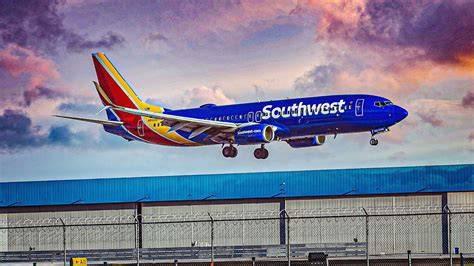
Southwest Airlines is expanding a part of its network that might seem surprising at first glance: ultra-short flights covering less than 125 nautical miles. While many passengers could reasonably drive these city pairs faster than they can complete an airport journey, these services serve a different purpose. They can connect smaller markets with major Southwest airports and feed passengers into the carrier’s broader network.
Between August 2026 and March 2027, one of every 81 Southwest flights is scheduled to cover less than 125 nautical miles, or about 232 kilometers. That is a substantial change from seven years earlier, when only one in every 286 services fell into this category. The growth reflects how Southwest has increasingly used short sectors to strengthen connectivity around major operating bases.
The airline’s overall network has an average stage length of approximately 676 nautical miles, according to the referenced Cirium Diio analysis. That remains comfortably within the short-haul range for which Southwest’s Boeing 737 fleet has traditionally been optimized. Yet the very shortest routes are particularly interesting because they demonstrate how the airline is using its aircraft beyond conventional point-to-point city pairs.
Denver–Colorado Springs Remains Southwest’s Shortest Route
At just 63 nautical miles (117 kilometers), Southwest’s service between Denver International Airport (DEN) and Colorado Springs Airport (COS) is the shortest route identified in the network. The service began in 2021, during the COVID-19 pandemic, and has now been operating for more than five years.
Initially, Southwest scheduled four daily departures between Denver and Colorado Springs. During the August 2026 through March 2027 period, the schedule calls for three daily flights, including service on Christmas Day. About 59% of these flights are scheduled with the 137-seat Boeing 737-700, highlighting the role of smaller-capacity aircraft on a route where demand is unlikely to justify larger equipment.
The route also provides an important example of why passenger numbers alone do not tell the entire story. In the 12 months through April 2026, the U.S. Department of Transportation recorded 276,789 Southwest passengers between DEN and COS. That made it the airline’s 40th-busiest route from Denver.
Southwest’s load factor on the city pair was 73.3%, below its network-wide average of 77.4% and its Denver average of 80.3%. United Airlines, which also operates between the airports, recorded a higher 79.9% load factor during the period. However, United frequently uses regional jets, meaning the number of seats offered and the role of the route within each carrier’s network are not directly identical.
Chicago–Milwaukee Adds Another Short Link
Southwest’s 70-nautical-mile Chicago Midway (MDW)–Milwaukee service is another remarkably short sector. The route launches in 2026, placing it among the newer additions to the airline’s network.
The city pair illustrates the changing strategy behind Southwest’s short routes. Chicago Midway is one of the carrier’s important operating airports, while Milwaukee provides access to another significant regional market. A short flight can therefore function less as a substitute for driving and more as a network connector, particularly for passengers continuing onward to destinations that would be inconvenient to reach by road.
The same logic appears across several other Southwest markets. Hawaii features extremely short inter-island sectors, while Florida and the Mid-Atlantic region contain additional examples designed around the carrier’s larger network.
Hawaii Features Several Ultra-Short Flights
Hawaii contributes some of Southwest’s shortest scheduled services. The 73-nautical-mile Kahului–Kona route has operated since 2020, while Honolulu–Kahului covers only 87 nautical miles and Honolulu–Lihue approximately 89 nautical miles. Both Honolulu routes were introduced in 2019.
Although these distances look tiny compared with mainland U.S. routes, geography changes the equation dramatically. The Pacific Ocean eliminates the possibility of driving between the islands, making air travel essential for practical inter-island transportation.

Florida and Arizona Expand the Short-Haul Network
Florida is another major source of Southwest’s ultra-short flying. Orlando–Sarasota, at 90 nautical miles, launched in 2025, while Orlando–Fort Myers covers 116 nautical miles and returned to Southwest’s network in 2020 after previously being served until 2012. Orlando–Palm Beach, at 123 nautical miles, also began in 2025.
Arizona contributes the 96-nautical-mile Phoenix–Tucson route, introduced in 2026. Meanwhile, Southwest operates 105 nautical miles between Baltimore/Washington and Richmond, a route launched in 2024.
The network also includes 119 nautical miles between Chicago Midway and Grand Rapids, a route dating back to 2016, and 123 nautical miles between Denver and Steamboat Springs, which began in 2020.
Baltimore–Philadelphia Will Join in 2027
One of the most notable additions is Southwest’s 78-nautical-mile Baltimore/Washington–Philadelphia route. The airline announced the new service in 2026, with flights scheduled to begin on March 11, 2027.
Southwest plans to operate the route twice daily. The service is particularly significant because Baltimore/Washington International Thurgood Marshall Airport (BWI) is a major connecting point for the airline. Between May 2025 and April 2026, approximately 8.7 million Southwest passengers connected through BWI, according to the referenced DOT data.
That makes the short Baltimore–Philadelphia flight less about replacing a road journey and more about feeding Southwest’s broader network. The strategy is similar to the role played by several other ultra-short routes: the aircraft covers a small distance, but the connectivity created at the airport can be considerably larger.
Why Southwest Keeps Adding Short Flights
Southwest’s growing collection of ultra-short routes demonstrates that distance is not necessarily the most important measure of a flight’s value. A 63-mile service can still make sense when it feeds a major connecting airport, protects access to an important market, or links locations separated by water.
The 13 routes identified for the August 2026 to March 2027 period range from 63 to 123 nautical miles. Some are longstanding services, while others are brand-new additions or recently restored routes. Together, they reveal a Southwest network increasingly willing to use short flights as strategic building blocks rather than simply as standalone journeys.