The modern airline network is often associated with ultra-long-haul journeys spanning continents, yet a fascinating countertrend is quietly unfolding. Delta Air Lines is doubling down on ultra-short-haul flying, unveiling a network of routes so brief they challenge traditional assumptions about air travel efficiency. At the center of this strategy lies a striking statistic: a flight covering just 64 nautical miles (119 km)—barely enough time for passengers to settle into their seats.
This evolving network reflects a deeper strategic logic. While Delta’s average stage length has climbed to 821 nautical miles in April 2026, among the highest in its history, the airline continues to maintain—and even refine—its shortest links. These routes are not anomalies; they are deliberate, high-frequency connectors feeding powerful hub ecosystems.
Why Ultra-Short Flights Still Matter in a Long-Haul World
Despite the aviation industry’s obsession with long-haul expansion, ultra-short routes play a critical role in sustaining hub-and-spoke systems. Delta’s network demonstrates that distance alone does not define value. Instead, connectivity, frequency, and passenger flow determine profitability.
Short routes serve as feeder arteries, channeling passengers from smaller regional markets into major hubs like Detroit, Atlanta, and Minneapolis. From there, travelers disperse across domestic and international networks. This explains why even routes with modest load factors remain viable—they are not endpoints but critical links in a broader revenue chain.
Delta’s current strategy highlights a post-pandemic recalibration. With demand patterns shifting and regional travel stabilizing, the airline has optimized these short hops to maximize connectivity rather than point-to-point demand.
The 64-Mile Benchmark: Detroit to Lansing
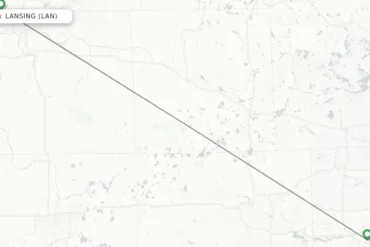
At the heart of Delta’s ultra-short network is the route between Detroit and Lansing. Covering just 64 nautical miles, this intrastate connection stands as the airline’s shortest active route in April 2026.
Flights typically last around 20 minutes, making them among the briefest scheduled commercial services in the United States. The experience is almost surreal—boarding, takeoff, and descent occur in rapid succession, leaving little time for anything beyond essential service.
Yet the numbers tell a deeper story. In 2025, nearly 99.3% of passengers on this route were connecting travelers. Lansing itself is not the destination; Detroit is the gateway. Popular onward routes include Orlando, Atlanta, Minneapolis, Boston, and Washington Reagan, illustrating how a short hop can unlock global mobility.
Even with a seat load factor of 64.4%, the route remains operationally relevant. Its purpose is not to fill seats in isolation but to feed higher-yield long-haul and transcontinental flights.
A Network of Precision: Delta’s 10 Shortest Routes
Delta’s ultra-short network extends beyond a single route, forming a carefully calibrated system of short-haul links. These routes range from 64 to 104 nautical miles, each tailored to specific regional and hub dynamics.
Among the most notable connections are:
- Detroit to Lansing (64 nm)
- Minneapolis to Rochester (66 nm)
- Atlanta to Columbus, Georgia (72 nm)
- Detroit to Cleveland (83 nm)
- Detroit to Saginaw (85 nm)
- Atlanta to Chattanooga (92 nm)
- Los Angeles to San Diego (95 nm)
- Detroit to Kalamazoo (98 nm)
- Minneapolis to Brainerd (99 nm)
- Detroit to Grand Rapids (104 nm)
These routes are characterized by high frequency and regional jet dominance, ensuring flexibility and cost efficiency. Aircraft such as the CRJ700, CRJ900, and Embraer E175 are ideally suited for these missions, balancing capacity with operational economics.
Atlanta to Chattanooga: The Exception That Proves the Rule
Among Delta’s shortest routes, one stands apart: Atlanta to Chattanooga. At 92 nautical miles, it is not the shortest, but it is unique for its use of mainline aircraft, specifically the Boeing 717.

This route operates with remarkable intensity, reaching up to nine daily departures. The inclusion of the 717—typically reserved for higher-capacity operations—signals strong demand and strategic importance. With around 110 seats, the aircraft bridges the gap between regional efficiency and mainline capacity.
The decision to deploy the 717 here reflects Delta’s ability to match aircraft size with market dynamics, ensuring optimal utilization across its fleet.
Historical Context: Even Shorter Routes Once Existed
While today’s 64-mile route is impressive, it is not unprecedented. Delta’s history includes even shorter connections, particularly those inherited from Northwest Airlines.
Routes such as Detroit to Toledo (43 nautical miles) and Detroit to Flint (49 nautical miles) once operated within the network. These ultra-compact segments highlight how airline strategies evolve alongside infrastructure, demand, and competition.
Their disappearance underscores a key reality: ultra-short routes must justify their existence through connectivity value, not just geographic proximity.
Operational Realities of Ultra-Short Flying
Operating flights of such short duration presents unique challenges. Turnaround times must be minimized, fuel burn must be tightly controlled, and scheduling precision becomes critical.
From a passenger perspective, the experience is equally distinctive. There is little time for inflight service, and the journey feels more like an extension of airport transit than traditional air travel. Yet the convenience of bypassing lengthy ground transportation often outweighs these limitations.
For airlines, the economics hinge on frequency and network integration. A single underperforming flight may seem inefficient, but when integrated into a broader system, it becomes a vital component of revenue generation.
Strategic Implications for Delta’s Network Future
Delta’s ultra-short routes reveal a broader strategic philosophy: balance scale with precision. While the airline continues to expand long-haul offerings, it recognizes that network strength begins with efficient regional connectivity.
The 11% increase in average stage length since 2019 demonstrates growth in long-distance travel, yet the persistence of these short routes highlights their enduring importance. They are not relics of the past but essential tools for modern network optimization.
As competition intensifies among major U.S. carriers, the ability to seamlessly integrate short and long-haul operations will define success. Delta’s approach—leveraging ultra-short flights as high-frequency feeders—positions it to maximize both passenger flow and revenue efficiency.
Conclusion: Small Distances, Outsized Impact
The idea of a 20-minute commercial flight may seem counterintuitive in an era of global aviation, yet Delta’s network proves its value. These ultra-short routes are not about distance—they are about connection, strategy, and precision execution.
By maintaining and refining these links, Delta ensures that even the smallest markets remain plugged into a vast global network. In doing so, it transforms seemingly insignificant distances into powerful drivers of connectivity and growth.