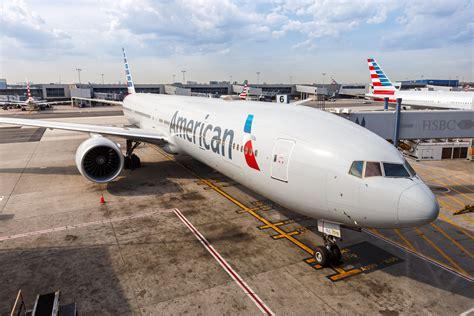
American Airlines is preparing to launch one of the most unusual flights in modern commercial aviation—a 142-mile international hop operated by a Boeing 777-300ER, one of the largest and longest-range passenger aircraft in service. The route, linking Buenos Aires (EZE) and Montevideo (MVD), is not designed for convenience or demand. Instead, it is a precise operational response to a temporary but highly disruptive runway limitation at Argentina’s primary international gateway.
This short segment, lasting barely enough time for a full beverage service, will briefly become the shortest Boeing 777 route in the airline’s global network, highlighting how infrastructure constraints can reshape airline strategy in unexpected ways. What might seem like a novelty is, in reality, a carefully calculated workaround to preserve long-haul connectivity during a critical infrastructure upgrade.
Why a Boeing 777 Is Flying Just 142 Miles
The core reason behind this unusual deployment lies in runway restrictions at Ministro Pistarini International Airport (EZE). Beginning in late October 2026, the airport will undergo a phase of construction that reduces the usable runway length to just 1,850 meters, down from its standard 3,300 meters. For fully loaded widebody aircraft, especially long-haul configurations like the Boeing 777-300ER, this limitation is decisive.
A fully fueled 777 requires significantly more runway to safely take off. Faced with this constraint, American Airlines has opted for a “fuel stop” strategy:
- Depart Buenos Aires with a reduced fuel load
- Fly a short sector to Montevideo
- Refuel to full capacity
- Continue onward to long-haul destinations in the United States
This operational adjustment allows American to maintain service continuity without compromising safety or payload efficiency.
Routes Affected: Miami and New York Flights Reimagined
The temporary routing change will impact two of American Airlines’ flagship long-haul services from Buenos Aires:
- AA908: Buenos Aires (EZE) → Montevideo (MVD) → Miami (MIA)
- AA954: Buenos Aires (EZE) → Montevideo (MVD) → New York (JFK)
Both routes are typically operated as nonstop daily flights using the Boeing 777-300ER, a workhorse for high-demand international corridors. However, between October 25 and November 11, these flights will incorporate the Montevideo stop, transforming their operational profile.
Interestingly, another Miami-bound service—AA934, operated by the smaller Boeing 787-8—remains scheduled as a nonstop flight for now. Yet even this aircraft may face limitations, given that its required takeoff distance still exceeds the temporarily reduced runway length at EZE.
A Widebody Oddity: Redefining Short-Haul Aviation
A 142-mile flight on a Boeing 777-300ER is not just rare—it is almost paradoxical. Designed for ultra-long-haul missions exceeding 7,000 miles, the aircraft will instead perform a segment that could be completed in under 40 minutes.
To put this into perspective, the next shortest widebody route in American Airlines’ network—Miami to Charlotte—covers 651 miles, more than four times the distance of the EZE-MVD leg. This makes the Buenos Aires–Montevideo hop a standout anomaly, even in an industry accustomed to operational flexibility.
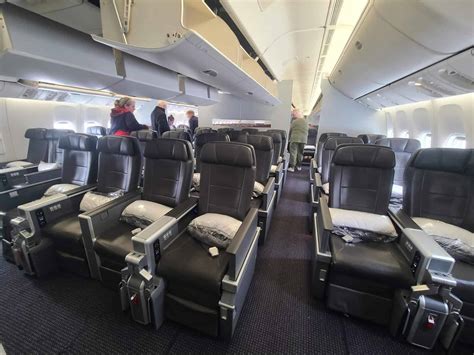
From a passenger standpoint, the experience may feel unusual. A long-haul aircraft with premium cabins, lie-flat seats, and extensive inflight amenities will be deployed on a route barely long enough for initial climb and descent phases to dominate the journey.
The Strategic Importance of Montevideo
Montevideo’s Carrasco International Airport (MVD) plays a crucial supporting role in this temporary network redesign. Located just across the Río de la Plata, it offers sufficient runway length and infrastructure to handle fully loaded widebody departures.
By leveraging Montevideo as a refueling point, American Airlines effectively creates a micro-hub operation, ensuring that its long-haul flights can depart with optimal payload and range. This approach is not entirely unprecedented, but its application on such a short sector is highly distinctive.
At the same time, American will be the only airline operating this specific route segment, as most carriers serving Buenos Aires use Aeroparque Jorge Newbery (AEP) for regional flights to Uruguay.
A $100 Million Transformation at Ezeiza
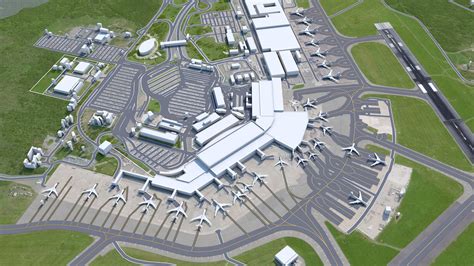
Behind this operational shift lies a broader infrastructure initiative. Aeropuertos Argentina is investing over $100 million into Ezeiza Airport, aiming to enhance efficiency, safety, and capacity across multiple fronts.
Key elements of the project include:
- Construction of a new apron (Platform Golf) for narrowbody aircraft
- Rehabilitation of the secondary runway (17/35)
- Upgrades to taxiways and lighting systems
- Improvements to passenger and cargo facilities
While these enhancements promise long-term benefits, the short-term impact is significant. For a period of nearly three weeks, Ezeiza—handling over 12 million passengers annually—will operate under constrained conditions that ripple across global airline networks.
Global Ripple Effects: Airlines Forced to Adapt or Withdraw
American Airlines’ creative workaround stands in stark contrast to the decisions of its competitors. Delta Air Lines and United Airlines have opted to suspend their Buenos Aires services entirely during the affected period, avoiding the operational complexity of rerouting or payload restrictions.
The disruption extends far beyond North America. Several international carriers operating long-haul routes to Ezeiza face similar challenges:
- Lufthansa’s Boeing 747-8 flights from Frankfurt cannot operate under reduced runway conditions
- KLM is considering rerouting via Santiago
- Emirates plans to terminate its Dubai–Rio de Janeiro service without continuing to Buenos Aires
- Air Europa is shifting capacity toward Montevideo
These adjustments underscore a critical reality: airlines must choose between rerouting, reducing payload, or suspending service altogether. Each option carries financial and logistical trade-offs, especially on ultra-long-haul routes where margins are tightly managed.
Operational Creativity vs. Economic Practicality
American Airlines’ decision reflects a balance between operational ingenuity and commercial pragmatism. By maintaining service through a short refueling stop, the airline preserves revenue streams, protects market presence, and avoids the reputational impact of cancellations.
However, this approach is not universally viable. For many carriers, the added complexity of intermediate stops—especially in regions with limited slot availability or infrastructure—can outweigh the benefits. This explains why suspension remains a common response.
The temporary nature of the disruption also plays a role. With the runway restrictions lasting just over two weeks, airlines must weigh whether short-term adjustments justify the operational overhaul required.
A Rare Aviation Moment with Lasting Implications
While the 142-mile Boeing 777 flight will exist only briefly, it offers a fascinating glimpse into the adaptability of modern airline operations. It demonstrates how even the largest aircraft can be redeployed in unconventional ways when infrastructure constraints demand flexibility.
For aviation enthusiasts, this represents a rare opportunity to witness a widebody aircraft performing a mission far removed from its intended design. For industry professionals, it serves as a case study in crisis management, network resilience, and strategic decision-making.
As Ezeiza’s upgrades progress and normal operations resume, the Buenos Aires–Montevideo segment will likely fade into aviation trivia. Yet its significance lies in what it reveals: that even in a highly optimized global system, unexpected constraints can give rise to remarkably creative solutions.