Delta Air Lines is often celebrated for operating some of the longest domestic flights in the United States, including the sprawling Boston–Honolulu sector that stretches more than 5,000 miles across the Pacific. Yet the true backbone of Delta’s network is not found in marathon journeys over oceans, but in compact, high-frequency sectors that measure barely more than a highway drive. In February 2026, Delta’s shortest US domestic route spans just 74 miles, a distance that perfectly illustrates how modern hub-and-spoke aviation thrives on precision, connectivity, and relentless efficiency.
These ultra-short corridors may seem modest in mileage, but they carry strategic weight. They funnel travelers from regional communities into powerful hubs like Detroit Metropolitan Wayne County Airport (DTW) and Hartsfield-Jackson Atlanta International Airport (ATL), where global connectivity begins. Without these short flights, the reach of Delta’s long-haul ambitions would be significantly constrained.
The 74-Mile Lifeline: Lansing to Detroit
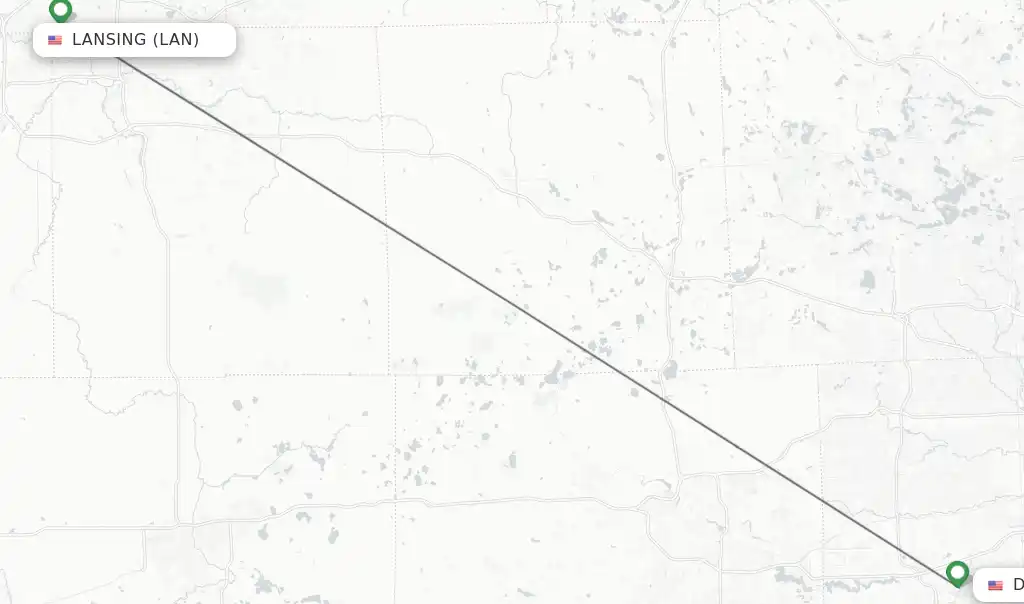
The shortest Delta-marketed route in the United States currently links Capital Region International Airport (LAN) in Lansing, Michigan, with Detroit’s sprawling DTW hub. Covering just 74 miles (119 kilometers), the flight lasts as little as 48 minutes block time, making it one of the briefest scheduled jet services in the country.
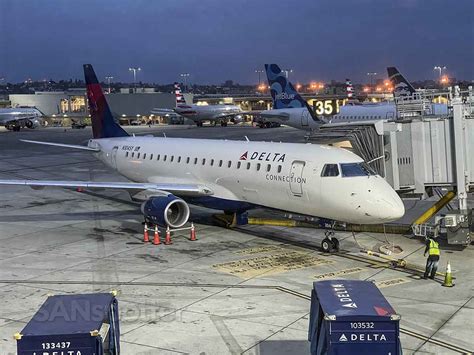
In February 2026, Delta scheduled 78 flights in each direction on this route. That equates to multiple daily rotations, ensuring seamless access for business travelers, government officials, and connecting passengers. Rather than deploying mainline aircraft, Delta entrusts the route to SkyWest Airlines, operating under the Delta Connection banner with Bombardier CRJ regional jets. These rear-engined twinjets are engineered for precisely this mission: short hops, quick turnarounds, and efficient feeder operations.
Detroit serves as far more than a transfer point. It is a fully developed global gateway featuring five Delta Sky Clubs and extensive domestic and international departures. For Lansing passengers, that 74-mile sector is effectively a bridge to Europe, Asia, and beyond. The route’s brevity belies its impact.
Under 100 Miles: A Network of Micro-Routes
Delta’s commitment to short-haul connectivity extends well beyond Lansing. Four additional routes fall under the 100-mile threshold, each reinforcing key Midwestern and Southern markets.
The most frequently operated is the 95-mile route between Detroit and Cleveland Hopkins International Airport (CLE). In February 2026, this corridor sees 132 rotations, split between SkyWest and Endeavor Air. Both carriers rely heavily on the CRJ series, reflecting a deliberate standardization strategy for short-haul efficiency. The Detroit–Cleveland sector exemplifies how Delta sustains high-frequency service in competitive regional markets.
Slightly longer at 98 miles, the route connecting Detroit with MBS International Airport—serving Midland, Bay City, and Saginaw—underscores Delta’s regional reach within Michigan. With 84 rotations scheduled, this corridor operates as a dependable shuttle, typically clocking in around an hour from gate to gate.
Further south, Delta maintains an 83-mile link between Atlanta (ATL) and Columbus, Georgia (CSG). Operated by Endeavor Air’s CRJs, this route strengthens Atlanta’s dominance as the world’s busiest airport while providing smaller communities with direct access to a global superhub.
Meanwhile, in Minnesota, the 76-mile Minneapolis (MSP) to Rochester (RST) service operates 78 times in each direction. Here, Delta mixes Endeavor’s CRJs with SkyWest’s Embraer E175 aircraft, introducing slightly larger capacity while preserving short-haul economics.
These sub-100-mile sectors are not anomalies. They are carefully calibrated components of Delta’s broader network strategy, designed to maximize passenger flow into its core hubs.
Regional Jets: Precision Tools for Short-Haul Strategy
Every route under 100 miles in Delta’s current schedule shares a defining characteristic: operation under the Delta Connection regional brand. This outsourcing model allows Delta to deploy right-sized aircraft while maintaining brand consistency and network integration.
The Bombardier CRJ family, known for its rear-mounted engines and narrow fuselage, remains a staple of these ultra-short routes. With seating configurations typically ranging between 50 and 76 passengers depending on variant, CRJs strike a balance between operating cost and frequency. Their quick climb performance and compatibility with smaller airports make them ideal for Midwestern and Southern feeder markets.
The Embraer E175, meanwhile, offers improved cabin comfort and slightly higher capacity, often featuring first-class seating and enhanced legroom compared to older regional designs. Its presence on short routes signals Delta’s focus on passenger experience, even over distances that can feel barely airborne.
In aviation economics, profitability on such short sectors depends on rapid aircraft utilization and minimal ground time. Turnarounds are streamlined, flight crews operate tight schedules, and connections are optimized within hub banks. Every minute counts.
The Shortest Mainline Delta Flight
While regional partners dominate the ultra-short spectrum, Delta’s own mainline fleet also operates a remarkably brief domestic sector. The 106-mile route between Chattanooga Metropolitan Airport (CHA) and Atlanta (ATL) stands as Delta’s shortest mainline flight.
This service utilizes the Boeing 717-200, a compact yet capable twinjet equipped with 12 first-class and 98 economy seats. The aircraft’s rear-mounted engines and robust climb performance make it well-suited to short, high-frequency missions. Up to three daily departures connect Chattanooga directly to Atlanta’s massive hub complex.

The distinction here is significant. Unlike Delta Connection services, this route is operated by Delta pilots and crew as part of its primary fleet. At just over 100 miles, it illustrates how even mainline aircraft are strategically deployed on short sectors when passenger demand and operational logic align.
Why Ultra-Short Flights Matter
Short domestic routes may lack the glamour of transcontinental or transpacific journeys, but they form the connective tissue of Delta’s network. They enable:
- Hub concentration, ensuring optimal load factors on long-haul flights
- Community access, linking smaller cities to global destinations
- Fleet optimization, matching aircraft size to demand
- Schedule frequency, supporting business travel flexibility
In a network carrier model, reach is everything. A 74-mile flight may appear insignificant on a map, yet it unlocks thousands of onward possibilities. Aviation thrives on these hidden arteries.
Delta’s shortest routes reveal an essential truth about airline strategy: scale is not merely about distance. It is about integration. From Lansing’s runway to Honolulu’s tropical horizon, the journey often begins with a flight shorter than a commuter train ride.