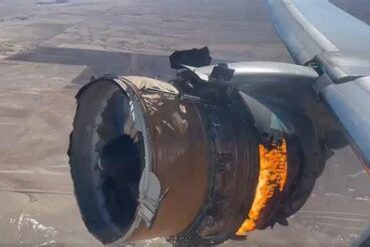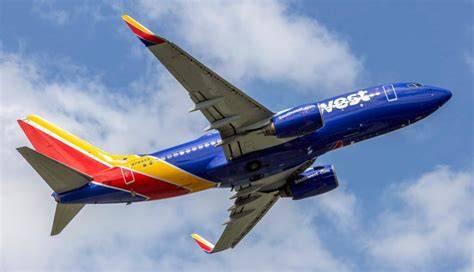
Shortly after lifting off from John Wayne Airport in Santa Ana on Friday, Southwest Airlines flight WN3396 stopped its climb, squawked 7700, and turned southwest toward Los Angeles. The 19-year-old Boeing 737-700 had lost power to its #2 engine minutes into a routine one-hour hop to San José, forcing the crew into one of aviation’s most demanding scenarios: managing a single-engine jet over densely populated Southern California while coordinating an emergency diversion to Los Angeles International Airport (LAX).
WN3396 Loses Its #2 Engine After Departing John Wayne Airport
The jet pushed back from the gate at 11:49, fourteen minutes behind its 11:35 schedule, then climbed out of SNA in a north-easterly direction before the engine issue forced a sharp turn southwest toward the Los Angeles South Bay. According to CodeThreeNews, the crew confirmed to air traffic control that 97 souls were onboard when the failure struck. Flight data shows the aircraft never climbed above 5,000 feet (1,524 meters), a deliberate profile that kept the jet within easy reach of runways while the pilots worked through emergency checklists and burned fuel down to a safe landing weight.
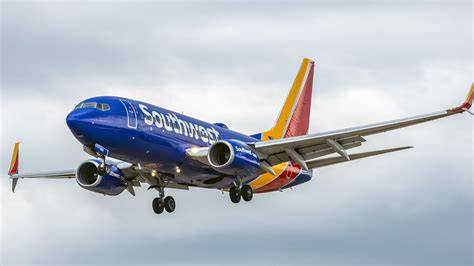
That prolonged low-altitude orbit was not hesitation but procedure. With one engine producing asymmetric thrust, the jet wants to yaw and roll toward the dead side, so the pilots apply opposite rudder and aileron to hold the aircraft level. Keeping the altitude low and the airspeed controlled bought the crew time to run through the single-engine landing checklist, confirm the nature of the failure, and pick the best runway without committing to a rushed approach.
FAA and Southwest Confirm Safe Landing at Los Angeles International Airport
The Federal Aviation Administration released a concise statement obtained by the Los Angeles Times confirming that the flight “landed safely at Los Angeles International Airport around 12:25 p.m. local time after the crew reported an engine issue.” A Southwest spokesperson offered more detail, explaining that the pilots received an “engine-related maintenance indication” while flying from John Wayne Airport to San Jose Mineta International Airport, followed established procedures, and landed the aircraft uneventfully. The airline praised the professionalism of its pilots and flight crew and confirmed that customers would be accommodated on other flights to San Jose.
The distinction between a confirmed catastrophic engine failure and a maintenance indication matters in how such events are investigated. An indication may reflect a sensor fault, an exceedance, or genuine mechanical damage, and crews are trained to treat any abnormal engine signal as real until proven otherwise. Southwest’s framing, alongside the 7700 squawk, suggests a crew that erred on the side of caution rather than one that waited for certainty.
N281WN: The 19-Year-Old 737-700 That Carries Southwest History
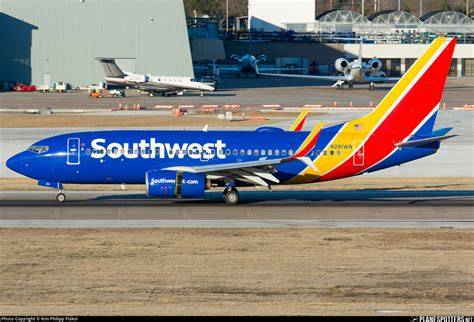
The aircraft at the center of the incident, registration N281WN, is no ordinary airframe. Delivered to Southwest in June 2007, it was the 500th Boeing 737 handed to the Dallas-based carrier and still wears a commemorative sticker on its fuselage marking that milestone. Its first flight took place on June 20, 2007, with delivery following on June 28, giving it roughly 19.4 years of active service. The jet, serial number 36528 and line number 2307, is a 737-7H4 configured for 143 passengers in an all-economy layout and powered by two CFM56-7B24 engines.
Southwest operates an all-Boeing 737 fleet and remains the world’s largest operator of the 737-700, with around 270 of the type still in service according to ch-aviation. That makes N281WN a familiar workhorse rather than an outlier, flying the airline’s dense short-haul network across the United States.
Flight Track: Circling Over the Pacific Before Runway 25L
Reviewing data from the Simple Flying Flight Tracker, WN3396 spent roughly 18 minutes over the Pacific Ocean after the emergency declaration before being cleared to land. The jet touched down safely on Runway 25L at 12:28, 38 minutes after departing Santa Ana, with emergency services meeting the aircraft on arrival. Passengers disembarked with no reports of injury, and affected travelers were reaccommodated onto a replacement flight scheduled to leave at 1:13 p.m.
The timeline reflects a textbook single-engine diversion: an immediate turn away from terrain and traffic, a level-off at low altitude, a controlled orbit to manage fuel and workload, and a stabilized approach to a long, well-equipped runway with full emergency support standing by.
How Pilots Handle an Engine Failure on Takeoff
An engine failure on takeoff is the scenario every airline crew rehearses until the responses become reflex. If the aircraft has not yet reached decision speed, the crew rejects the takeoff and stops on the runway. Beyond that point, the takeoff is continued, with the flying pilot using rudder and aileron to counter the asymmetric thrust while the other pilot runs the checklist and declares an emergency. Pre-calculated climb gradients ensure the jet can clear obstacles on one engine, and once airborne, the crew may circle to burn or dump fuel before landing.
Friday’s outcome, a safe landing, 97 people unharmed, and a swift rebooking, is the result of that training working exactly as designed. For Southwest, the incident also highlights the maturity of its 737-700 fleet: a jet nearly two decades old, still carrying its historic sticker, performing precisely as its crews were trained to expect.