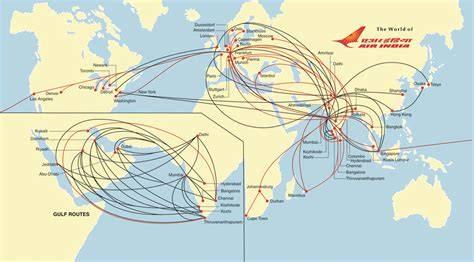
Air India has quietly redrawn a substantial slice of its route map, ending seventeen nonstop services across Europe, the Middle East, and its own domestic backyard, while handing most of the affected flying to its low-cost sister carrier, Air India Express. The retrenchment lands in the same year the flag carrier opened new long-haul chapters, including Mumbai–Toronto and an upcoming Delhi–Osaka Kansai link, making the airline a case study in how a full-service operator sharpens its network without abandoning growth.
Why Air India Cut 17 Nonstop Routes Across Europe, the Gulf, and India
The pressures behind the cuts are structural rather than seasonal. Rising fuel prices have squeezed margins on thinner point-to-point services, and operational constraints tied to the closure of Pakistani airspace continue to stretch flight times and crew duty hours on routes heading west. Those two forces together make short and medium-haul nonstop flying with widebody metal uneconomic in ways that fleet planners cannot easily absorb. Rather than defend every city pair with full-service capacity, Air India is concentrating its resources where premium demand is deepest.
The second driver is the architecture created when the Tata Group consolidated its four airlines into two in 2024, merging Vistara into Air India and AIX Connect into Air India Express. That structure now gives the group a clear split: Air India flies long-haul and trunk routes, while Air India Express absorbs price-sensitive, point-to-point traffic that never needed a full-service cabin to begin with.
Europe Loses Three Delhi Nonstops as Pakistan Airspace Woes Bite
The European retrenchment is concentrated on Delhi’s Indira Gandhi International Airport (DEL). Delhi–Birmingham (BHX) ended earlier this month, meaning the West Midlands no longer holds any nonstop connection to the Indian capital. Delhi–Vienna (VIE) closes in October, a cut that removes Austria’s only direct link to India entirely. Delhi–Copenhagen (CPH) disappears the same month, stripping Denmark’s capital of its Air India service. For travellers in those markets, the practical effect is a return to one-stop itineraries through Gulf or European hubs, a shift that hands connecting traffic back to competitors such as Emirates, Qatar Airways, and Lufthansa Group carriers.
Gulf Cuts: Riyadh, Dubai, and Chennai’s International Exit
In the Middle East, the withdrawals run through Dubai International Airport (DXB) and one service to King Khalid International Airport (RUH) in Riyadh. Delhi–Riyadh ends in October and returns as a four-weekly Air India Express operation from December. Kochi–Dubai and Hyderabad–Dubai both close in March, replaced by up to two daily and five-weekly Air Express flights respectively. The sharpest cut is Chennai–Dubai, which ends in March and amounts to a complete withdrawal from Chennai’s international market for the parent carrier, with Chennai–Singapore following in May under a two-daily Air India Express schedule.
| Route | End Month 2026 | Remark |
|---|---|---|
| Delhi – Birmingham | November | No direct connection to Delhi |
| Delhi – Vienna | October | Austria’s only India link removed |
| Delhi – Copenhagen | October | Withdrawn |
| Delhi – Riyadh | October | Air India Express, 4x weekly from December |
| Chennai – Singapore | May | Air India Express, 2x daily |
| Chennai – Dubai | March | Complete Chennai international withdrawal |
| Hyderabad – Dubai | March | Air India Express, 5x weekly |
| Kochi – Dubai | March | Air India Express, up to 2x daily |
Domestic Cuts Shift to Air India Express at Non-Metro Airports
Domestically, the pattern is a deliberate handover. Air India Express has taken over the group’s operations at several non-metro airports, including Aurangabad, Bhopal, Coimbatore, Jamnagar, Jodhpur, Madurai, and Tirupati, and now serves 48 domestic and 16 international destinations. Mumbai–Coimbatore and Mumbai–Jamnagar end in August, each running twice daily on the low-cost carrier. Mumbai–Bhopal closes in July, flying daily until month-end before restarting in April 2027. Mumbai–Varanasi (twice daily), Delhi–Aurangabad (twice daily), Hyderabad–Tirupati (daily), and Chennai–Madurai all shift in August, while Delhi–Goa Mopa moves in May and reaches three daily from December.
Air India Express Winter Schedule Grows 5.1 Percent Despite Handovers
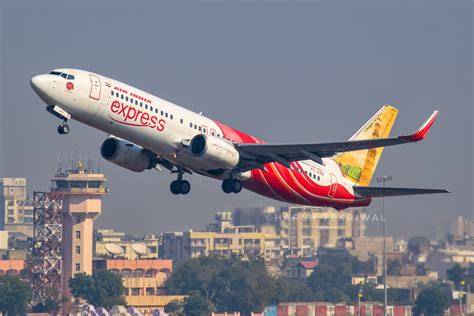
The handover strategy is not a contraction for the group so much as a reallocation. For the current winter season, Cirium schedule data shows Air India Express operating 78,202 flights, up 5.1 percent from 74,374 last winter. The carrier fields more than 70 daily international flights alongside up to 390 daily domestic flights, capacity the parent airline could not deploy profitably on the same city pairs.
New Long-Haul Additions Offset the Route Withdrawals
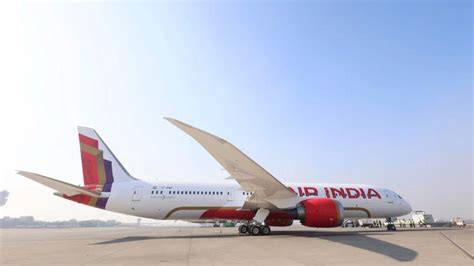
The additions tell the other half of the story. In May, Air India launched five weekly Delhi–Hanoi (HAN) flights to Vietnam’s Noi Bai International Airport. The following month brought four weekly Mumbai (BOM)–Tokyo Haneda (HND) services on Boeing 787-8 aircraft. Last month it began a winter seasonal Mumbai–Toronto Pearson (YYZ) link, and from February 2, 2027, it will fly four weekly Delhi–Osaka Kansai (KIX) services on the 787-8, becoming the only airline offering nonstop flights between India and Osaka.
What the Air India Route Cuts Mean for Travellers Booking Winter 2026
Bookers should treat the change sheet as a live document rather than history. Direct Delhi access to Birmingham, Vienna, and Copenhagen is gone, and Chennai has no Air India international presence at all. Yet most Gulf and domestic city pairs survive in Air India Express colours, often with comparable frequency, so passengers keep the connection while accepting a single-cabin product and lighter baggage allowances. Anyone holding tickets should confirm operating carrier and terminal assignments before departure, since a route can persist while the airline code, seat map, and loyalty accrual quietly change beneath it.