United Airlines is quietly reshaping one of the most extensive narrowbody international networks in the United States, and the Boeing 737 MAX sits at the center of that shift. Fleet data from ch-aviation shows the Chicago-based Star Alliance founding member operating 123 737 MAX 8s and 188 737 MAX 9s, with another 35 MAX 9s on order as its mainline fleet modernizes. That is a formidable piece of metal, and United has spent years deploying it well beyond domestic corridors, using the type’s range and economics to open and sustain transatlantic and Caribbean missions that were once the preserve of widebodies.
Why United Is Pulling the 737 MAX From So Many 737 MAX International Routes
Comparing United’s 2027 schedules with its 2026 plan, aviation analytics firm Cirium reveals that the carrier has taken the MAX off no fewer than 27 international routes. Those cuts are spread across six hubs—two on the East Coast, two on the West Coast, and two in the center of the country. The pattern is not random: heavy Canada exposure, thinning Caribbean and Mexico frequencies, and a clear preference for protecting the type’s highest-yield missions. In practical terms, United is rebalancing capacity rather than retreating, shifting MAX hulls toward routes where the aircraft’s premium cabin and fuel efficiency generate the strongest returns.
East Coast Cuts: Newark and Dulles Lose 737 MAX International Flights
Newark Liberty International Airport (EWR) has escaped relatively lightly, losing the MAX on just two international routes: Piarco International Airport (POS) in Trinidad and Vancouver International Airport (YVR) in Canada. That restraint matters because Newark remains an enormous operation—United’s November schedule alone lists 11,531 departures and 1,746,420 seats from the New Jersey hub. Dulles is substantially leaner at 7,830 departures and 976,993 seats, and it absorbs a wider set of losses, including MAX service to three Canadian destinations: Vancouver, Calgary International Airport (YYC), and Toronto Pearson International Airport (YYZ). Dulles also drops its MAX flying to Barbados, Liberia, and Nassau in the Caribbean.
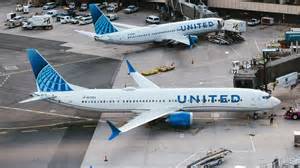
Central Hubs: Houston Leads All United Airports in MAX Route Removals
George Bush Intercontinental Airport (IAH) is where United has pulled the MAX from the most routes, eight corridors in total. Two are Canadian—Calgary and Toronto Pearson—while three Mexican destinations follow: Cozumel, San Jose del Cabo, and Puerto Vallarta. The remaining trio is Caribbean: Flamingo International Airport (BON) in Kralendijk on Bonaire, Owen Roberts International Airport (GCM) near George Town on Grand Cayman, and Santo Domingo Airport (SDQ) in the Dominican Republic. At Chicago O’Hare International Airport (ORD), four cuts land: Montreal Trudeau (YUL), Vancouver, Philip S.W. Goldson International Airport (BZE) in Belize City, and Nassau.
West Coast Cuts: San Francisco and Los Angeles Lose Six Combined
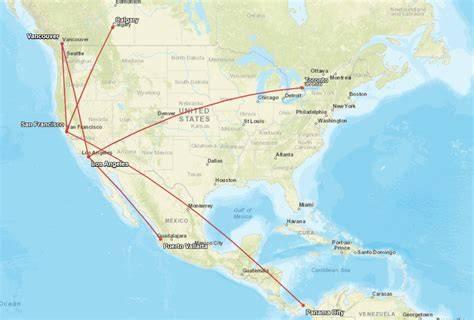
United’s two California gateways each surrender the MAX on three international routes. Los Angeles International Airport (LAX) drops Puerto Vallarta, Toronto Pearson, and Vancouver, while San Francisco International Airport (SFO) loses Vancouver, Calgary, and Tocumen International Airport (PTY) in Panama City. The scale of what remains still tells the real story: in the 12 months to October 2027, United has planned 26,868 MAX flights from SFO and 11,132 from LAX. Those figures confirm the aircraft is nowhere near leaving the West Coast—it is simply being concentrated on the densest, most premium-heavy missions.
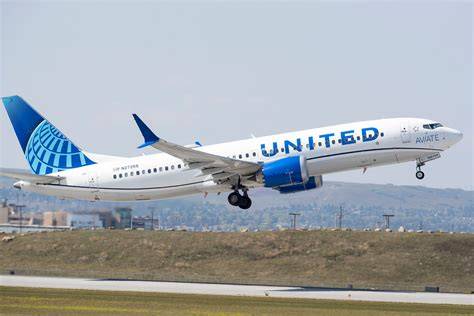
What the 737 MAX Cabin Means for Passengers on These Jet Streams
Passenger experience explains much of United’s calculus. The airline’s MAX 9 carries 20 domestic first-class recliners and 159 economy seats, 45 of them with extra legroom. The smaller MAX 8 seats 16 in domestic first class and 150 in economy, 54 with extra legroom. That two-class configuration with meaningful premium capacity makes the MAX ideal for business corridors such as Toronto and Vancouver, and equally attractive on leisure routes where travelers will pay for space. Where demand softens, United can shift the same airframe elsewhere without reconfiguring cabins.
Which United Hub Lost the Most International 737 MAX Routes?
The answer is Houston George Bush Intercontinental, with eight routes—more than any other United hub. Newark and Dulles combined account for the East Coast share, O’Hare adds four, and the California hubs contribute three apiece. For travelers, the practical effect is straightforward: itineraries to Canada, the Caribbean, and Mexico that previously listed a MAX may now show different equipment or connections. United’s MAX fleet expansion promises more flying in the years ahead, just not on these 27 corridors.