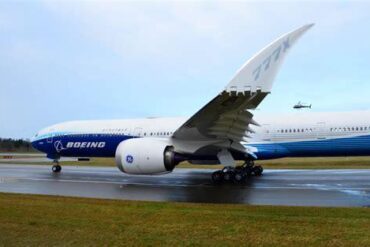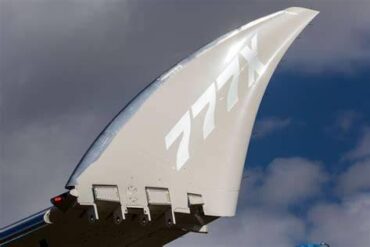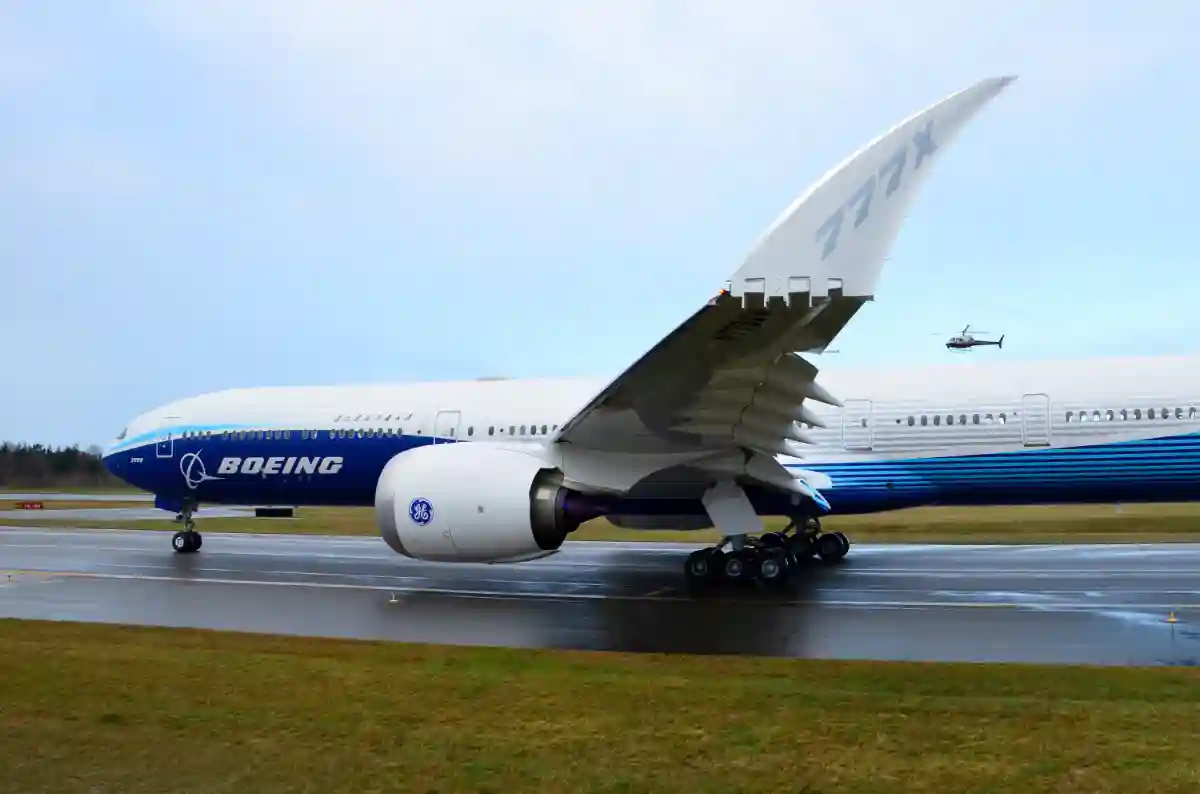
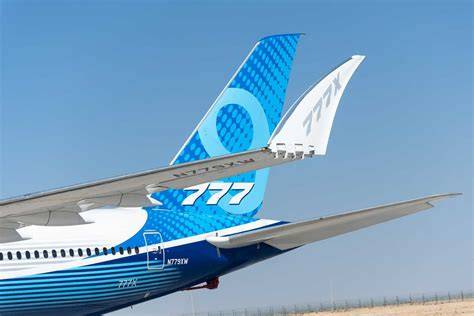
The Boeing 777X is built around a paradox. It carries the widest wing the company has ever put on an airliner, a carbon-composite structure spanning 235 feet five inches (71.76 meters) when fully deployed, yet it must squeeze into airport gates and taxiways designed for a jet that is roughly 23 feet narrower. Boeing’s answer is a folding wingtip system, the first of its kind on a commercial airliner, and the way crews interact with it is deliberately asymmetric. Pilots must manually extend the tips before takeoff. After landing, the aircraft folds them without being asked.
That split personality is not an oversight or a quirk left in the flight logic. It reflects two very different phases of flight, two very different cockpit environments, and two very different sets of risks. On departure, extending the tips is a decision that demands human judgment about clearance and timing. On arrival, folding them is a chore that can be handed to a computer while the crew wrestles a heavy widebody down a runway.
How the Boeing 777X Folding Wingtips Actually Move
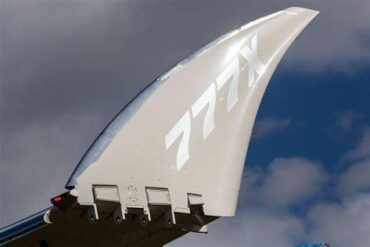
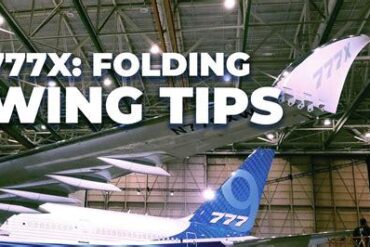
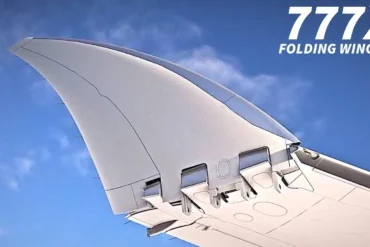
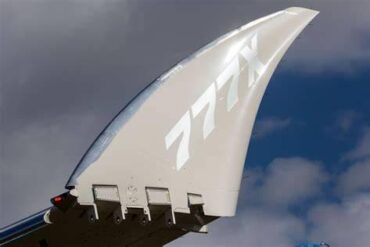
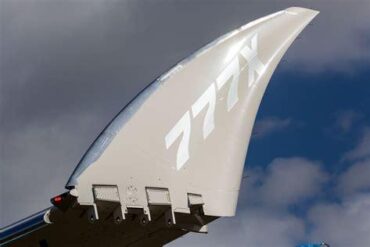
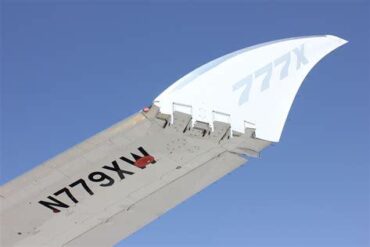
The last 11 feet (3.5 meters) of each wing on the 777X can swing upward on a hydraulically driven hinge, shrinking the wingspan from 235 feet five inches (71.76 meters) to 212 feet nine inches (64.84 meters). That folded figure matches the ground footprint of the legacy 777, which is the entire point of the design. The transition takes roughly 20 seconds in either direction. Once the tip reaches its commanded position, electric locking pins engage and physically prevent it from drifting into the other position on its own.
The tips themselves are carbon-composite structures, consistent with the rest of the 777X wing, and they are driven by a control architecture that keeps the flight crew in the loop through simple, familiar interfaces. Command authority lives on a knob on the overhead panel, and the resulting position is annunciated on the aircraft’s EICAS displays. The EICAS icon also shows when the tips are in motion, so a pilot can confirm completion without stepping outside or relying on ground observers.
Boeing did not treat the mechanism as a convenience feature bolted onto an existing wing. It is a load-bearing, safety-critical system, and it is interlocked with the aircraft’s takeoff logic. If the crew attempts to take off with the tips still folded, the master warning horn sounds and the aircraft will not quietly let the error pass. The system is designed to make a folded-tip departure impossible to miss rather than merely unlikely.
The Pre-Departure Flow: Manual Extension as a Deliberate Crew Action
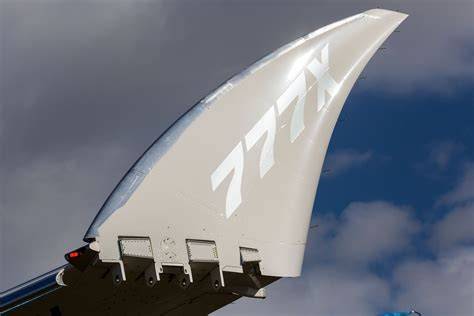
The operational logic begins with ICAO Code F classification. With the tips extended, the 777X’s wingspan pushes it into the largest airport compatibility category, exceeding the Code E envelope that governed earlier 777 variants. With the tips folded, the jet presents the same span as a 777-300ER on the ground, which means it can use the same gates, the same taxiway fillets, and the same stands. The tips are therefore meant to be extended only shortly before takeoff, as part of the pre-departure checklist that crews run right before lining up on the runway.
Because the extension adds so much span at once, it creates a temporary collision hazard. A crew that deploys the tips while parked between two other widebodies, or while maneuvering through a congested alley, could sweep them into a neighboring aircraft, a jet bridge, or airport infrastructure. The flight crew is the only party with the situational awareness to judge that moment correctly. Ground handlers see one side of the aircraft; the pilots see the whole picture from the flight deck and hold final authority over the aircraft’s configuration. Manual extension keeps that judgment where it belongs.
A Boeing 777X standing on a ramp with its wingtips folded looks, from a distance, like a very large twin-engine jet with an unusually long wing. The tell is at the tip, where the hinge line and the folded panel are visible. Ramp crews and pushback teams rely on that visual cue, and so do pilots taxiing past. The folded state is the default ground state, and the extended state is an exception that lasts only as long as it needs to.
The After-Landing Flow: Automatic Folding Below 50 Knots
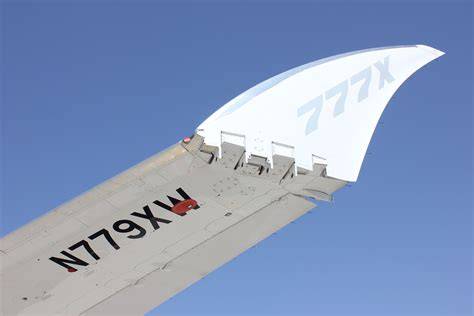
On landing, the logic reverses itself, and the reversal is the interesting part. Once the aircraft decelerates below 50 knots during the rollout, the wingtips fold automatically, and the overhead switch physically pops back into its folded position without crew input. The flight crew’s responsibility shifts from commanding the system to verifying that it has completed its job. Under normal circumstances, manually retracting the tips after landing is not an action crews are expected to perform at all.
The reason is workload. The rollout is one of the busiest phases of any widebody flight. Pilots are managing deceleration, monitoring brake temperatures and autobrake behavior, steering off the runway, reconfiguring the aircraft, communicating with ground control, and running after-landing checklist items, all within a couple of minutes. Adding a procedural step that requires the crew to assess clearance and command a 20-second mechanical transition would impose cognitive load at precisely the wrong moment. Automating the fold removes a decision the crew should never have to make in that window.
There is also a physical argument. Immediately after touchdown, the aircraft is still moving fast and the surrounding environment is unpredictable. If a pilot were to extend or fold the tips at 80 knots, the wing would be changing shape while the jet was still vulnerable. Tying the automatic fold to a speed threshold below 50 knots ensures the aircraft is slowing, under control, and past the point where a span change could interact with a high-speed event. The system waits for the aircraft to settle before it acts.
Why the 777X Wing Is So Large in the First Place
The folding tips exist to solve a problem created by the wing itself. The 777X wing is all-new, and Boeing reportedly spent an estimated $2 billion on this single element of the program. The outgoing 777-300ER was a commercial triumph, but its wing was relatively undersized for the weights it routinely carried on long-haul missions. To answer the Airbus A350-1000, which delivered markedly better economics at roughly the same size, Boeing needed a wing that could generate lift efficiently at altitude rather than brute-forcing its way into the air.
The resulting structure is the widest wing Boeing has ever built, with a span greater than that of the 747-8, although the 747-8’s wing is larger by area. The benefit shows up in cruise. More span means more lift at the initial cruise altitude when the aircraft is fully loaded, which lets the 777X climb higher and fly in thinner air where fuel burn drops. It also means the aircraft needs less thrust for takeoff, which lets the GE9X engines run at lower power settings, cutting fuel consumption and extending the engine’s long-term durability. A smaller wing would have compromised the entire aircraft.
That capability collides with airport infrastructure. A 235-foot wingspan does not fit into a Code E gate, and retrofitting airports worldwide to accommodate a single new type was never realistic. The folding tip is the compromise that lets Boeing keep the aerodynamic wing while shipping an aircraft that physically fits the existing 777 footprint. It is an expensive, heavy, complex solution to a problem that has no cheaper answer.
The Engines, Fuselage, and Cabin Behind the Wing
Beneath that wing sit two General Electric GE9X turbofans, the largest jet engines ever built and holders of the record for the most thrust produced by a jet engine. They lean heavily on advanced materials, including ceramic matrix composites (CMCs), to deliver thermal efficiency that the previous generation could not approach. Compared with the GEnx on the 787, the GE9X is a substantial generational leap rather than an incremental refresh.
The airframe itself is a deliberate hybrid. The 777X retains the original 777’s metal fuselage, which is heavier than the carbon-composite barrel on the A350, but it is stretched to seat significantly more passengers while adding comparatively little weight. The cabin and flight deck have been reworked to feel closer to the 787, including larger windows mounted higher with a dimming function and a lower cabin pressure target that is remarkable for a metal fuselage. The folding wingtip is the showpiece, but the 777X is a thorough overhaul from nose to tail.
Where the 777X Stands in the Market
The family comes in three variants. The 777-8 has drawn very few orders, and development is paused. The 777-8F freighter is progressing and has accumulated just over 100 orders, closely matching the competing A350F. The 777-9 is the volume seller, with just under 550 orders against 373 for the A350-1000. Roughly 325 of those 777-9 orders come from two customers, Emirates and Qatar Airways, which concentrates the program’s exposure but still represents a strong commercial result.
What has slowed both the 777-9 and the A350-1000 is the durability of the aircraft they are meant to replace. Most 777-300ERs in service remain young and economically productive, so the replacement cycle has not yet forced airlines to commit. When it does, the 777-9 will appeal to carriers that need floor space, heavy payload capability over 15- to 16-hour missions, and a step up from the A380 and 747. The A350-1000 remains a highly effective 777-300ER substitute with less floor area, and it can still fly farther and carry more payload near the edge of the 777-9’s envelope.
What the Folding Wingtip Teaches About Modern Flight Deck Design
The asymmetry between manual extension and automatic retraction is a small case study in how manufacturers divide labor between humans and automation. The crew extends the tips because clearance is a judgment call that requires eyes, context, and authority. The aircraft folds them because the rollout is a moment of high workload where a routine action can safely be delegated. Boeing did not automate both steps for consistency, and it did not leave both to the crew for simplicity. It matched each step to the environment in which it occurs.
That logic will shape how airlines train on the type. Pilots will rehearse the pre-departure tip extension as a normal checklist item with a genuine clearance assessment attached to it, and they will learn to confirm, rather than command, the after-landing fold. The master warning interlock guarantees that a forgotten tip becomes a loud, unmistakable event rather than a subtle configuration error. For a technology appearing on a commercial airliner for the first time, that combination of human judgment where it matters and automation where it helps is the real innovation.