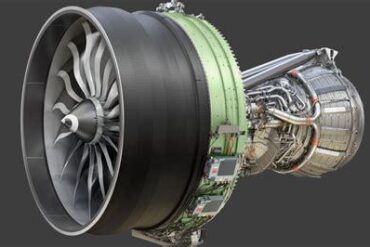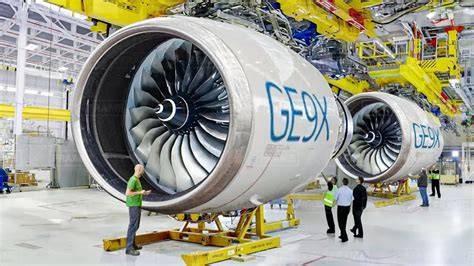
The headline figure attached to the incoming GE Aerospace 134-inch GE9X turbofan, $42 million to $45 million, is misleading. Understood strictly as a catalog list price, it holds up well. Compared against the market value of a GE90-115B or a Rolls-Royce Trent XWB, it does not. The engine will almost certainly be the most expensive commercial powerplant on the market, yet it belongs to the same tier as its closest rival, the Trent XWB-97, with the gap measured in single digits of millions of dollars, not tens of millions.
Disentangling the price of an engine from its financing, its airframe, its status as a bundled spare, its long-term maintenance contracts, and its place in bulk orders is an exercise in untangling threads that manufacturers deliberately knot together. It is almost unheard of for an airline to walk into a GE Aerospace showroom, point at a large turbofan, and pay the sticker price upfront for one engine with no maintenance, tooling, spare components, or services attached. What a GE9X is worth in 2026 depends entirely on which version of the number is being asked for.
Largest by Diameter, Not Largest by Certified Thrust
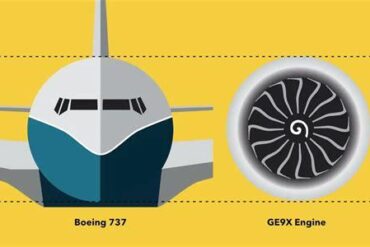
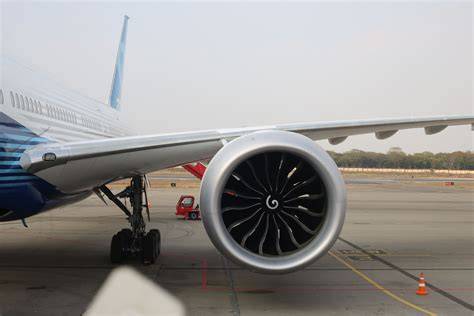
The GE9X is the world’s largest commercial jet engine by fan diameter, and it holds the record for thrust produced during test runs, but it is not the largest by certified thrust. That title belongs to its predecessor, the GE90-115B, built to power the Boeing 777-200LR, the 777-300ER, and the 777F freighter. The GE90-115B carries a certified thrust of 115,300 lbf at sea level, and its GE90-94B counterpart is certified for 93,700 lbf, having powered the earlier 777-200 and 777-300 generation. GE Aerospace states that it has test-run the new GE9X at 134,300 lbf, the highest thrust achieved by any commercial jet engine, but producing a figure on a test stand and being certified for it are two different claims. The GE9X is certified at 105,000 lbf in the GE9X-105B1A configuration, roughly 5,300 lbf below its predecessor. In exchange, it delivers a 5% improvement in specific fuel consumption against any twin-aisle engine available, meaning the Trent XWB, and up to 10% better than the older GE90-115B, with a bypass ratio of approximately 10:1.
Why the $42–45 Million List Price Misleads Buyers and Analysts
Engine values are among the most consequential metrics in commercial aviation finance, because a single powerplant can cost more than a complete private jet, and in today’s market some engine types are worth more than the airframes they lift. According to analysis by Safe Fly Aviation, the GE9X is the world’s most valuable engine at roughly $42–45 million list, a figure that exceeds the list price of many business jets and places it at the pinnacle of aircraft engine valuations. For reference, the same analysis places the GE90-115BL at a full-life value above $32 million, with its half-life market value climbing 60% since 2023, while the Rolls-Royce Trent XWB is valued at approximately $25 million per unit.
There are glaring problems with these side-by-side figures. The GE9X is not yet in revenue service, because the Boeing 777X has not entered it, so the only published data point is its list price, while the figures for the GE90 and the XWB are market values reflecting actual transactions, leases, and residual assessments. Comparing a brochure number with a traded price is an accounting error of the first order. List prices function as marketing anchors, where manufacturers and sellers routinely inflate the nominal worth of their products to create negotiating room and to flatter order-book headlines. Market value, the number companies actually pay, is the metric that governs balance sheets, lease rates, and residual risk.
Rising Widebody Engine Values and the Scarcity Premium
In its second-half 2026 update, aviation appraiser IBA observes that widebody engine values continue to grow strongly because of new aircraft production delays, with existing engine retention high, MRO demand strong, and spare engine supply limited. An engine’s value rests on more than its performance or manufacturing cost; it also reflects scarcity, the elementary economics of demand outstripping supply. The 777X delay and the fact that the GE9X is not yet flying have made the GE90-115BL and Trent XWB more valuable, not less. Airlines are being forced to keep older GE90-powered 777s in service for longer, which keeps engines inside airframes rather than on the used market, and low spare engine availability for the GE90-115BL pushes values upward. IBA puts GE90-115BL full-life values above $35 million, with long-term lease extensions observed between $250,000 and $300,000 per month, while MBA Aviation lists a market lease rate of $287,000 for the Trent XWB-97 in the first half of 2026.
| Specification | GE9X detail |
|---|---|
| Manufacturer | GE Aerospace (revenue-sharing partners: IHI Corp., Safran, MTU Aero Engines) |
| Aircraft applications | 777-9, 777-8, 777-8F |
| Fan diameter | 134 in (3.4 meters) |
| Bypass ratio | 10:1 |
| Certified thrust | 105,000 lbf (GE9X-105B1A) |
| Catalog list price | $42–$45 million |
| Implied market prices (approximate) | From $18 million+ (line-fit for Emirates) to $37 million (standalone spare) |
The GE9X Has No Known Market Value Yet
In commercial aviation, virtually no airline or lessor pays the published Original Engine Manufacturer list price for a factory-new widebody engine. GE Aerospace can assign any catalog value it wishes, but that figure is divorced from market reality; the real price is the discounted price that airlines and lessors actually pay. As a rule of thumb, when engines are bought as part of a new aircraft order, particularly on competitive twin-engine aircraft, OEMs routinely offer concessions of 40% to 46% or more off inflated catalog prices. The discount is typically smaller on aircraft such as the A350 or the 777, where Rolls-Royce or GE Aerospace is the exclusive engine supplier and bargaining leverage is structurally weaker, but substantial discounts still apply.
The true value of the GE9X will become far clearer once it enters service and begins appearing on secondary markets, where lease rates, teardown values, and half-life valuations emerge. Until then, there is simply no transaction data comparable to that for the XWB and the GE90. Value also shifts depending on whether the engine arrives attached to an aircraft or sold separately, much as a car costs less fully assembled than as a box of parts bought individually and bolted together. A standalone spare engine ordered directly from the OEM typically commands a smaller discount than a line-fit installed engine, which is why implied market prices for the GE9X range from around $18 million or more at line-fit on Emirates aircraft to roughly $37 million for a standalone spare.
An Apples-to-Apples Comparison With the Trent XWB-97
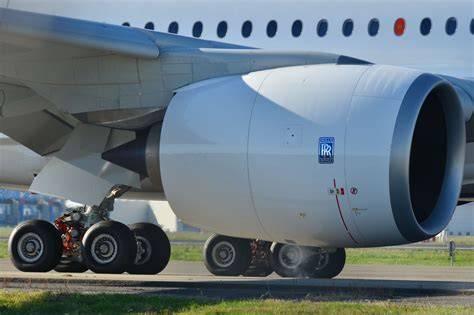
Discussing list prices per seat rather than engines alone, Sirius Capital Aviation notes that published list prices were far higher than any realistic estimate of actual prices, with typical discounts already over 50%, yet they still provided a limited signal of relative pricing. The GE9X’s $42 million catalog figure is therefore a starting point that must be discounted before any honest comparison with a Trent XWB-97 market price can be made. Comparing it even to XWB list prices is difficult, because Rolls-Royce does not publish standalone engine list prices and Airbus stopped publishing its annual aircraft list price catalog in 2018. A reverse calculation suggests the implied list value of the XWB fits into the $35 to $40 million range, though that is back-of-envelope arithmetic and should not be trusted too far.
Because the GE9X is the sole engine for the 777X, an expected discount off list of around 35% to 40% is a reasonable assumption, and that yields an implied market rate of roughly $22 million to $28 million per engine. Even with exclusivity, the 777-9 still has to compete head-to-head with the Trent XWB-powered A350-1000, which constrains GE’s pricing power at the aircraft level. If the real discount sits closer to 35%, the market price may be higher than the middle of that range. Either way, new XWB and GE9X engines probably trade within a modest margin of each other, which is precisely the point the $42 million headline obscures.
Engine Orders Are Bundles, Not Line Items
Engines are rarely purchased alone; they form part of bundles including airframes, spares, tooling, and service agreements. Manufacturers may sell engines at or even below manufacturing cost, because their margins are made on the lucrative 15-to-25-year servicing window. In 2022, GE announced that Singapore Airlines had ordered 22 additional GE9X engines for $2.8 billion at list price, which works out to more than $100 million per engine, but the package also included a 12-year maintenance contract under the TrueChoice brand. Price per engine therefore varies enormously by airline.
Emirates holds roughly 45% of the entire global 777X backlog, shifting bargaining power decisively from Boeing and GE toward the airline. Much of the program depends on Emirates and Qatar, and Emirates understands that leverage. Without published figures, it is reasonable to assume Emirates is buying GE9X engines for considerably less than Silk Way West, which is ordering two aircraft carrying four engines. The world’s largest commercial engine may list at $42 to $45 million, but its real price is a negotiated number that only becomes legible once the 777X starts earning revenue.