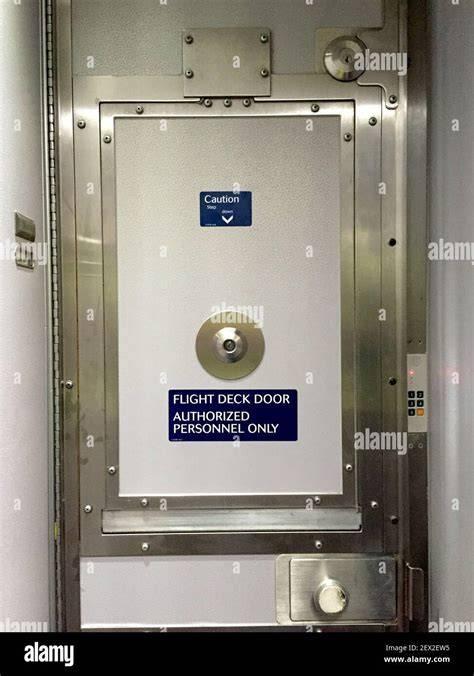
Every flight you board now begins behind a locked door most passengers never notice: a reinforced cockpit door that turns the flight deck into a hardened fortress. It is one of the most consequential pieces of security hardware in modern aviation, and its story runs from thin aluminium to steel plate and Kevlar, from a single barricade to a layered system of gates and protocols. The tragedy of September 11, 2001 forced a redesign of commercial aircraft interiors that reshaped how pilots work, how crews move through the cabin, and how regulators think about protecting the people in command of an aircraft in the air.
Before the attacks, cockpit doors were flimsy panels often built from thin aluminium. They existed to keep curious passengers out, not determined attackers. The hijackers of 2001 exploited exactly that weakness, moving through the cabin and finding only light barriers between them and the flight deck. The Federal Aviation Administration responded by mandating reinforced cockpit doors that could not be forced open manually and that could withstand small-arms fire. That mandate created the modern flight deck door: a composite structure with reinforced frames, steel plates and Kevlar composites, engineered to absorb punishment that ordinary cabin hardware was never designed to take.
The engineering behind a reinforced cockpit door is far more involved than a layer of steel. Certification follows the FAA’s Advisory Circular 25.795-1, which sets out the tests a new design must pass. One of the most demanding is an impact test using a 100 lb (45 kg) pendulum delivering a force greater than that of a person attempting to break the door down. The door must also carry decompression blow-out panels, a counterintuitive but vital feature. Because a reinforced door is virtually airtight, a sudden loss of cabin pressure would create a dangerous difference between the cabin and cockpit unless the door has a controlled way to release pressure. The result is a barrier that is deliberately strong against people and deliberately weak against physics, a design compromise that protects both security and survival.
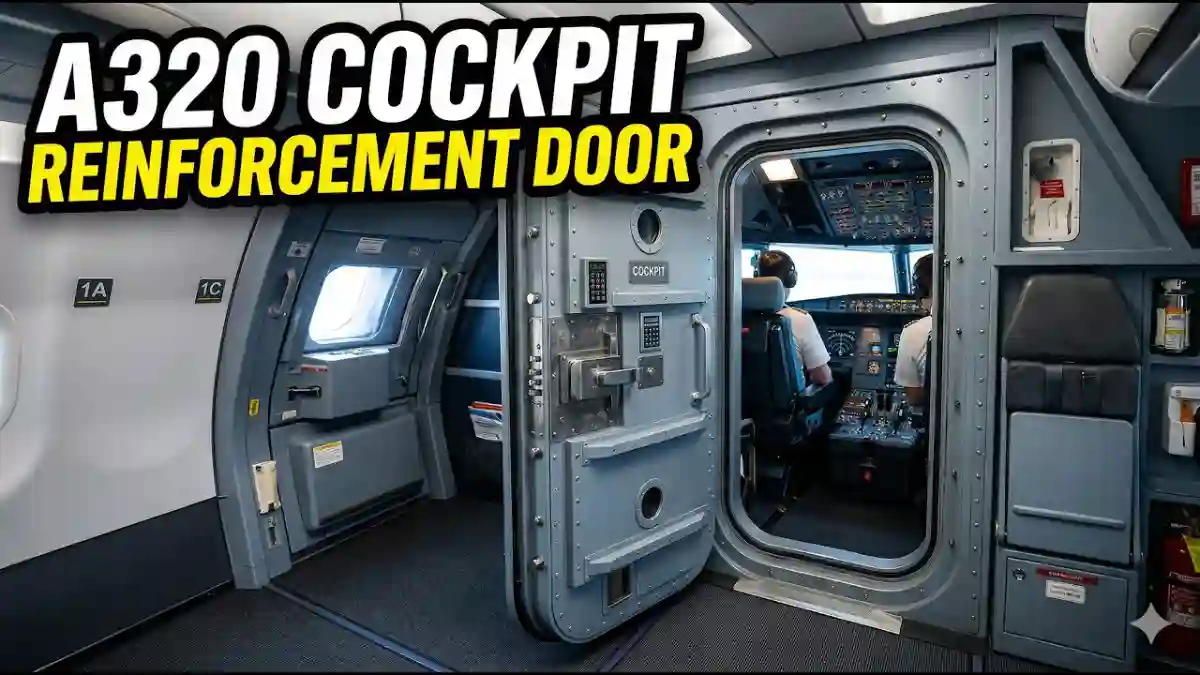
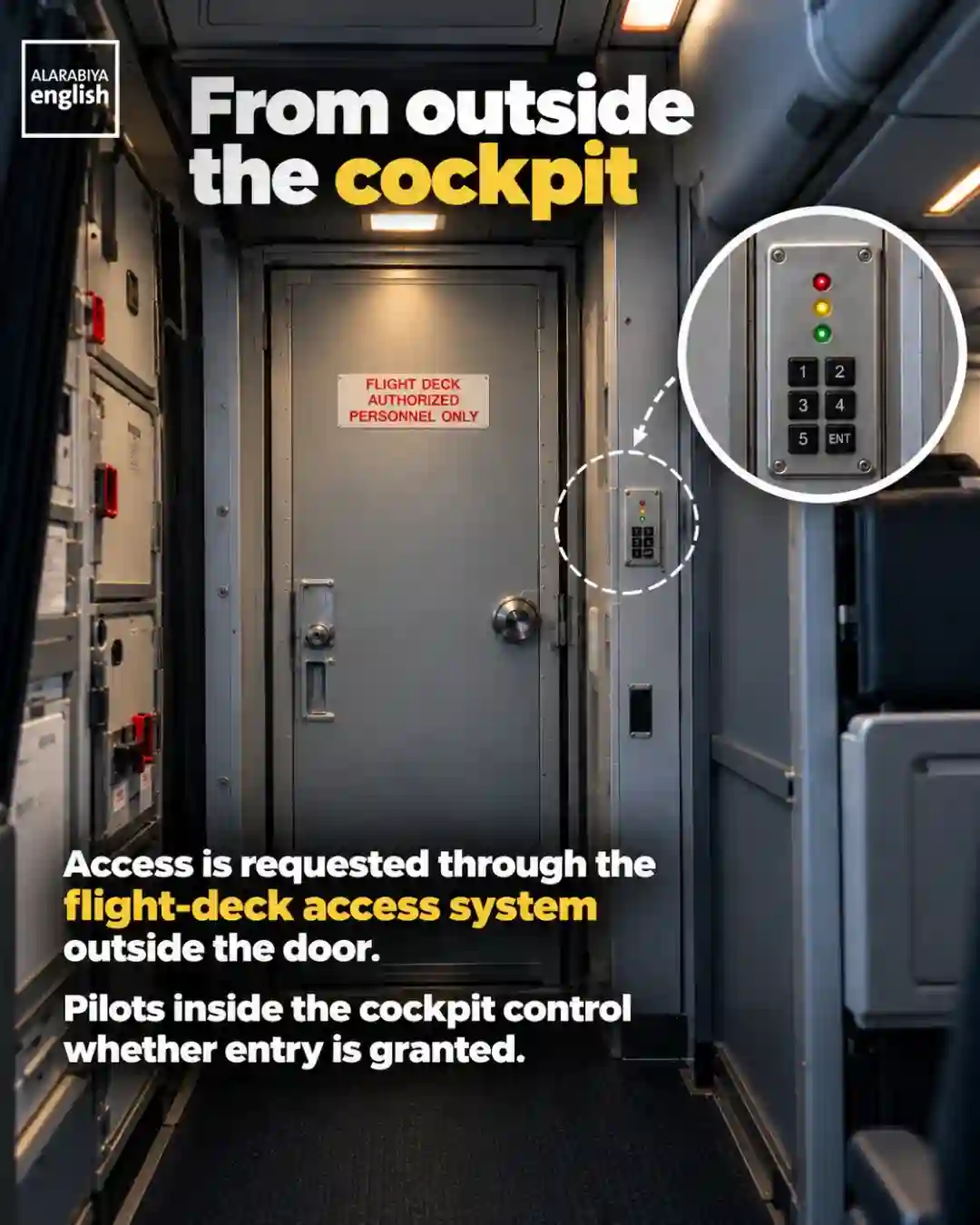
Securing the door also required rewriting the culture of the flight deck. In pre-9/11 aviation, routine and casual visits to the cockpit by crewmembers were common; pilots and cabin crew socialised across the threshold, and the door was often left open or unlocked during cruise. Those social calls have been eliminated entirely. Pilots now lock the door from the inside, using internal specialised keypads, delayed-release toggles and pilot override switches that let the crew control access without opening the barrier to anyone else. The keypad outside the door allows flight attendants to request entry and, in some designs, to enter a code in an emergency, but the final decision on whether the door opens rests with the pilots at the controls.
Yet the reinforced door introduced unintended vulnerabilities as well. A barrier strong enough to stop intruders is also strong enough to shelter them. If an attacker ever does reach the flight deck, the same steel and Kevlar that keep people out become a stout protection for the intruder against passengers and crew fighting back. The internally locking design creates a second problem when pilots become incapacitated, since a locked flight deck can shut rescuers out as effectively as it shuts attackers out. Some airlines adopted procedures such as the two-person cockpit rule, requiring another crewmember to be present whenever one pilot leaves, so that a solo pilot is never left alone in command.
For all its strength, the reinforced door leaves a troubling moment of vulnerability each time it opens. On long-haul services in particular, pilots move around constantly, leaving the flight deck for rest breaks, crew changes and bathroom visits. Every one of those trips requires the door to open, and every opening creates a window of opportunity for anyone positioned to rush the threshold. The physical door cannot solve that problem alone, because the vulnerability is built into the routine of operating an aircraft over many hours.
That gap is what the secondary barrier was designed to close. Two years ago, President Joe Biden’s administration introduced the FAA Reauthorization Act of 2024, which requires commercial aircraft to carry a secondary barrier and eliminates the vulnerability created by a single door locked from the inside. Former US Transportation Secretary Pete Buttigieg framed the move in simple terms: “Every day, pilots and flight crews transport millions of Americans safely — and today we are taking another important step to make sure they have the physical protections they deserve.” Full implementation is expected to take five to six years, meaning many aircraft will keep flying in the US with only a single reinforced door for years to come.
The law did not appear overnight. It followed more than two decades of campaigning by Ellen Saracini, whose husband, United Airlines Captain Victor Saracini, died when United Flight 175 was hijacked and flown into the World Trade Center. Speaking to NBC Chicago, she described her motivation bluntly: “It’s insulting to the pilots and crews that died September 11. I can’t look another victim’s family in the eyes and say to them, ‘I knew there was an issue and I sat back and did nothing.'” When the measure passed through the federal legislature, it was known as the Saracini Aviation Safety Act, a name that ties the hardware directly to the people it was built to protect.
Airlines had been free to install secondary barriers before the law, but most chose not to. Saracini was especially disappointed that United did not take a lead on the issue given its history of hijackings. A United Airlines spokesperson defended the carrier’s position by arguing that security measures had evolved in the years since the barriers were ordered and that many more layers of security now exist, while denying that cost was the deciding factor. The reluctance reflected a broader industry view that perimeter screening, intelligence and crew training had already changed the threat picture since 2001.
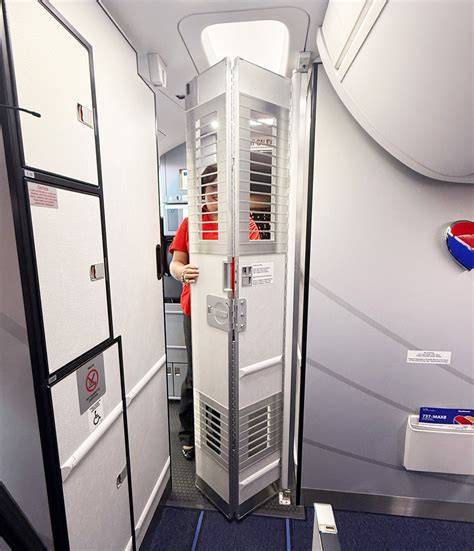
The secondary barrier itself is a retractable gate or mesh barrier installed in the forward galley area, sitting between the cockpit door and the passenger cabin. Whenever a pilot leaves the flight deck, the barrier is deployed so the aisle is blocked before the reinforced door opens, then retracted once the pilot returns. The process resembles the double-barrier systems used by zoos and similar sites, where at least one barrier is always in place. Before the mandate, JetBlue Airways and Delta Air Lines already used lightweight wire-mesh gates that crew installed manually to let pilots step out.
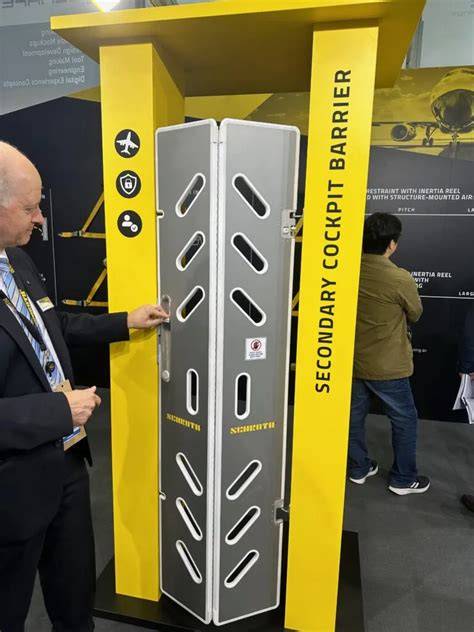
Some carriers had improvised even more crudely. Runway Girl Network reported that some airline crews used whatever was on hand when pilots needed to leave the cockpit, with the catering trolley a common choice. A trolley wedged across the aisle bought just enough time for the pilot to close the reinforced door. The new rule replaces that improvisation with standardised barriers built into new aircraft, rather than aftermarket solutions airlines design themselves, and lets the FAA formalise standards all operators must follow, just as it did for the main reinforced door.
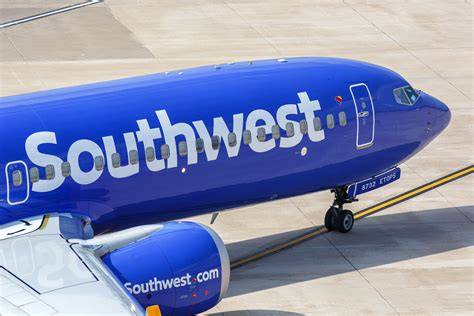
The rollout began in earnest on August 29, 2025, when Southwest Airlines operated the first passenger service under the FAA secondary barrier mandate, flying from Phoenix Sky Harbor International Airport (PHX) to Denver International Airport (DEN) with a newly delivered Boeing 737 MAX 8. Southwest’s fleet consists exclusively of 737 aircraft, which helps illustrate how the new MAX 8 fits its strategy. According to Planespotters.net, the carrier flies 262 737-700s averaging 20.3 years, 188 737-800s averaging 11.1 years and 352 737 MAX 8s averaging just 3.7 years, for a total of 802 aircraft at an average age of 10.9 years. Southwest is expected to receive 25 new 737s by the end of 2025, all with the mandated doors installed, and the airline was already moving to install them before the law took effect because it wanted to be proactive about safety.
Not everyone embraced the change quickly. The FAA initially planned for all airlines under its jurisdiction to install the barriers by August 2025, but the trade group Airlines for America objected, citing certification holdups and the need to train crewmembers. The airlines asked for a two-year delay, and the FAA agreed to a single-year extension. The Air Line Pilots Association (ALPA), a union representing around 80,000 pilots in the US and Canada, criticised Airlines for America for requesting the delay and the FAA for granting it. “While we acknowledge this ruling falls short of the unacceptable [two-year] delay requested by Airlines for America, this extension still compromises the safety and security of our skies,” said ALPA President Jason Ambrosi.
Taken together, the reinforced door and the secondary barrier form a layered defence that no longer depends on a single locked panel. The door stops forced entry and small-arms fire, the internal locking system keeps control with the pilots, the two-person rule protects against incapacitation, and the retractable gate guarantees that a barrier always stands between the cabin and the flight deck. The hardware has grown heavier, the procedures more rigid and the certification more demanding, but the principle is straightforward: ensure that the people flying the aircraft are never separated from an attacker by nothing at all.