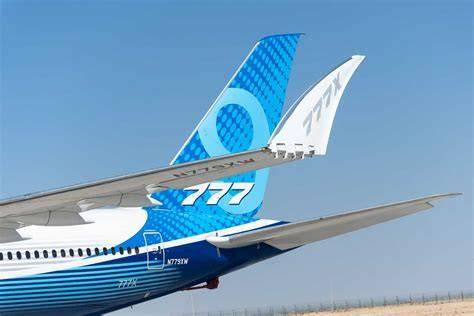
Boeing has never sold a 777X wing, never quoted one, and never published a figure for the pair. That silence is the first thing a serious reader needs to understand, because it explains why every number in this article is built from inference rather than disclosure. The 777X carries the largest wing Boeing has ever built for a commercial airliner, a carbon-fiber structure with folding wingtips, and the company has done everything possible to keep its unit economics out of public view. What follows is the most defensible range, the evidence behind it, the higher figures circulating online, and the reasons those figures disagree.
The most reasonable working estimate for a pair of Boeing 777X wings is roughly $35 million to $55 million. That number is inferred, not confirmed. It comes from applying an aerospace benchmark compresses advanced composite wings to 15% to 25% of an aircraft’s value, and applying it to a 777-9 street price of about $190 million to $230 million. Run the same math across the full range and the theoretical window stretches to roughly $29 million to $58 million, which is why $35 million to $55 million sits as a sensible middle.
Anyone quoting the official price introduces a different problem entirely. The 777-9’s last published list price was about $442 million, but airlines rarely pay list, and large campaigns routinely negotiate discounts deep enough to make the brochure figure almost meaningless. Multiplying 15% to 25% by $442 million would generate wing estimates well above $60 million and set a false floor under the whole discussion. Street price, not list price, is the correct starting point, because it reflects what a customer actually believes the aircraft is worth.
Boeing 777X Wings Are Never Priced Individually
The 777X is sold as a complete aircraft with engines, avionics, interiors, and a full support package negotiated into a single contract. Boeing’s customer-facing documents contain no line-item for the wing, no spares price list, and no published component catalogue the way automotive manufacturers maintain. The wing exists inside the aircraft’s certified type design, and its cost exists inside the programme’s cost structure, not inside a price list.
That structure means a wing price cannot exist in isolation. A wing set produced in year one carries a different burden than one produced in year seven, because the cost of tooling, engineering, and certification is spread differently across the production run. Even if Boeing produced an internal transfer price for each wing set, that figure would reflect accounting policy as much as manufacturing reality. For the public, the honest answer is that any dollar figure is a reconstruction.
The $50 Million Per Wing Claim and Why It Breaks Down
Higher estimates circulate, and they deserve scrutiny rather than repetition. A BlackJet pricing guide places the cost of each 777X wing around $50 million, which, read literally, implies roughly $100 million for a pair. The trouble is definitional: the source does not make clear whether it means one wing, a complete wing set, or an entirely different valuation measure such as replacement value including spares, tooling, and lifetime support obligations.
This ambiguity matters because the difference between $50 million per wing and $50 million per set changes the conclusion by a factor of two. A literal reading would put the wing pair at roughly a quarter of the aircraft’s street price, which contradicts the composite-wing benchmark and every published cost breakdown for comparable programmes. The figure is best treated as an upper bound, or as a measure of what a replacement wing might cost an out-of-warranty operator under a bespoke contract, rather than as the manufacturing cost of one wing.
How Big the Boeing 777X Wing Actually Is
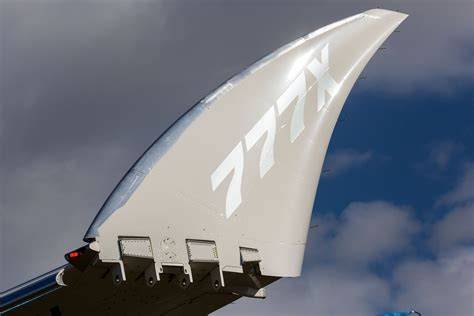
The scale explains why the wing draws so much of the aircraft’s cost. With its folding tips extended, the wing spans 235 feet, 5 inches (71.8 meters), making it the longest wing Boeing has ever built. It has roughly 18% more area than the wing on the 777-300ER, a meaningful jump in an aerodynamic surface that must carry the loads of a heavier airframe.
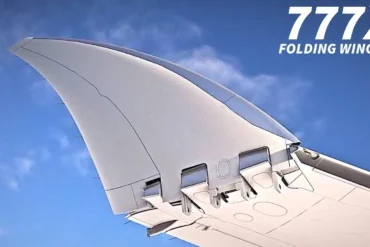
The folding mechanism forces a design compromise no conventional wing faces. On the ground, the tips fold to bring the span down to 212 feet, 9 inches (64.8 meters), keeping the aircraft compatible with gate and taxiway infrastructure built around smaller wings. The actuators, locks, sensors, and redundant indication needed to make that conversion safe add weight, complexity, and additional certification work that a fixed wing simply never requires.
Manufacturing the Boeing 777X Wing: Autoclaves, Robots, Autoclaves
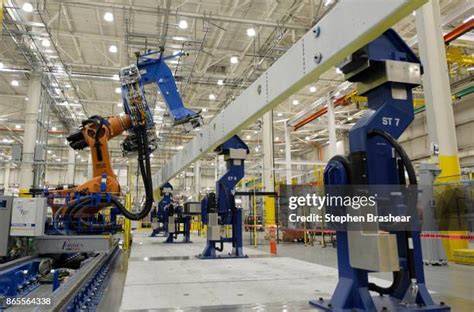
Boeing’s decision to build the wing internally rather than outsource it, as it did with the 787’s composite wing at Mitsubishi Heavy Industries, shaped the cost base. The Everett wing centre represented an investment of about $1 billion. At the facility’s opening, Boeing noted the building houses three of the world’s largest autoclaves, each large enough to hold two 737 fuselages, with each measuring 120 feet (37 meters) long and 28 feet (8.5 meters) in diameter.
Production is equally capital intensive. Automated equipment lays carbon-fiber tape across spars and skins, and a single wing skin requires roughly 300 separately programmed robot runs. Those runs need unique programmes, unique inspection routines, and unique curing cycles, meaning the recurring cost of a wing is dominated by process, not by raw fiber. Volume compounds the problem: programmes producing modest numbers of extraordinarily complex components must spread tooling, robotics, autoclave time, engineering, and inspection across comparatively few aircraft, which lifts the effective cost of every delivered wing set.
Wing Development Spending That Never Appears on a Price Tag
The factory is only the visible layer. Boeing reportedly spent at least $2 billion on research, engineering, and testing for the wing, a figure repeated widely but never officially confirmed by the company. No public breakdown shows how much of a 777-9’s selling price can be attributed to that research or to the 777X programme’s broader development ledger.
Programme-level numbers dwarf the wing itself. Boeing has taken roughly $15 billion in 777X-related charges across the programme’s life, driven by delays, production inefficiencies, and certification hurdles rather than by material or labour content. Some industry estimates suggest final development costs could approach $20 billion. In October 2025, CEO Kelly Ortberg moved the first delivery target to 2027 and the company recorded a $4.9 billion charge in the quarter. Those figures describe programme economics, not the cost of one pair of wings, but they explain why early aircraft carry a burden far larger than their own hardware.
List Price Versus Street Price and the Valuation Evidence
Valuation data offers a more grounded anchor than brochure pricing. Avitas placed the 777-9’s discounted purchase price at approximately $200 million in 2018 dollars, a figure consistent with the $190 million to $230 million range used here. Demand has stayed resilient at the right price: Qatar Airways was waiting on 124 aircraft and Emirates had ordered 205 at the time of those reports. Large committed fleets are precisely what allow a manufacturer to absorb a punishing development bill.
The same demand also tells you what cannot be computed. Engine choices, interior specification, spares commitments, training packages, and financing terms all move a contract price without moving the wing at all. Applying a percentage to a negotiated aircraft price, therefore, is a proportionality exercise, not an accounting exercise, and it produces a range rather than an answer.
What the Boeing 777X Wing Buys in Return
The same investment buys efficiency. The 787 comparison shows a different production model: Boeing outsourced that carbon wing, while the 777X wing is built in-house at Everett around a much larger structure. The 777-300ER offers a generation-level contrast, with an aluminum wing spanning roughly 212 feet (64.8 meters) and no folding tips, simpler in both structural and manufacturing terms even though the 777X needs a larger aerodynamic surface.
Airbus took a more conservative route with the A330neo, lengthening an existing aluminum wing from 197.8 feet (60.3 meters) to 210 feet (64 meters) and adding composite elements rather than building a clean-sheet carbon structure. That decision needs less specialised infrastructure and delivers a smaller aerodynamic step. Boeing’s approach costs more upfront, but the design is aimed squarely at lower fuel burn across thousands of flights, and the relevant question is whether that saving over a 25-year service life repays the premium.
Carbon fiber is lighter and stiffer than aluminum, allowing more span and fuel capacity without the equivalent weight penalty. That advantage is real, and it explains why manufacturers accept autoclave complexity. It does not, however, prove that Boeing’s specific design choices were economically optimal for every airline in every network.
Why the $35 Million to $55 Million Figure Needs Caveats
A benchmark is not a ledger. Manufacturing cost per unit also depends on how tooling is amortised, how much rework occurred, how scrap on composite parts is treated, and how overhead is allocated across aircraft and other programmes. None of that data is public, and the absence of data guarantees that anyone claiming a precise number is overstating the certainty.
The benchmark also travels poorly. A percentage appropriate for one generation of aircraft cannot be carried wholesale to another, because composites, folding mechanisms, and dedicated production lines have little in common with aluminum wings built at higher volumes. The $35 million to $55 million range should be read as an illustration of economic scale, not as a verified Boeing figure, and any future estimate should move when production volumes, delivery cadence, or street prices move.
The Bottom Line on Boeing 777X Wing Cost
On current evidence, $35 million to $55 million remains the strongest estimate for a pair of Boeing 777X wings, derived from a 15% to 25% share of a $190 million to $230 million aircraft value. Boeing has not confirmed it, higher figures online remain poorly defined, and no public breakdown will quietly validate any of them. What is plainly documented at the programme level is more than $1 billion in factory investment, at least $2 billion in reported wing development, and roughly $15 billion in programme charges.
Those numbers show why the deeper value of the wing lives outside the carbon fiber. Most of the cost was incurred long before an airline can fly the aircraft, and recovery depends on how many aircraft are eventually built and how efficiently. Once deliveries begin in 2027, fuel-burn and maintenance data from operators will finally answer the question current estimates cannot: whether the 777X wing is an expensive engineering achievement, a commercial masterstroke, or something that is genuinely both.