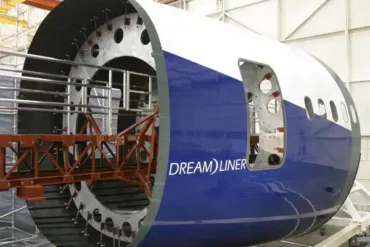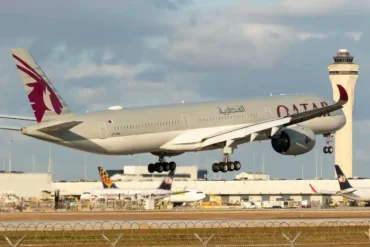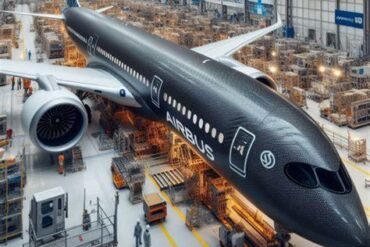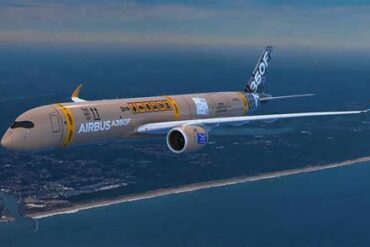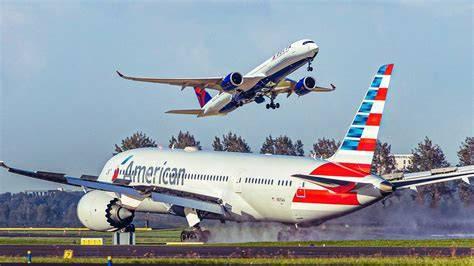
When Boeing launched the 787 Dreamliner, the aircraft industry was supposed to converge on a single truth: the future of widebody manufacturing lay in carbon-fiber-reinforced polymer barrels wound on enormous rotating mandrels. Yet the Airbus A350 XWB, built as a direct answer to the Dreamliner, took the opposite fork in the road. Airbus chose carbon fiber for its fuselage skin just as decisively, but it declined to build the hull of that skin as a set of continuous barrels. Instead, the European manufacturer fastened four longitudinal carbon panels — the crown, the keel, and two lateral walls — onto an internal skeleton of aluminum-lithium frames. That single decision — barrels versus panels — is the most consequential architectural divide in modern commercial aviation.
The divide is not cosmetic. It shapes cabin geometry, production ramp-up, how easily a family of stretched variants can be created, how quickly a dented fuselage returns to service after a baggage tug collision, and even how easily a retired aircraft can ultimately be dismantled and recycled. Understanding why Airbus broke with its rival requires looking beyond rivalry and into tooling physics, pressurization loads, and some very expensive early mistakes on a South Carolina assembly line.
Circular Mandrels Force Circular Cabins
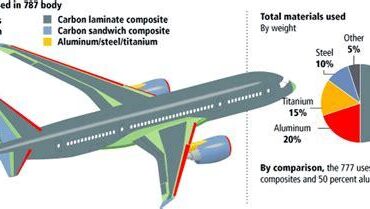
The physical mechanism behind Boeing’s barrel architecture is the mandrel itself. Carbon-fiber tape is applied by automated fiber placement machinery onto a rotating form, and a rotating form can only produce a surface of revolution that is perfectly circular along its central axis. Boeing embraced that constraint and turned it into an advantage: monolithic sections wound to near-perfect symmetry, cured in giant autoclaves, and then joined at a handful of circumferential interfaces along the fuselage.
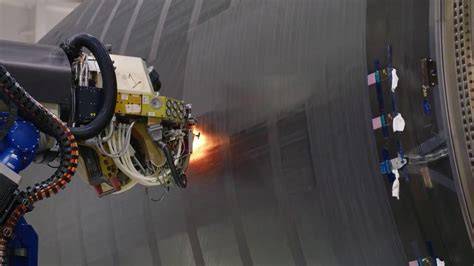
Airbus evaluated the same tooling and found it geometrically incompatible with its market thesis. Airlines wanted an extra-widebody cabin, and Airbus’s internal studies pointed toward an ovoid, slightly egg-shaped cross-section that bulges outward at the shoulder line rather than arcing rigidly inward. A solid mandrel cannot render an ovoid surface, and even if it could, the pressure loads distributed around such a shell demand a non-uniform material distribution that a continuous wound layer build-up handles badly. The only feasible route to that cross-section was panel assembly, where individual curved panels can be laid up on fixed tools and then joined to a frame structure that defines the cross-sectional shape.
Five Inches That Airliners Cannot Ignore
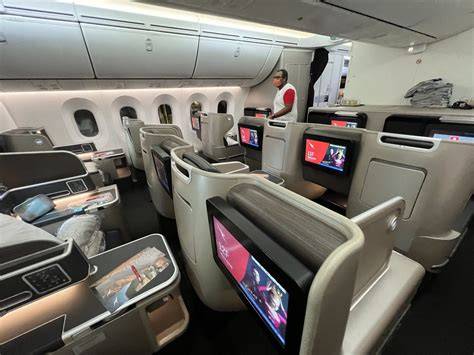
The payoff of the ovoid cross-section is measured in centimeters of human comfort. The A350 cabin offers roughly five additional inches (about 12.7 cm) of lateral clearance at shoulder height compared with the 787’s perfectly circular barrel. That single figure supports a nine-abreast economy layout with standard-width seats and an aisle that does not force passengers into awkward side-stepping during boarding. Airlines sell the A350 as a widebody cabin that feels wide, and the structural choice is the literal reason it does.
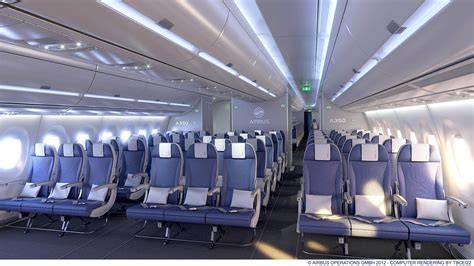
The tradeoff is component count. Panelized architecture means more parts, more jigs, more interfaces, and more assembly steps than winding four or five giant rings. Airbus judged that the dimensional freedom at the eye line was worth that complexity, because the extra width is exactly what sells seats on long-haul routes where every inch of cabin comfort influences yield.
Load Paths That Do Not Match the Hull’s Shape
A pressurized fuselage is not a uniformly loaded structure. The crown panel along the top of the airframe primarily resists heavy longitudinal tension during flight, while the bottom keel panel endures severe compression loads, runway debris strikes, and concentrated forces from landing-gear attachment points. A continuous wound barrel distributes roughly the same ply schedule around its entire circumference, meaning that material is over-supplied in low-stress zones and under-used in high-stress ones. Airbus’s panel architecture lets engineers tailor composite ply depth and fiber orientation panel by panel, zone by zone.
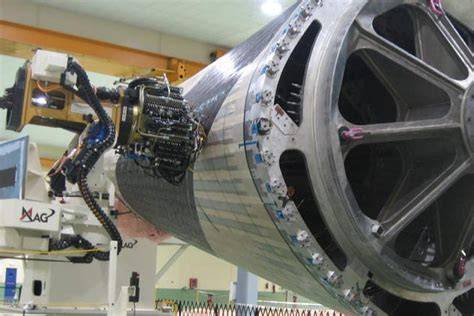
Automated fiber placement machines can vary the layup of each panel before it ever reaches final assembly, so the crown receives a tension-weighted schedule while the keel receives reinforcement calibrated to compression and impact. The savings are not trivial for a widebody that flies for two and a half decades: every kilogram of structural dead weight removed lowers operating empty weight permanently, and therefore lowers fuel burn and trip cost for as long as the aircraft remains in service. Airbus pairs these tailored carbon panels with an internal aluminum-lithium frame grid, an arrangement that blocks corrosion at the fastening interfaces and delivers fatigue resistance precise enough to extend major structural inspection intervals out to around twelve years.
Four Panels Versus the Shimming Crisis
The most celebrated argument for the panel approach, however, has less to do with flight loads than with factory floors. Boeing’s earliest 787 assembly issues are now a case study in industrial risk. When suppliers shipped completed barrel sections to final assembly, microscopic manufacturing variances across the circular mating interfaces left out-of-spec gaps. Resolving them required manually installing thousands of customized carbon shims, one interface at a time, and that labor-intensive process stalled the entire assembly line and delayed deliveries for months.
Airbus’s panelized design structurally avoids the same failure mode. The four longitudinal skin panels overlap the metallic frames along their edges, and those adjustable lap joints tolerate small positional variations without demanding custom shimming. Technicians align the overlapping skins, insert fasteners through the frame flange, and move the airframe forward. A defect in a single panel from a single supplier can be isolated and corrected without redesigning the interface between enormous structural sections. Boeing’s single barrel requires fewer fasteners overall, but its rigidity makes the entire supply chain hostage to any calibration error anywhere upstream.
Stretching a Family Without Replacing the Tooling
Widebody families live or die by their stretched variants, and the manufacturing architecture determines how painful each growth step is. Boeing’s 787-8, 787-9, and 787-10 all required reworked or replaced mandrels and autoclave infrastructure as the barrels lengthened, since the tooling is fundamentally sized to the section it produces. Airbus’s modular panelized line, by contrast, expanded from the A350-900 to the A350-1000 by lengthening the longitudinal skin panels and inserting additional constant-section frame bays on the same automated fiber placement infrastructure and largely the same jigs.
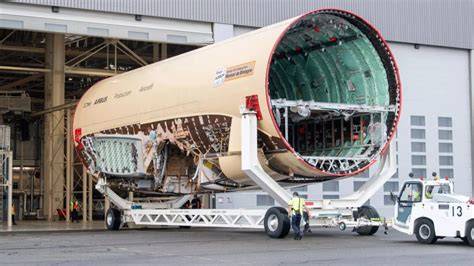
This modularity protects both capital expenditure and delivery predictability. Airbus can shift the production mix between variants inside a single factory footprint as airline demand moves toward higher-capacity aircraft, while operators benefit from more stable acquisition costs and more reliable handover dates. Mandrel-based programs carry the opposite exposure: every family stretch triggers a tooling project that must succeed on schedule, or the entire variant slips.
Ramp Rash and the Economics of the Ground
Airport ramps are hostile to aircraft skins. Baggage tugs, catering trucks, and mobile stairs routinely clip fuselages, and those minor impacts are classified as ramp rash. On a monolithic barrel, an impact can alter the load path of an entire continuous structural ring, forcing inspectors to sweep a broad surface with non-destructive testing to confirm no hidden delamination has compromised airworthiness. On the A350, technicians can isolate the damage to a single panel segment or frame bay, verify that specific area, and frequently install a standardized bolted patch rather than perform a complex multi-ply scarf repair on a load-bearing cylinder.
That isolation converts directly into reduced aircraft-on-ground time, which is a financial metric airlines take seriously. Every additional day of unavailable aircraft after a routine ground incident is lost revenue, and Airbus designed its hull specifically so that damage containment translates into faster return to service.
Humid Cabins, Galvanic Corrosion, and the Long Retirement
The composite-metal hybrid raises subtle long-term questions. Boeing minimized internal metallic frames to create an almost pure composite shell that supports higher cabin humidity without structural degradation, a passenger comfort benefit the Dreamliner markets heavily. Airbus’s aluminum-lithium skeleton introduces potential galvanic corrosion and differential thermal expansion concerns at the fastening interfaces, mitigated through alloy selection, isolation layers, and sealing, while delivering the familiar structural grid that line maintenance crews already understand. Neither airframe has reached an age of mass retirement, so the definitive verdict on fleet-wide aging behavior remains theoretical.
The end-of-life question is even more open. Dismantling and recycling flat or curved individual panels from an A350 is an industrial task that existing composite processors can approach incrementally, whereas cutting up continuous 787 barrel rings will require purpose-built decommissioning infrastructure. The manufacturing philosophy chosen in the mid-2000s will therefore echo through the environmental and economic footprint of these fleets well into the middle of the twenty-first century, long after the two design teams that made these decisions have retired.