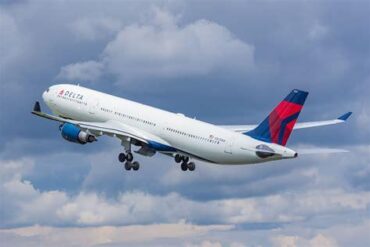
The Airbus A330 has picked up a nickname that most aircraft designers would sacrifice a fuel-burn target to earn. Aviation enthusiasts call it the Butter Machine, a tribute to landings so soft that the first hint of the runway often arrives as a whisper rather than a jolt. Slipping grease metaphors aside, the phrase describes something genuinely observable: the gentle rear-wheel-first contact that has become the A330’s signature on thousands of arrival videos. What looks like luck is, in fact, a tight chain of decisions made by Airbus engineers decades ago, spanning the shape of the landing gear, the hydraulics that position it, the fly-by-wire software that coaches the flare, and the timing pilots apply in the final three seconds before touchdown. Each link in that chain was chosen for sound engineering reasons, but together they produce the velvet touchdown that spotters now travel to airside fences to film.
The Tilted Four-Wheel Bogie That Defines the A330 Look
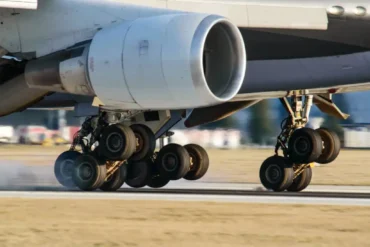
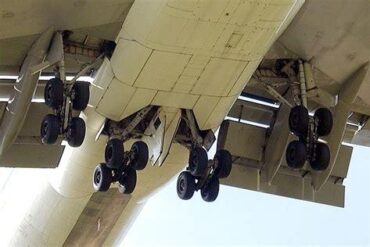
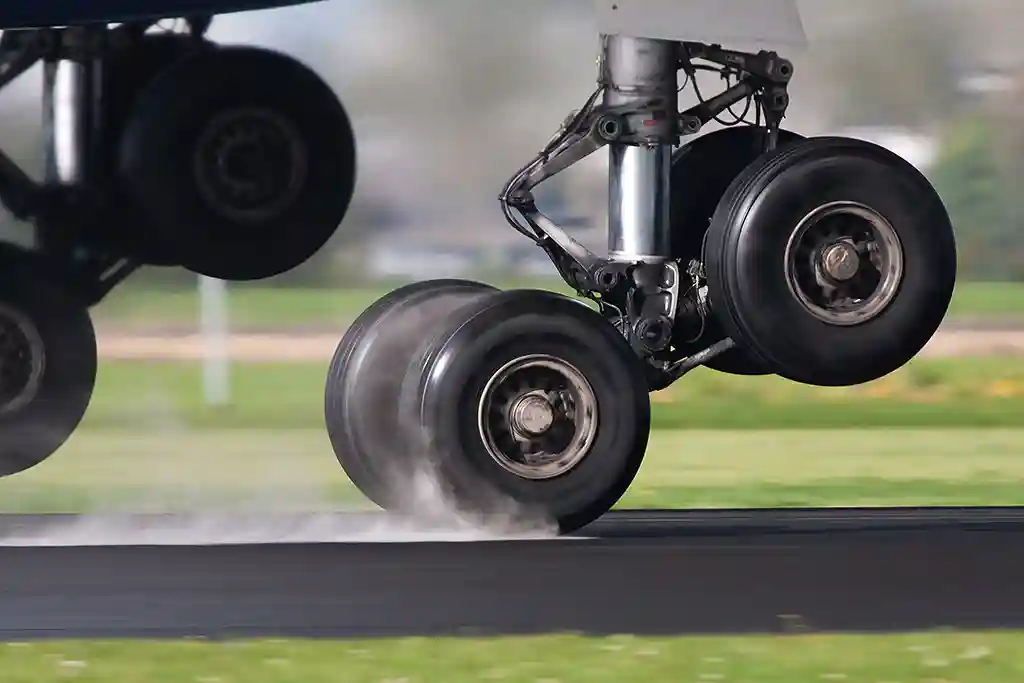
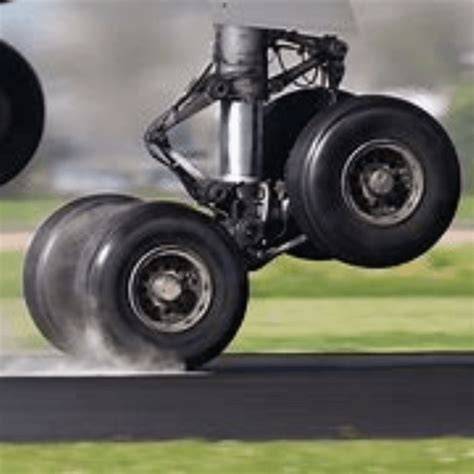
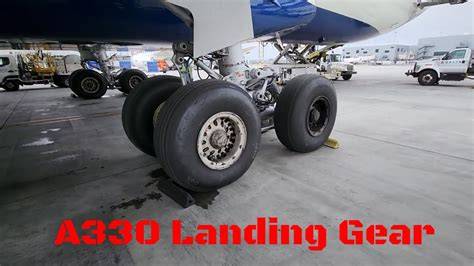
Step under an A330’s wing and the first clue is unmistakable. The jet carries two main landing gears, each fitted with a four-wheel bogie arranged in a twin-tandem layout, and each bogie sits at a conspicuous backward tilt when the gear extends. Flightradar24 singles out this combination, two sets of four wheels angled rearward, as the A330’s easiest visual identifier, the detail that helps observers separate it from near relatives at a glance. Canada’s Transportation Safety Board describes the same geometry in an A330 investigation report, confirming that the bogies are inclined so the rear tires reach the runway before the forward pair, and that forces are transferred to the aircraft gradually rather than arriving through all eight main tires simultaneously. The four-engine A340, by contrast, carries an extra center landing gear, which distributes weight across three units; the A330 leans entirely on its two main bogies, placing greater responsibility on how those two matched assemblies behave in the moment of contact.
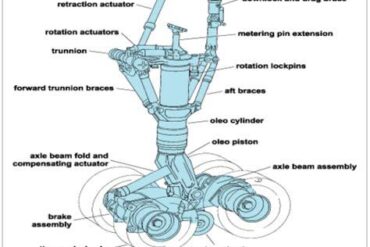
That arrangement is supported by machinery that rarely earns a mention but does much of the quiet work. The legs are built around oleo-pneumatic shock absorbers, a balanced bogie design, forgings of titanium and corrosion-resistant steel, and two landing gear control units that alternate to add redundancy. The bogie beam itself pivots at its center on the shock strut, and its position is deliberately set to the same angle every time the gear is selected down. The A330 does not improvise on approach; it configures itself identically for every landing, which is precisely why its touchdown signature is so reproducible.
How the Pitch Trimmer Sets the Bogie Before Touchdown
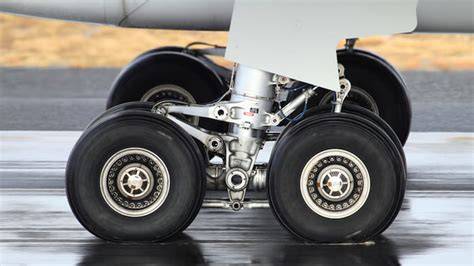
Wheels cannot hold an angle on their own, so a dedicated hydraulic ram, the pitch trimmer, positions the bogie nose-up when the gear is lowered and manages its motion through the entire landing cycle. Pilots and engineers on the PPRuNe forums describe it as the component that sets the attitude before contact, while a research paper on tire heat at touchdown documents how it lifts the front wheels of the bogie and lets the rear wheels descend around the bogie beam. The same analysis notes that the trimmer can behave much like a shock absorber, softening the rotation of the beam rather than letting it slam into its travel limits. A patent covering a variable-damping pitch trimmer goes further, explaining that the actuator positions the wheels before touchdown, assists with gear stowage, and damps the bogie beam’s movement relative to the leg. That damping function is the detail enthusiasts often miss, yet it is central to why the A330’s eight main tires seem to share the load like a team passing a weight hand to hand.
A separate mechanism completes the picture. During retraction a shortening mechanism pulls the shock absorber up inside the leg, shrinking the entire assembly so it fits into a compact bay. Simple Flying notes that Airbus had not applied such a feature to many earlier models, marking the A330’s gear as a genuine generational step. Keeping the two jobs distinct matters, because the pitch trimmer positions and damps the bogie while the shortening mechanism handles packaging. Once those roles are untangled, the more interesting question emerges: why does the bogie lean backward at all?
Why the A330’s Main Gear Leans Backward
The reason behind the tilt is less settled than the nickname implies, and the debate is worth following because it shapes how every smooth-landing clip should be read. On a PPRuNe thread about landing gear lean, one contributor insists that simple geometry points to storage, arguing that the tilt exists so the bogie folds neatly into the bay. Another poster counters that the A330 and A340 are a special case, claiming the nose-up attitude is intentional and functions much like the semi-levered gear on the Boeing 777-300ER, raising the rear of the aircraft and improving clearance beneath the aft fuselage. Enthusiasts maintain a long-running Airliners.net thread devoted to A330 main gear bogie tilt, and The Points Guy reports that wheel orientation is largely a space-saving choice even though pilots generally agree trailing-link gear produces the most flattering landings.
The most defensible reading sits between the camps. The tilt probably originated as a packaging solution, yet it demonstrably changes the touchdown sequence, and designers rarely object when a storage constraint doubles as a comfort feature. On the A330 the two purposes reinforce each other: the geometry that lets the gear stow also lets the rear tires meet the runway first, converting a stowage necessity into the staged contact that passengers experience as butter.
Flare Mode and the Fly-By-Wire Software Behind a Soft Landing
The gear explains why the A330 touches down in stages, but it does not explain everything that happens in the final seconds. Once the jet nears the runway, the flight-control system and the wing carry equal weight. The A330 was designed to give pilots handling that felt familiar near the ground despite its fly-by-wire architecture. According to the Australian Transport Safety Bureau, flare mode replaces the normal load-factor law with a flare law, letting crews use the same landing technique they would apply in a conventionally controlled aircraft. Airbus’ own Safety First magazine recommends beginning the flare around 40 feet (12 meters) above the runway on the A330, A340, A350 and A380, compared with 30 feet (nine meters) on smaller Airbus types, and warns that a steeper-than-nominal three-degree approach may justify an earlier flare. The software supports the pilot’s timing; it does not replace it.
Handling reinforces the effect. Pilots routinely describe the A330 as stable and predictable, its older-generation wing giving a slightly heavier control feel than the A350. Members of the Infinite Flight Community credit the wing’s size and strong ground effect, though that remains speculation rather than documented engineering. A pilot on a PPRuNe flare-height thread offers the practical version, noting that the A330 and A340 settle nicely with a 40-foot retard and a smooth rotation. Intentional control law, predictable aerodynamics and disciplined technique converge in the same few seconds, and the runway receives the aircraft rather than absorbing an impact.
Why Some A330 Landings Still End With a Thump
Here the story turns, and the turn is the most valuable part of the whole investigation. On a PPRuNe thread about hard A330 landings, pilots describe how the aircraft can touch down beautifully on the rear wheels, then float along the runway before the front wheels come down heavily. Their remedy is to touch down on the rear wheels and then pitch down firmly enough to bring the forward pair gently onto the pavement while speed remains, precisely what they say the autopilot does during an autoland. That distinction reframes how any landing clip should be judged. A long, graceful hold-off can look almost perfect from the fence while producing a noticeably firmer second contact for the people seated over the wing, which is why pilots argue that the landings looking smoothest from the outside are not always the ones passengers feel as smooth.
Timing tightens the trap further. A thread on A340 touchdowns explains that applying reverse thrust as the rear axle lands can make the aircraft drop onto the front axle once the ground spoilers kill the lift, and that a higher pitch attitude at the flare worsens the thump. A pilot in the same thread confirms the A330 behaves similarly and that the cure is to flare for the rear axle, derotate smoothly until the front axle is down, and only then select reverse. The spoiler logic measured in an ATSB investigation of an A330 landing depends on weight on both main gears plus either radio altitude below 6 feet (1.8 meters) or wheel speed above 72 knots (133 kilometers per hour). One Airliners.net user neatly lists the three distinct bumps a sloppy arrival can deliver: rear wheels, front wheels, nose wheel. The A330’s butter reputation, then, is less about eliminating every bump than about controlling when each part of the gear takes the load.
A Landing Gear Philosophy Carried Into Newer Airbus Widebodies
Airbus did not stop refining large-aircraft gear once the A330 entered service, and the same principles reappear on later widebodies. The A350-1000’s six-wheel bogie is built so the rear wheels typically touch first, stabilizing the aircraft before the forward wheels settle, reducing pitching forces and improving comfort. The A380 takes the weight-sharing problem to its outer limit with 20 tires on its main gear. Both inherit the A330’s core logic: share the load, sequence the contact, and let the shock absorbers finish the job.
The A330neo added new engines and winglets that improved per-seat fuel economy by 14 percent, yet the family’s touchdown personality barely changed. That persistence is what makes the landing gear such an interesting part of the A330’s legacy. Engines and wingtips have been renewed, but the gear that helped create the Butter Machine reputation remains fundamentally unchanged, and as the NEO version spreads across more route networks, pilots, passengers and spotters still get the same butter landings. The magic was never in a single component. It lives in the rear-wheels-first tilt, the damped pitch trimmer, the flare law and the pilot’s derotation, a chain of clever decisions that turns the most physical moment in flight into something passengers barely notice at all.