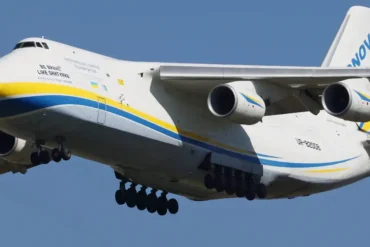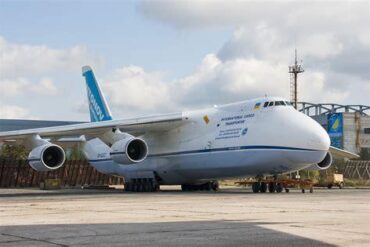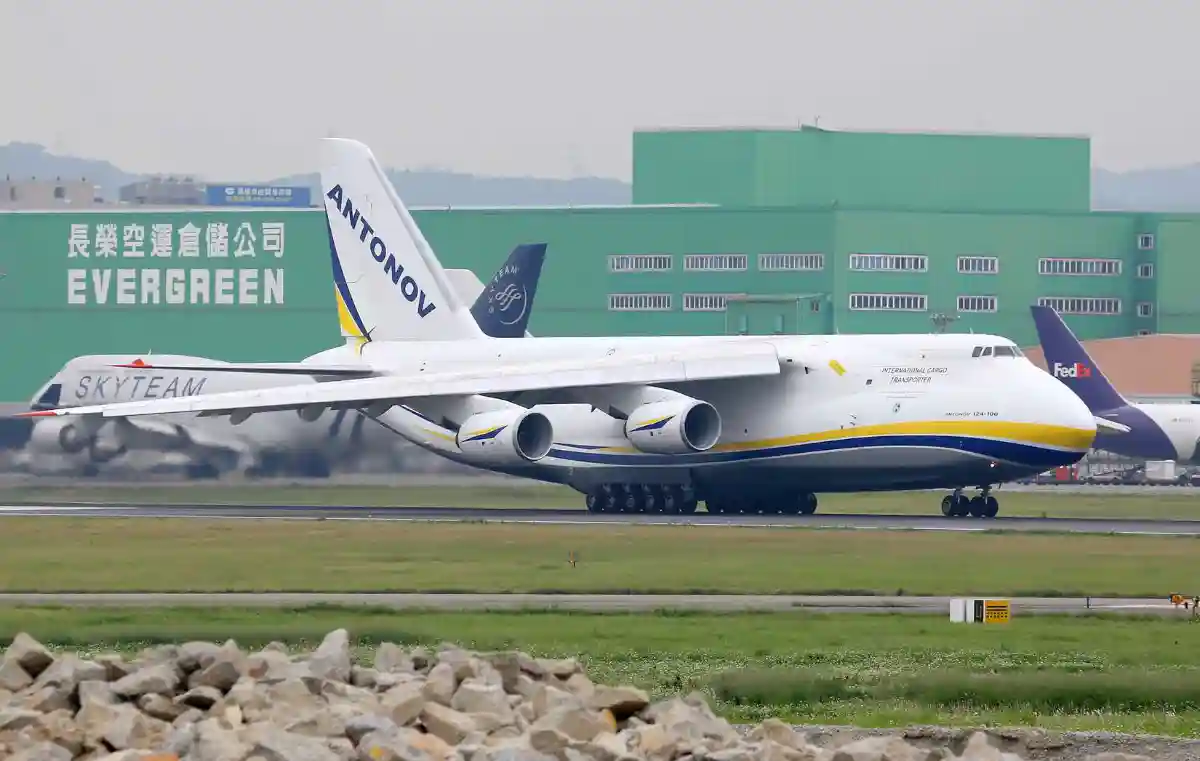
An Antonov Airlines Antonov An-124 lifted off from Chubu Centrair International Airport (NGO) in Nagoya, Japan, on November 10, and within moments of rotation, a fragment of the giant freighter tore away and fell to the ground, forcing the artificial-island airport to shut its main runway until the debris was cleared. The aircraft, registered UR-82007, kept climbing and pressed on to its planned destination, Clark International Airport (CRK) in the Philippines, landing there just under five hours later with no reported injury to the crew. It has not flown since.
A Dramatic Departure From Chubu Centrair’s Runway 18/36
The flight carried the designation ADB357F and represented a routine heavy-lift rotation for the Ukrainian operator’s six-strong An-124 fleet, which has been based at Leipzig/Halle Airport (LEJ) in Germany since Russia’s full-scale invasion of Ukraine in 2022. Video circulating on social media captured the moment a piece of the airframe separated shortly after the four-engine jet cleared the ground, and observers quickly asserted that the detached material came from the fuselage. The 3,500-meter (11,483-foot) runway 18/36, the same strip that serves every widebody arrival at the man-made island hub, was closed for 50 minutes while airport crews swept and inspected the surface for foreign object debris.
That closure was not a procedural afterthought. Loose metal on a runway is one of the most feared hazards in commercial aviation because engines and tires ingest it with almost no warning, and the catastrophic destruction of Air France’s Concorde on flight AF4590 out of Paris in July 2000, triggered by a titanium strip left on the runway, remains the industry’s defining warning about what happens when debris is missed. Nagoya’s swift shutdown reflected that lesson: nothing else moved until the pavement was verified clean. Antonov Airlines has been approached for comment on the cause, and the operator had not issued a public statement at the time of writing.
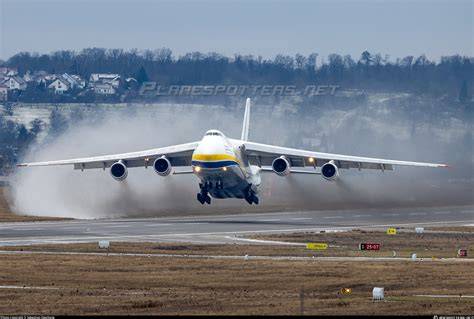
Why Any Debris On A Runway Forces An Immediate Closure
The operational calculus behind that 50-minute halt is worth unpacking, because it explains why a single fallen panel can ripple through an entire airport’s schedule. Chubu Centrair operates with a compact single-runway footprint on reclaimed land in Ise Bay, which means a closure removes essentially all arrival and departure capacity for the duration rather than shifting traffic to a parallel strip. Airport authorities must locate the fragment, photograph and remove it, then walk the surface to confirm nothing else came loose. The very geometry of the An-124 makes that risk greater than it would be for a narrowbody: its high-mounted wing sits more than five meters above the ground, its landing gear and flaps churn enormous volumes of air at rotation, and a piece of skin or fairing that fails under that load has a long, unobstructed arc before it strikes the pavement.
The Second Antonov An-124 Incident At Nagoya In Three Weeks
November’s departure drama is inseparable from what happened at the same airport on October 22, when another Antonov Airlines An-124, registered UR-82029, arrived in Nagoya with its auxiliary power unit alight. The APU, a small turbine in the tail cone that supplies electrical power and air independently of the main engines, caught fire after the aircraft touched down following a long sector from Fairbanks International Airport (FAI) in Alaska. Local media reported that airport fire crews extinguished the blaze quickly and that the jet came to a halt safely at its parking stand, with operations resuming after a 15-minute runway closure. According to aircraft tracking data compiled by Planespotters.net, the damage did not keep the airframe grounded: it returned to service the following day.
Two incidents involving the same operator at the same airport inside a single three-week window is the kind of pattern that invites scrutiny, even when the underlying failures are unrelated. One involved a tail-mounted auxiliary power unit and a fire on arrival; the other involved structural material departing the airframe during takeoff. What they share is the setting, a Japanese cargo gateway that handles a steady stream of outsized freight charters, and the airframe family, a type whose average age among Antonov Airlines’ active examples sits at 36.3 years.
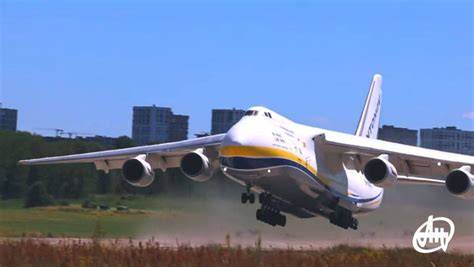
Antonov’s Six-Frame Fleet And The Aging Airframes Behind These Incidents
UR-82007 is the oldest aircraft Antonov Airlines still flies, with an estimated age of 40.4 years as of November 2026, and it carries the name “Be brave like Mykolaiv.” UR-82029, the aircraft that burned at Nagoya in October, is a comparatively youthful 35.4 years old and is named “Be brave like Bucha.” Those inscriptions are not decoration; since 2022 the operator has named much of its fleet after Ukrainian cities scarred by the war, turning each fuselage into a flying memorial. The contrast between the honorific lettering and the metal that fell onto a Japanese runway is difficult to ignore.
Antonov Airlines’ present capability rests on exactly six An-124s, a fleet that historically also included two further An-124s and three An-140 turboprops, and that once operated alongside the six-engine An-225 “Mriya,” the only complete example ever built, destroyed in the opening days of the invasion. Every one of these freighters is a Cold War-era design flown far beyond the service life its manufacturers imagined, held in the air by scrupulous maintenance and by the absence of any Western replacement with comparable payload and nose-loading capability. For shippers moving generators, satellites, or outsized industrial components, the An-124 remains effectively irreplaceable, and each new incident narrows the margin on which that unique market depends.
What The Nagoya Incidents Mean For Heavy-Lift Cargo Reliability
The immediate consequences appear contained. UR-82007 reached Clark safely, no runway excursion or collision occurred at either Nagoya event, and UR-82029 was flying again within a day. What remains unresolved is the inspection regime for a 40-year-old airframe that has just shed a fuselage fragment in flight, the precise nature of the failed component, and whether the wider fleet will see enhanced structural checks as a result. For now, the aircraft sits at Clark, its next movement unannounced, while the runway at Chubu Centrair has reopened and the airport’s cargo handlers continue to accept the outsized freight charters that keep Antonov Airlines’ aging giants airborne.