A Radical Reinvention of Flight Energy
The idea of an aircraft taking flight after just a four-second charge sounds like science fiction, yet this breakthrough proves otherwise. Aerospace engineer Tom Stanton has pushed the boundaries of experimental aviation by combining 3D printing, ultra-light materials, and energy-efficient propulsion into a single, elegant design. Instead of relying on traditional batteries, this aircraft uses a supercapacitor, delivering an instant burst of energy that powers the propeller just long enough to achieve sustained glide.
What makes this innovation compelling is not merely its novelty, but its engineering philosophy. The aircraft doesn’t depend on continuous power; instead, it leverages aerodynamic efficiency to maintain flight. This approach echoes early aviation experiments, where maximizing lift and minimizing drag were the only ways to stay airborne.
Engineering Simplicity Meets Advanced Materials
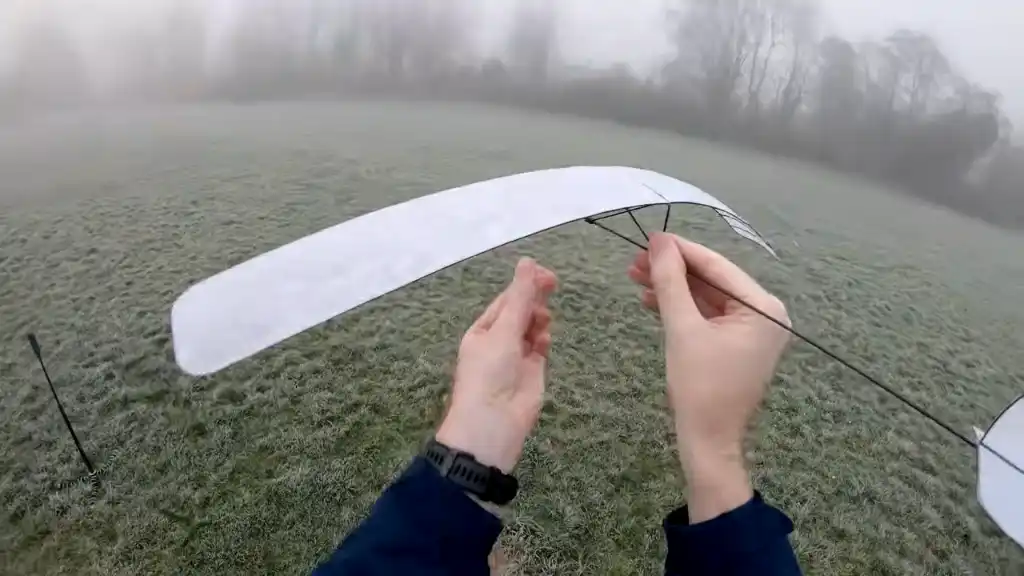
At the heart of this design lies an ingenious use of 3D-printed structures fused with tissue paper wings. While traditional model aircraft rely on balsa wood, Stanton opted for rapid prototyping through additive manufacturing, allowing immediate iteration and refinement. The wings, printed directly onto tissue paper, strike a delicate balance between structural rigidity and extreme lightness.
A carbon fiber rod reinforces the structure, ensuring durability without compromising weight. The propulsion system is equally minimalist:
- A 2.7-volt, 10-farad supercapacitor weighing just 3.2 grams
- A micro-brushed motor optimized for low-energy bursts
- A custom 3D-printed mounting bracket integrating all components seamlessly
This careful integration results in a system where every gram matters, and every component contributes directly to flight performance.
How a Four-Second Charge Sustains Flight
The aircraft’s most striking feature is its energy delivery model. Unlike batteries that provide steady output, the supercapacitor discharges rapidly, offering a short but powerful burst. This initial thrust is enough to launch the aircraft into stable flight, after which aerodynamic lift takes over.
In testing, the plane achieved up to 45 seconds of continuous airtime, a remarkable figure given its minimal energy input. This performance underscores a critical insight: flight efficiency is not just about power, but about how intelligently that power is used.
The concept mirrors glider physics, where altitude and airflow replace propulsion as the primary sustainers of motion. Stanton’s design simply compresses the energy input phase into a matter of seconds.
Why This Matters for the Future of Aviation
While this aircraft is a proof of concept, its implications ripple far beyond hobbyist experimentation. The project challenges long-standing assumptions about energy storage, propulsion systems, and manufacturing methods in aviation.
Additive manufacturing is already transforming aerospace, enabling the production of complex geometries, lighter components, and rapid prototyping cycles. Stanton’s work highlights how small-scale experimentation can inspire large-scale innovation, particularly in areas like:
- Ultra-light UAV design
- Energy-efficient propulsion systems
- Hybrid power architectures combining capacitors and batteries
Concerns about durability and structural integrity in 3D-printed aviation remain valid, but projects like this provide valuable data points that push the technology forward.
From Hobby Experiment to Industry Inspiration
There is a certain elegance in how this aircraft bridges toy-like simplicity and cutting-edge engineering. Inspired by classic wind-up planes, it replaces rubber bands with modern electrical energy storage, creating a hybrid between nostalgia and innovation.
More importantly, Stanton has made his design accessible, sharing blueprints for others to replicate and improve. This open approach accelerates innovation, inviting a global community of engineers and enthusiasts to explore new frontiers in lightweight flight.
A Glimpse Into Ultra-Efficient Flight Systems
This 3D-printed plane demonstrates a powerful principle: efficiency can outperform raw power when design is optimized to its limits. By reducing weight, maximizing lift, and rethinking energy delivery, it achieves what traditional systems would consider impossible.
As aviation moves toward sustainability, concepts like this hint at a future where aircraft may rely less on continuous energy consumption and more on smart energy bursts combined with aerodynamic mastery. The result is not just a fascinating experiment, but a blueprint for rethinking how flight itself is powered.