The salary gap between airline pilots and flight attendants has traditionally been enormous. Pilots undergo years of specialized training, accumulate thousands of flight hours, pass demanding examinations, and carry direct responsibility for operating an aircraft safely. Flight attendants, meanwhile, have a different but equally important safety role, and their path into commercial aviation generally requires far less upfront training. Yet the picture becomes surprisingly different at the highest levels of the cabin crew career ladder.
A senior flight attendant working as a purser on long-haul flights at one of the largest US airlines can potentially earn around $140,000 or more per year, depending on the airline, seniority, schedule, premium flying, and other forms of compensation. That figure can put an experienced long-haul purser remarkably close to the earnings of a regional airline captain. In some cases, the most senior cabin crew members can even exceed the compensation of captains at smaller regional operators.
That does not mean flight attendants have suddenly entered the same pay structure as professional pilots. The important distinction is that the figure belongs to the upper end of the flight attendant profession. It typically takes many years of seniority to reach the hourly pay ceiling, secure productive schedules, regularly hold long-haul flying, and obtain purser assignments. The unusual earnings are therefore the result of seniority, high hourly rates, productive trips, and premium responsibilities working together rather than a standard flight attendant salary.
How Much Can a Long-Haul Purser Earn?
The largest US legacy airlines have substantially increased flight attendant compensation in recent years. American Airlines, Delta Air Lines, and United Airlines are particularly important in this discussion because they operate extensive long-haul networks and have among the highest flight attendant pay scales in the US industry. Their compensation structures also demonstrate why the most experienced cabin crew members can reach six-figure annual earnings.
According to the supplied salary figures, American Airlines’ top flight attendant hourly rate reaches approximately $84.50, while Delta’s reaches about $86.32 and United’s about $87.47. Those figures represent the upper end of the applicable pay scales rather than what a newly hired flight attendant can expect. Reaching that level generally requires many years with the airline, with the pay ceiling typically occurring after roughly 12 or 13 years.
The hourly rate alone, however, does not tell the complete story. Airline flight attendant compensation is based heavily on credited hours and the structure of individual trips. Cabin crew members can also receive per diem, premium pay, boarding pay, and additional compensation associated with specific assignments. A senior employee who consistently secures productive trips can therefore earn considerably more than another employee at the same hourly rate who spends more time on reserve or operates less productive schedules.
A long-haul purser occupies an especially favorable position within this system. The purser is not simply a flight attendant who happens to work internationally. The position involves additional training and greater responsibility for cabin operations, communication, coordination, and service leadership. Because purser positions and desirable long-haul assignments are heavily influenced by seniority, the employees most likely to combine these opportunities are already among the most experienced people on the flight attendant seniority list.
Why Long-Haul Flying Can Increase Flight Attendant Earnings
It might seem obvious that a long-haul flight should automatically produce a larger paycheck, but the relationship is more complicated. Long-haul flying is not necessarily paid at a dramatically higher hourly rate simply because the aircraft crosses an ocean. Its financial advantage often comes from productivity.
A long-haul trip can generate substantial credited flying within a relatively concentrated period. A flight attendant may spend many hours operating a single flight instead of completing several shorter sectors separated by lengthy periods on the ground. Although international trips can involve substantial layovers and extended rest periods, the actual productive flying can be concentrated into fewer segments.
This matters because flight attendants are generally not paid in the same way as conventional salaried employees who receive compensation for every hour they spend at work. A duty day can include reporting, boarding, taxiing, flying, deplaning, waiting, and other periods, while compensation is tied to specific contractual rules. Consequently, two employees can spend similar amounts of time away from home yet generate very different monthly credit totals.
Senior flight attendants understand this dynamic extremely well. With greater seniority, they can often bid for more productive monthly lines, better destinations, longer trips, preferred days off, and premium opportunities. A junior employee might be required to accept reserve assignments or less desirable trips, while a senior employee can construct a schedule designed to maximize both income and lifestyle.
Seniority Is the Real Key to High Flight Attendant Pay
The most important factor behind the headline figure is seniority. Unlike a conventional office career in which an employee might negotiate a promotion or compete for a management position, flight attendant career progression is strongly connected to the employee’s position on the airline’s seniority list.
A flight attendant’s date of hire determines their position relative to colleagues who joined before or after them. That seniority can influence the ability to hold a particular base, obtain desirable trips, select days off, avoid reserve, and secure positions such as purser. The result is that two flight attendants with identical contractual hourly rates can have dramatically different annual earnings.

Most major airlines now use some form of Preferential Bidding System, commonly known as PBS, to construct monthly schedules. Flight attendants can request combinations of credit hours, days off, destinations, trip lengths, and other preferences. The system then awards lines according to operational requirements and seniority. A highly senior employee therefore has a much better chance of receiving the schedule they want.
Reserve is particularly important to understanding why new flight attendants earn relatively little. A reserve employee remains available to the airline for assignments and generally has less control over how their month develops. Reserve schedules can produce fewer credit hours and therefore lower total earnings. Senior employees are usually able to escape reserve and hold established lines, creating another financial advantage that goes beyond the published hourly rate.
Regional Airline Captain Pay Has Changed Dramatically
The comparison becomes interesting because regional airline pilot salaries have changed substantially since the COVID-19 pandemic. Regional airlines historically represented the lower end of the professional airline pilot pay scale. New pilots often accepted relatively modest salaries in exchange for gaining experience and eventually moving to a major airline.
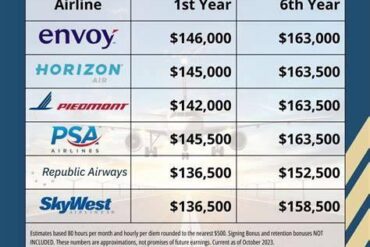
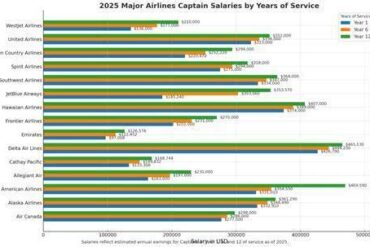
That model became increasingly difficult to sustain when the industry faced a severe pilot shortage. Regional carriers needed to attract and retain qualified pilots, and compensation increased rapidly. Today, according to the supplied figures, new regional airline first officers can earn approximately $90,000 to $100,000 annually at many carriers, depending on the operator, contract, flying, and other compensation.
The jump becomes even more significant after a pilot upgrades to captain. A newly promoted regional captain can start around $140,000 to $160,000 per year, putting that pilot’s compensation directly alongside the potential earnings of a highly senior long-haul purser at a major airline.
That comparison would have sounded extraordinary before the pandemic. Regional airline pilot salaries were once dramatically lower, with annual compensation at some operators reportedly falling toward $50,000. The industry’s labor shortage forced regional carriers to reconsider the economics of the traditional career ladder, leading to major increases in wages, signing incentives, retention programs, and pathways toward larger airlines.
A Purser and a Regional Captain Are Not Equivalent Jobs
Although the salaries can overlap, it is important not to interpret the numbers as meaning the two professions have equivalent responsibilities or qualifications. A regional airline captain and a long-haul purser perform fundamentally different jobs.
The captain is ultimately responsible for the safe operation of the aircraft. That requires extensive flight training, regulatory qualifications, medical certification, recurrent training, examinations, and substantial experience. Before reaching captain, a pilot must generally spend years building flight time and progressing through increasingly demanding positions.
A purser has a different area of responsibility. The position is centered on cabin safety, crew coordination, passenger management, service leadership, and communication between the cabin and flight deck. Pursers may have considerable experience and additional training, but their professional pathway does not involve becoming qualified to operate the aircraft.
The salary overlap therefore says more about the evolution of aviation labor markets than about the relative complexity of the two jobs. Regional pilot compensation has risen sharply while top-end mainline flight attendant compensation has also increased. Two separate career paths have simply reached a point where their upper compensation ranges can intersect.
Why Most Flight Attendants Will Not Earn $140,000
The biggest potential misunderstanding is assuming that a typical flight attendant can expect to earn close to $140,000. That is not the reality. The highest figures belong to a relatively small group of highly senior employees at major airlines.
A new flight attendant at a US regional carrier can start at approximately $27 to $30 per hour, according to the supplied figures, with annual earnings around $40,000 depending on the contract and actual credit. For someone living in an expensive metropolitan area, that income can be difficult to manage, particularly during the first several years of employment.
The situation can be challenging because some of the largest and most attractive bases are also among the most expensive places to live. New York and San Francisco are notable examples. A junior flight attendant may therefore have to commute from another city or accept significant housing costs while waiting for seniority to improve.
The progression can be slow, but the financial picture changes significantly over time. Once an employee reaches the top of the pay scale, gains access to more productive lines, becomes eligible for premium trips, and regularly secures purser assignments, annual compensation can rise far beyond the starting level.
Long-Haul Purser Pay Depends on More Than the Hourly Rate
Another important factor is that airline compensation cannot be judged solely by multiplying an hourly figure by 2,080 hours, as might be done for a conventional full-time job. Flight attendants operate under specialized contracts that define credit hours, duty periods, boarding pay, per diem, overtime or premium opportunities, and other compensation mechanisms.
For example, flight attendants can have duty days extending to approximately 14 hours under applicable rules, but they are not necessarily compensated as though every minute were standard paid work. A trip can include significant periods on the ground, while boarding may be compensated at a reduced rate under certain contracts.
That makes schedule quality extremely important. A senior flight attendant with a productive line can generate substantially more compensation than someone with the same base rate but fewer credited hours. This is one reason seniority has such enormous practical value within the cabin crew profession.
The Long-Term Advantage of a Senior Flight Attendant Career
Flight attendants also have an unusual advantage compared with pilots when it comes to career longevity in the United States. There is no mandatory federal retirement age for flight attendants equivalent to the mandatory retirement rule that applies to airline pilots. As long as an individual remains able to meet the applicable requirements and continue working, a cabin crew career can extend well beyond the age at which pilots must retire from commercial airline operations.
The career of Betty Nash illustrates just how long that path can become. Nash became famous for her extraordinary tenure with American Airlines and continued working for decades, ultimately becoming one of the most senior flight attendants in the industry. Her story also demonstrates that seniority does not have to be used exclusively to maximize income. A senior employee can use their position to prioritize personal circumstances, preferred routes, or a lifestyle that offers more time at home.
That flexibility is one of the less obvious rewards of seniority. Money is only one benefit of being near the top of a flight attendant seniority list. Schedule control, vacation selection, base opportunities, preferred trips, days off, and the ability to avoid reserve can be equally valuable.
So, Can a Long-Haul Purser Really Earn Nearly as Much as a Regional Captain?
Yes, the claim is plausible, but it needs important context. A highly senior purser working long-haul flights for a major US legacy airline can potentially earn around $140,000 or more annually when a high contractual pay rate is combined with productive flying, premium assignments, per diem, and other compensation. That can put the employee close to the compensation of a newly promoted regional airline captain.
However, this is an upper-end scenario rather than an industry-wide norm. A regional captain’s salary is itself dependent on the airline, aircraft, contract, seniority, monthly credit, and other factors. Likewise, a purser’s income can vary significantly from one month or year to another depending on the schedule they are able to hold.
The most interesting part of the comparison is therefore not that a flight attendant can supposedly “make a pilot’s salary.” Instead, it demonstrates how dramatically seniority and labor-market conditions have reshaped airline compensation. Regional pilots have benefited from a major shortage of qualified crew, while senior mainline flight attendants have benefited from stronger contracts and years of progression through their pay scales.
For an aspiring flight attendant, the lesson is straightforward: the entry-level salary tells only a small part of the story. The real financial potential comes after years of building seniority and gaining access to better schedules and positions. For aspiring pilots, the regional captain’s salary represents an early stage in a much longer progression toward major-airline first officer and captain positions.
Ultimately, a long-haul purser earning near the salary of a regional airline captain is not an aviation myth, but neither is it representative of the average cabin crew member. It is the product of reaching the upper end of one of the industry’s most seniority-driven careers. At the right airline, with enough years on the seniority list and the right long-haul schedule, a veteran purser can indeed find their annual earnings surprisingly close to those of a regional captain.