On July 21, 1948, a B-29 Superfortress thundered over the glassy expanse of Lake Mead, its four Wright R-3350 engines droning against the desert sky as the crew prepared to land. The altimeter told the pilot and copilot the bomber was holding 400 feet of clearance above the water. That reading was wrong. Traveling at roughly 230 mph, the aircraft slammed into the lake’s surface, skipped, and tore itself apart before sliding beneath the waves. Every man aboard survived, scrambling into life rafts to watch helplessly as the massive silver airframe disappeared into the depths. For nearly eight decades, that is exactly where it stayed — until the water began to give it back.
The story of how this particular Superfortress came to rest on the bottom of a Nevada reservoir is bound up in a strange chapter of Cold War-era research. The aircraft was not a bomber on a combat sortie but a test platform, modified for a secret program that married heavy bombers to guided missile development. During the flight that doomed it, the crew was conducting a high-altitude atmospheric study, gathering data on conditions far above the desert. The fatal error was one of the most mundane failures in aviation: a faulty altimeter, an instrument that lied at precisely the wrong moment. The impact shattered the lower fuselage and tore away engine nacelles, yet the structural integrity of the Boeing-designed airframe kept it largely intact as it sank several hundred feet to a rocky, silt-covered shelf.
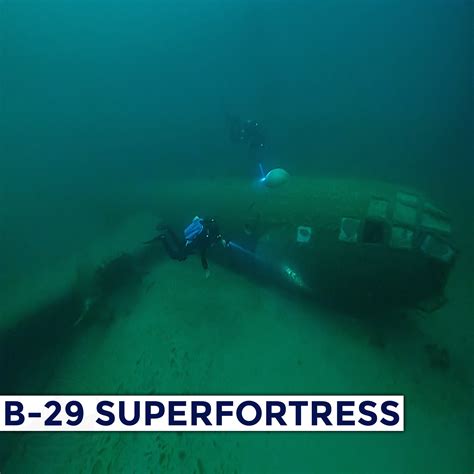
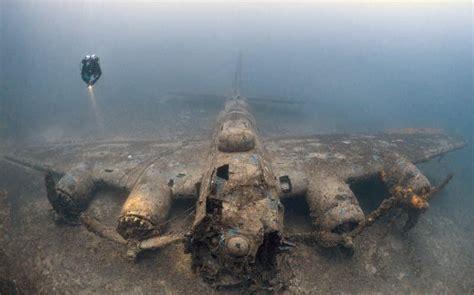
For decades, the wreck existed only as rumor and sonar ghost. Sport divers whispered about a “big plane” somewhere in the Overton Arm, but nobody could pin it down. That changed in 2000, when a team of National Park Service divers finally confirmed its exact location, and again in the early 2000s when the site became the focus of an intense flurry of exploration. What they found astonished them: despite a violent crash and more than half a century underwater, the Superfortress retained its distinctive silhouette — wings, tail, fuselage, and gun turrets all largely recognizable in the cold, dark water.
Management of the site falls to the National Park Service, which regulates every dive and enforces a strict philosophy of preservation. The rule is simple and absolute: look, do not touch. Silt, corrosion, and the accumulated weight of human curiosity all threaten a structure that has survived on borrowed time. For years, the NPS restricted access to technical divers only, because the wreck sat at a depth that demanded mixed-gas training, decompression planning, and serious experience. In 2003, the B-29 rested nearly 300 feet below the surface — a depth that put it out of reach for all but the most accomplished divers.
The calculus has shifted dramatically, and the culprit is drought. Lake Mead has been bleeding water for a quarter century, its shoreline retreating in stark, bathtub-ring bands visible to anyone who has driven across Hoover Dam. In 1948, when the bomber went down, the lake surface stood at approximately 1,180 feet above sea level. As of October 12, 2026, it sat at just 1,037 feet — a staggering loss of more than 140 vertical feet. The consequence for the wreck is profound: the B-29 now rests only about 115 feet below the surface, shallow enough for recreational divers to reach on a single tank of air.
That accessibility has transformed the site from a technical expedition into one of the most extraordinary recreational dives in North America. Qualified divers can now descend through the green-tinted water and come face to face with a genuine World War II-era heavy bomber, its aluminum skin furred with algae but its lines unmistakable. Water temperatures hover between the mid-50s and low 60s Fahrenheit year-round, cold enough to demand a thick wetsuit or drysuit but stable enough to make the site diveable in every season.
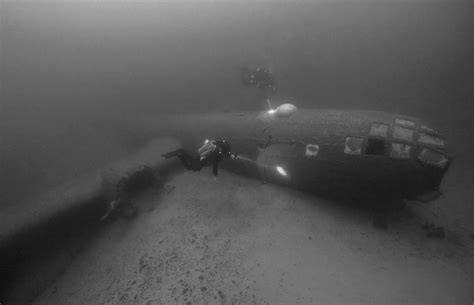
The plane’s remarkable condition is a product of chemistry as much as engineering. Freshwater lacks the salt that devours aluminum in ocean wrecks, and the lake’s depth keeps sunlight, wave action, and oxygen exchange relatively low. The result is a time capsule: a bomber that looks less like a wreck than a aircraft that simply paused mid-flight. The National Park Service monitors the site continuously, periodically pausing recreational diving when damage or crowding threatens the structure, and its long-term ambition is to keep the B-29 accessible and protected for the next century.
There is, of course, an uncomfortable irony at the heart of the story. The same drought that opened the Superfortress to ordinary divers is a symptom of a sweeping water crisis across the American Southwest, one that has forced unprecedented cuts to Colorado River allocations. As the lake continues to fall, the B-29 edges closer to the surface — and closer to the day when sun, air, and casual interference begin to erode what depth has preserved. For now, the bomber remains a haunting, beautiful relic, suspended between the sky it once ruled and the desert that is slowly draining its grave.