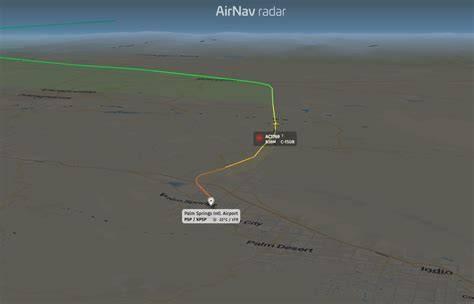
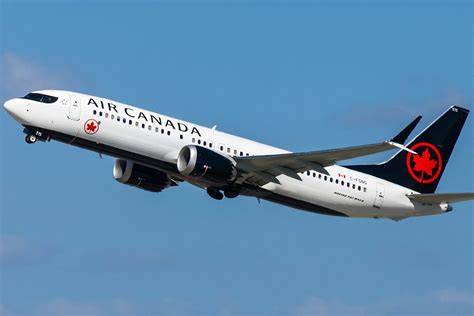
An Air Canada Boeing 737 MAX 8 climbing out of Palm Springs International Airport received a Traffic Collision Avoidance System (TCAS) resolution advisory after its crew detected an unresponsive Cessna in the vicinity of its climb path, forcing an immediate automated climb instruction before the jet continued to Vancouver. The encounter, which unfolded shortly after departure, has drawn attention to how quickly onboard collision-avoidance logic can intervene during an otherwise routine evening departure from one of California’s most compact commercial airports.
The flight carried the designation AC1769 and was operating a scheduled service from Palm Springs International Airport (PSP) to Vancouver International Airport (YVR). According to reports, the aircraft bore the registration C-FSDB, a Boeing 737 MAX 8 assigned to the carrier’s transcontinental and cross-border network. Weather, traffic volume, and field conditions at Palm Springs were unremarkable, which makes the sudden advisory all the more instructive for pilots and passengers alike.
Departure from PSP occurred at approximately 12:45 PM local time on November 17, with the jet lifting off from Runway 31R and turning into its initial climb toward cruise altitude. Palm Springs sits in the Coachella Valley, ringed by terrain on multiple sides, and departures from its single commercial runway must thread through designated corridors before reaching freer airspace over the desert to the north and east. It is within that narrow, constrained climb segment that the conflict is reported to have materialized.
The TCAS Resolution Advisory at 11,400 Feet That Forced a Climb to 12,000
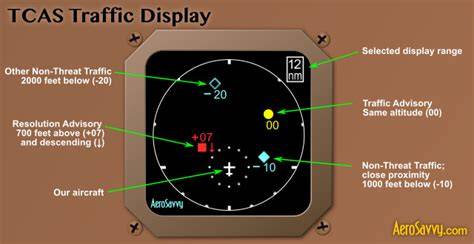
As the Boeing 737 MAX 8 passed through roughly 11,400 feet during its climb, the TCAS processed transponder returns from surrounding traffic and identified a trajectory it assessed as a potential collision threat. The system issued a resolution advisory (RA), the higher and more urgent of its two alert tiers, directing the Air Canada flight crew to climb to 12,000 feet, an additional 600 feet above their present altitude. The instruction was executed, and the aircraft gained the prescribed vertical separation.
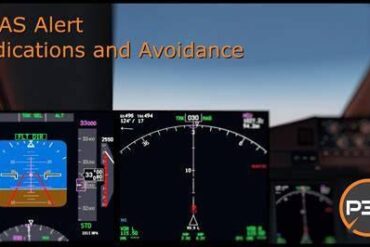
Crucially, the alert was specified as a resolution advisory, not a traffic advisory. A traffic advisory merely highlights proximate aircraft and prompts visual scanning; a resolution advisory goes further by commanding a specific maneuver. AeroSillage noted that an RA directs pilots to modify or maintain their vertical flight path to counter a perceived collision threat, which means the pilots were responding not to a suggestion but to a calculated instruction generated by the aircraft’s own surveillance logic.
The target aircraft was described as a small Cessna that was reportedly not responding during the encounter. Available reporting does not clarify whether the smaller aircraft failed to answer a radio call, whether it did not respond to an instruction from air traffic control, or whether its transponder data alone told the full story. The Cessna’s registration, the precise nature of communication attempts, and the minimum separation achieved between the two aircraft have not been disclosed, leaving the encounter’s finer geometry unresolved.
Why TCAS Asks Pilots to Climb Rather Than Descend
TCAS operates by interrogating transponders on nearby aircraft and calculating time-to-closest-approach in three dimensions. When the projected path falls inside a defined safety envelope, the system escalates from a traffic advisory to a resolution advisory, selecting a vertical maneuver that increases separation. In this case, the logic favored a climb, a common outcome when the intruder is detected below or laterally offset and the surrounding airspace offers clear altitude above.
Under the Federal Aviation Administration’s Aeronautical Information Manual, pilots are expected to comply with a resolution advisory promptly unless doing so would compromise the aircraft’s safety. The system’s authority is deliberately strong because RAs are generated faster than any human controller can react, and the FAA’s guidance reflects years of accident analysis showing that immediate compliance saves lives. The Air Canada crew’s climb from 11,400 to 12,000 feet fits squarely within that expected behavior.
Air Canada 737 MAX 8 Lands in Vancouver Without Diversion
Despite the automated advisory, the Boeing 737 MAX 8 did not divert or return to Palm Springs. The aircraft continued its scheduled routing and landed at Vancouver International Airport at approximately 4:45 PM local time, completing a journey of roughly two hours and forty minutes. Flight-tracking data independently confirms that the same airframe operated the PSP–YVR service and reached its destination, and no further emergency involving the jet was reported.
The outcome underscores a defining characteristic of modern collision-avoidance encounters: a properly executed RA often resolves the conflict within seconds, leaving the flight profile essentially intact. Passengers on board may have felt a firm, unannounced pitch change and a brief acceleration as the crew followed the commanded climb, then a return to normal climb scheduling. For the pilots, the event demanded immediate, decisive action inside a compressed window while other cockpit tasks were underway.
What Remains Unknown About the Cessna Encounter
No findings from US or Canadian aviation authorities have established the circumstances of the encounter, and without an official reconstruction it remains impossible to determine whether the Cessna suffered a communication failure, whether an instruction was missed, or how close the aircraft actually came. The absence of radar-tape analysis and controller transcripts leaves the incident in the realm of reported observation rather than verified fact.
The case nonetheless serves as a reminder that unexpected traffic conflicts can arise even on clear, routine departures from airports like Palm Springs, where general aviation and commercial traffic share constrained corridors. The resolution advisory did exactly what it was designed to do, converting a potential hazard into a controlled altitude change and allowing an Air Canada crew to complete its flight to Vancouver without further incident.