Chicago O’Hare International Airport is not the busiest airport in the world by passenger count, yet it holds a more demanding distinction: no airfield on Earth moves more aircraft than ORD. The Chicago Department of Aviation recorded more than 857,000 aircraft movements across 2025, an average well above 2,000 takeoffs and landings every single day. Numbers of that magnitude are not the product of generous terminal space or a sprawling route map alone. They are the result of an eight-runway airfield configuration engineered for relentless parallel flow, a layout developed through two decades of construction and completed only in 2021. Understanding how those eight strips of concrete convert into thousands of daily movements reveals the machinery behind one of aviation’s most scrutinized operating environments.
The Eight-Runway Layout That Defines Chicago O’Hare International Airport
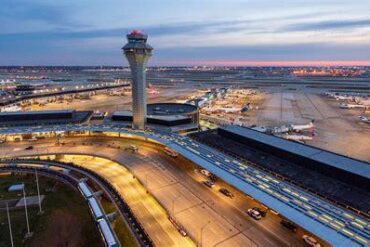
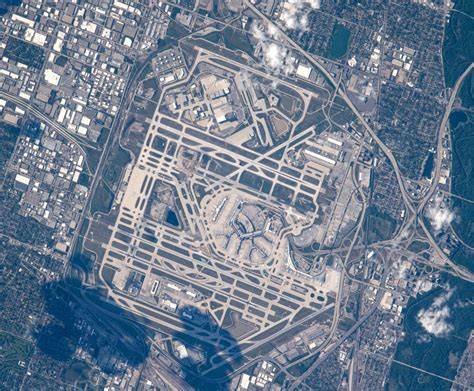
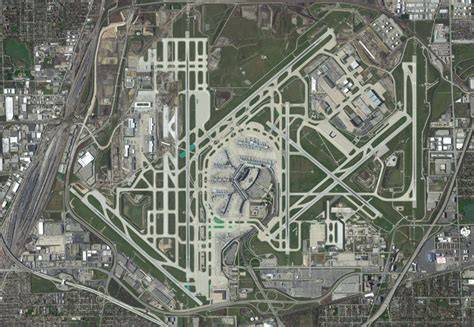
The geometry of ORD’s airfield is its greatest asset. Six parallel runways run east–west, designated 9L/27R, 9C/27C, 9R/27L, 10L/28R, 10C/28C, and 10R/28L. Three of these sit north of the terminal complex, three sit south, and critically, none of the six intersects another. That single design choice is what unlocks simultaneous operations at scale. A second pair of parallel runways, 4L/22R and 4R/22L, runs southwest to northeast, and these two exist for exceptional circumstances only, meaning unusually strong crosswinds or nonstandard traffic flows. Runway 4R/22L, the longer of the pair at 8,075 feet (2,461 meters), gives controllers a workable option when the primary east–west corridors become unusable.
In day-to-day practice, O’Hare functions as an airport with six parallel runways, a configuration that aviation planners regard as exceptionally efficient. Controllers can run up to four simultaneous parallel approaches when conditions allow, and two parallel departure streams are routine. The practical ceiling is not the concrete but the schedule: with the current layout, ORD is constrained more heavily by departures than by arrivals, which is why the airfield can technically absorb more traffic than the airlines currently send its way.
How Parallel Runway Assignments Convert Into Thousands of Daily Moves
The operating rhythm at ORD follows a disciplined division of labor among the six east–west runways. Runway 9L/27R on the north side receives arrivals from the north, while Runway 9C/27C handles arrivals from the south as well as heavy aircraft that need the extra margin. The two runways closest to the terminal core, 9R/27L and 10L/28R, carry the bulk of departures, with 10L/28R doubling as the airfield’s longest runway and therefore its preferred surface for long-haul departures. Runway 10C/28C absorbs the remaining south-side arrivals, and Runway 10R/28L receives traffic from the west, though its 28L end is used less frequently because of its proximity to Runway 4R/22L. The typical pattern is three runways receiving and two launching at any given moment, a split that keeps arrivals and departures from fighting for the same pavement.
The crosswind pair carries a narrower but essential role. Runway 22L is frequently used for departures during west flows, precisely when Runway 28L is unavailable, and Runway 4L/22R, despite intersecting 9C/27C and 9R/27L, is reserved for the rare days when wind directions demand it. That hierarchy lets ORD preserve high-capacity east–west flow on the overwhelming majority of operating days while retaining a backup that keeps the airport functional in adverse conditions.
The Transformation From a Six-Runway Pinwheel to a Modern Airfield
O’Hare’s capacity today is the product of a rebuild rather than an inheritance. When construction began in 2003, the airport operated six runways arranged in a pinwheel pattern, each pointing in a different direction to catch shifting winds. That design intersected runways repeatedly, which meant controllers could never use the full set at once. The original airfield was functional but structurally incapable of expansion. Over nearly two decades, the program closed two runways, constructed four new ones, and extended two existing ones, culminating in 2021 with the extension of Runway 9R/27R and the introduction of the new Runway 9C/27C. The result was the six-runway parallel grid that governs traffic today.
The trade-off embedded in that redesign is deliberate. The new layout produces more crosswind exposure on departures and arrivals than the old multi-directional pinwheel, but it delivers dramatically higher throughput, and throughput is what allows O’Hare to process more than 2,000 movements daily without gridlock.
United Airlines and American Airlines: The Hub Battle Feeding O’Hare’s Movement Counts
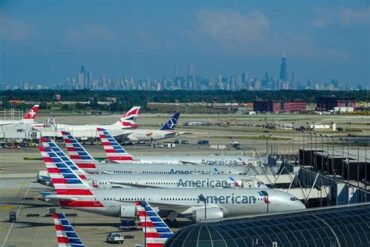
The sheer volume on O’Hare’s runways is driven by two carriers locked in an unusually intense contest. United Airlines, headquartered in Chicago and anchored at O’Hare as its largest hub, operates primarily from Terminal 1, with some regional flying out of Terminal 2, and holds just over 90 gates. American Airlines, the long-standing number two at ORD for decades, works from Terminal 3 with more than 60 gates after the most recent allocation round. International arrivals for both feed into Terminal 5, the only terminal equipped with a Federal Inspection Station.
For the summer 2026 season, United scheduled roughly 650 peak daily departures, more than 100 above its prior summer, while American operated over 500 daily departures. Both carriers run extensive domestic networks alongside European services, and United’s route map out of ORD includes nonstop service to Tokyo. The growth was not organic trend alone. After American trimmed flights in 2022 and 2023, United pressed toward pre-pandemic levels, planning an average of roughly 750 daily flights for 2026, more than 200 above its 2025 daily average. United was effectively pouring capacity into the Chicago market to pressure its rival, and American responded, partly because O’Hare’s gate allocation system rewards demonstrated usage. The collision between those ambitions and physical limits arrived quickly.
The Federal Flight Cap and the 2,700-Movement Ceiling
By the 2026 summer season, the airlines’ combined schedules had pushed past 3,000 planned daily takeoffs and landings. The FAA responded with a flight cap that held O’Hare to just over 2,700 movements per day, citing delay exposure and congestion. The cap hit United harder than American because it was calculated against O’Hare’s 2025 summer schedule, a baseline built before United’s aggressive 2026 expansion. The practical effect was to compress the gap between the two carriers, forcing both to trim ambitions that had been designed to reshape the Chicago market. Even under the cap, the airfield still comfortably exceeds the 2,000-movement threshold that defines its daily reality, and the cap itself demonstrates how tightly the runway system is now being worked.
Taxiway Bottlenecks, Metering, and the Remaining Constraints at ORD
Runway efficiency does not automatically translate into ramp efficiency. Several taxiways remain closed for construction, and the consequences ripple across the operation: departing aircraft clog movement areas, pushbacks get delayed, and arriving aircraft sometimes have nowhere to park. Controllers respond by routing aircraft on extended taxi patterns or holding them in the “penalty box,” formally the de-icing pad, where crews wait with the parking brake set until a gate frees up. During peak periods, ramp controllers use a metering system to regulate how many aircraft enter the taxiway network at once. Some runways also sit far from the core terminal area, adding rolling time that compounds every delayed pushback.
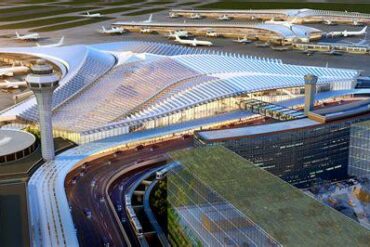
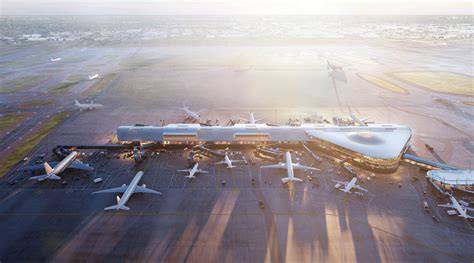
Those constraints are scheduled for relief. O’Hare is now in the middle of a far larger modernization effort than the runway program itself, including a new Terminal 2, known as the Global Terminal, which will provide a second international arrivals facility and break Terminal 5’s monopoly on Federal Inspection Station processing. Concourse expansions across the airport’s other terminals and revised taxiway layouts are being built to support higher volumes and future terminal growth.

Why O’Hare’s Runway Model Still Sets the Benchmark for Movement Capacity
The eight runways at O’Hare are not simply more concrete than the competition; they are a system whose parts were chosen so that none of the six primary runways interferes with another. Six non-intersecting parallels deliver the parallel arrivals and departures that generate 2,000-plus movements every day, while the two crosswind strips provide resilience when wind shifts would otherwise collapse throughput. The airfield is now departure-constrained rather than arrival-constrained, a rare position that means Chicago could physically absorb more flights than the current schedule allows, and the FAA’s cap exists to manage congestion rather than to mark a hard structural limit. With the Global Terminal, new taxiways, and expanded concourses coming online, ORD is positioning its ground infrastructure to match an airfield that already handles more aircraft movements than any airport in the world. The eight-runway formula, refined over twenty years and finished in 2021, remains the clearest blueprint for moving planes at global scale.