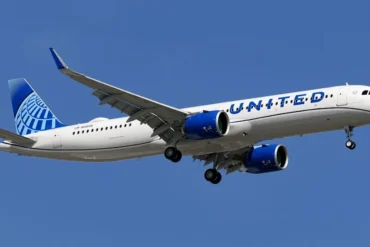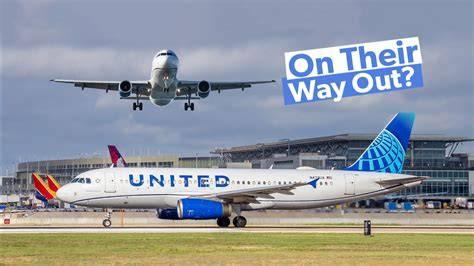
United Airlines has quietly begun dismantling one of the most familiar silhouettes in American aviation. The Airbus A320-200, a fixture on domestic trunk routes for nearly three decades, is sliding toward the exit ramp as the carrier accelerates a fleet modernization plan that will eventually erase the A320ceo family from its mainline roster. Fifty-nine examples remain in active service with two parked, and their average age of 26.7 years places them among the oldest active Airbus narrowbodies flying under a major US flag. For an airline long caricatured as a “Boeing airline,” that statistic carries unusual weight. United’s A320s were never an accident of history; they were a deliberate bet that a reliable, moderate-capacity European narrowbody could anchor the domestic network while the 737 line matured around it, and for two decades that bet paid off handsomely.
The retirement is therefore not a simple disposal story. It is an argument about capital allocation unfolding at 36,000 feet, where every dollar spent overhauling a three-decade-old airframe is a dollar that cannot be deployed against a fuel-efficient, higher-capacity replacement. Fuel prices have been volatile for years, heavy maintenance intervals tighten as airframes age, and passengers have grown unforgiving about cabin quality. The A320ceo sits at the uncomfortable intersection of all three pressures, and United’s decision to retire 21 aircraft in 2025 signals that the airline has stopped asking whether these jets can keep flying and started asking whether they should.
The Aging A320-200 Fleet and the Rising Cost of Keeping It Airborne
An airframe crossing the 25-year threshold enters a phase of life defined by structural inspections, aging-aircraft programs, and engine overhauls that arrive with grim predictability. United’s A320ceos are now well past that mark, and the bill has grown impossible to ignore. CEO Scott Kirby told ch-aviation that the airline spent $100 million on engine work in 2024 alone, a figure that reframes the retire-or-fly calculation as a pure opportunity-cost problem. The oldest jets are simply no longer earning their upkeep on routes where newer aircraft would deliver the same seats at a fraction of the operating cost.
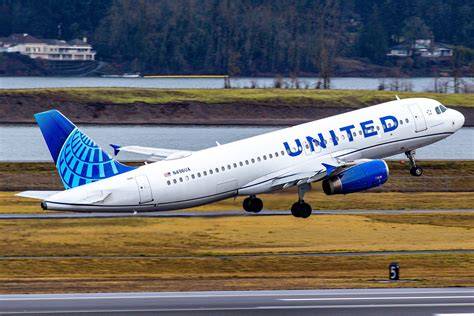
United responded by earmarking at least 17 of its oldest Airbus A320s for retirement between August and October 2025, a concentrated exit that removes the most expensive airframes from the fleet before they demand another round of deep maintenance. The logic is unforgiving by design. A thirty-year-old narrowbody requires more frequent A-checks, more invasive C-checks, and a growing inventory of aging components whose supply chains are themselves shrinking. Every inspection that finds corrosion or fatigue-prone structure extends downtime, and every overhaul competes for hangar space with a factory-fresh jet that needs almost nothing beyond routine attention. In a network as geographically dispersed as United’s, hangar capacity is a finite resource, and parking an old A320 frees mechanics, bays, and spare parts for the aircraft that actually represent the future.
The average age of 26.7 years also creates a subtler problem: aircraft within a fleet rarely age in isolation. When the youngest airframe in a subfleet is approaching two decades, the operator must stock parts for configurations that no longer exist anywhere else in its network, train crews on systems that new hires will never see again, and maintain knowledge bases for a wingtip fence era A320ceo that the rest of the world has largely moved beyond. United’s A320s represent a shrinking island of institutional knowledge inside a fleet rapidly converting to the A321neo and 737 MAX, and islands of knowledge become expensive precisely because they cannot borrow cheaply from the mainland.
Why United Is Raising A320ceo Retirements Now
The timing of United’s A320 drawdown reflects both economics and strategy. Scott Kirby’s comments at the Barclays industrial conference in early 2025 made clear that softer leisure demand and broader macroeconomic headwinds are shaping the near-term fleet plan, and grounding or parting out marginally profitable aircraft generates a cash-positive effect precisely when cash discipline matters most. Retiring an old jet is not merely a cost avoidance; it is a release of capital locked up in an asset that has already given everything it had to give. The decision to accelerate the wave of 21 retirements in 2025 was, in that sense, a present-value judgment dressed up as an operational one.
There is also a delivery-schedule component. United has placed enormous orders, including 130 A321neos and 50 A321XLRs, and fleet withdrawals must be sequenced against the pace at which those aircraft arrive. Delays on the A321XLR, whose long-range mission overlaps with the capabilities of the aging 757, have forced United to phase retirements carefully so that routes remain fully served. The airline cannot afford to ground an A320 before its replacement has cleared the delivery center and completed post-delivery checks, so the retirement calendar and the delivery calendar must be reconciled month by month. This explains why the exit is unfolding in waves throughout the year rather than overnight, and why the A320’s departure is best understood as a rolling reallocation of capacity rather than a single decisive event.
The Business Case for the A321neo and United Next Up-Gauging
Aircraft economics drive fleet decisions as surely as metal fatigue, and here the numbers are lopsided. The A321neo, powered by CFM LEAP-1A engines, delivers a significant reduction in cost per available seat mile compared with the A320ceo, thanks to newer powerplants, aerodynamic refinements, lighter materials, and a cabin that carries roughly 25 to 30 percent more passengers in United’s configuration. Where an A320ceo seats somewhere around 150 to 160 passengers on United’s layout, the A321neo accommodates roughly 190 to 220, which means the replacement aircraft can absorb the demand of nearly one and a half legacy A320s in a single fuselage.
That arithmetic is the engine behind United Next, the carrier’s growth plan built on up-gauging: flying larger narrowbodies on core routes so that fixed costs spread across more seats. Over hundreds of annual rotations, the savings compound into tens of millions of dollars per route family, and the airline has come to view the A321neo as its top domestic performer. Beyond cost, the type allows United to expand capacity at slot-constrained hubs such as Newark (EWR) and San Francisco (SFO) without adding a single departure, a structural advantage that no amount of refurbishment can manufacture from a thirty-year-old airframe.
The 757 replacement story completes the picture. United flies 36 757-200s averaging 29.8 years and 19 757-300s averaging 24.3 years, with four -200s and two -300s in storage. The 757 remains beloved for its short-field performance and its ability to make “long and thin” routes work, but it burns fuel like a much larger aircraft. The A321neo LR and XLR variants close most of the capability gap, offering ranges from 3,500 to 4,700 nautical miles with far better per-seat economics and lower emissions. United is therefore performing a rare dual-fleet transition: the same Airbus family is replacing both the 150 to 170-seat A320 and the 180 to 240-seat 757, simplifying maintenance, consolidating training pipelines, and inserting one flexible airframe into multiple mission profiles across transcontinental and short transatlantic sectors.
| Attribute | A320ceo | Boeing 757-200 / -300 | A321neo / LR / XLR |
|---|---|---|---|
| Typical United seats | ~150–160 | 176–204 / ~234 | ~190–220 |
| Average age in United’s fleet | 26.3 years | 29.5 / 23.9 years | 1.3 years |
| Typical range | ~3,300 nm | ~3,915 / ~3,400 nm | 3,500–4,700 nm (XLR) |
| Fuel burn per seat | High | High | Low |
| Key mission | Domestic trunk, mid-haul | Transcontinental, thin transatlantic | Domestic trunk, long thin routes |
Passenger Experience and Brand Consistency Across the United Network
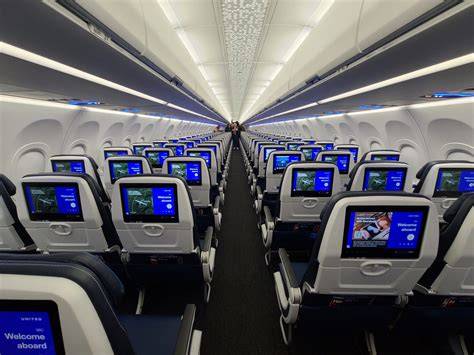
Economics may fund the transition, but the passenger experience justifies it. The A321neo arrives with a factory-fresh interior built around Airspace XL overhead bins, full-color LED mood lighting, fast satellite WiFi, and seat-back entertainment on most configurations. Retrofitting a 1990s-era A320 to anywhere near that standard is expensive and structurally incomplete, because the legacy cabin’s dimensions, systems, and wiring pathways limit what can be installed after the fact. United can brighten an old cabin and upgrade its screens, but it cannot retrofit the geometry that gives newer narrowbodies their psychological impression of space.
Frequent flyers notice these differences on every two-thousand-mile domestic leg. The quieter cabin, cleaner lighting, and functioning connectivity of the A321neo create a tangible upgrade, and the consistency has commercial weight: a traveler who books a premium seat from Chicago O’Hare to Denver expects the same product as one flying from New York to Los Angeles. By phasing out the A320s, United reduces product variation across the network, and that predictability becomes a selling point for loyalty program members and corporate accounts alike. The A321neo functions as a brand ambassador, reinforcing United’s premium domestic positioning while delivering operational efficiency that competitors are racing to match, as Delta and American both renew their own narrowbody fleets.
The Network United Is Building Toward, and What the A320 Retirement Changes
Removing the A320ceo and older 757s reshapes both the domestic and near-international network. Larger, more efficient narrowbodies allow United to consolidate frequencies while preserving or even growing total seats, a capability that matters enormously at hubs where slot constraints cap departures regardless of demand. Passengers gain more consistent onboard products, more modern cabins, and fewer operational disruptions caused by aging equipment, while the airline trims fuel burn per seat, supports its carbon-reduction goals, and strengthens its position against competitors moving in the same direction. The A321neo, alongside the 737 MAX and the 787 Dreamliner for long-haul missions, will define United’s flying experience well into the 2030s, and the retirement of the A320ceo fleet is the unglamorous administrative work that makes that future possible. In a competitive US market, fleet modernization is not a luxury; it is the price of admission, and United has chosen to pay it early rather than late.