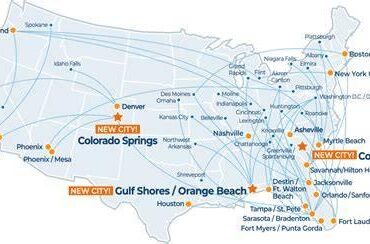
All airlines churn routes and airports, but ultra-low-cost carriers do it with unusual speed and finality. Allegiant Air, the Las Vegas-based ULCC built on linking small and medium-sized cities to leisure destinations, has carried more than 157 million scheduled passengers over the past decade, every one of them on domestic flights. Against roughly eight billion domestic passengers flown by all US airlines in the same period, that works out to about 2% of the market. Yet in those margin-thin leisure markets — the kind Volotea serves in Europe — Allegiant remains a defining presence, and its reach is set to grow modestly once the Allegiant Travel Company acquisition of Sun Country closes.
That entrepreneurial appetite explains both the expansion and the retreat. Where legacy carriers plan networks years ahead, Allegiant tests markets quickly and abandons them just as quickly when the numbers fail. Between January 2016 and October 2026, Cirium Diio data shows the carrier stopped flying to 34 airports. The figure excludes Minneapolis, which returns in 2027, and Chicago Midway, which Allegiant exits in 2027 but Sun Country will continue serving at O’Hare. The pattern of those exits — one year of quiet housekeeping, then clusters of cuts — tells the story of a carrier that tolerates losses only briefly.
The Year-by-Year Record of Allegiant Airport Cuts
The decade opened with no eliminations in 2016. In 2017, Allegiant left Burlington, Honolulu and Santa Rosa; 2018 brought exits from Casper, Wilkes-Barre/Scranton and Youngstown. The 2019 wave — Anchorage, Milwaukee and St. George — preceded the pandemic, while 2020 saw Ogdensburg, Montrose and San Juan disappear as travel collapsed. In 2021 the airline dropped Jackson Hole and Tucson, then executed its largest single-year purge in 2022, removing Albuquerque, Amarillo, Cleveland, Ogden, Raleigh-Durham, Redmond and State College in one sweep.

The retrenchment continued through 2023 with Owensboro, accelerated in 2024 with Baltimore, Gulfport/Biloxi, Reno and San Antonio, and carried into 2025 with El Paso, Grand Junction, Norfolk and San Diego. The 2026 list — Columbia (SC), Los Angeles International, Oakland and Palm Springs — closed the decade. Cumulatively, the cuts erased entire states from the map: Alaska, Hawaii (served briefly by the Boeing 757), New Mexico, Vermont and Wyoming, plus the territory of Puerto Rico. With Oakland gone, Allegiant no longer touches the San Francisco Bay Area at all; Stockton remains in the network but sits outside the Bay’s official boundaries.
Why Allegiant Quit Alaska After a Single Summer
Allegiant’s Alaska chapter lasted one season and one route. The carrier launched Bellingham to Anchorage in May 2019, exactly seven years before Southwest Airlines arrived in the Last Frontier, and flew it only between May 22 and September 2, 2019. The schedule counted just 31 takeoffs, all operated by the Airbus A319. It was the first — and remains the only — time Bellingham ever had scheduled service to Alaska.
The results were unambiguous. US Department of Transportation data shows 6,272 round-trip passengers on the brand-new route, which sounds respectable in isolation. Set against available seats, however, it produced a load factor of only 67.2% — weak even for a freshly opened market. Fare data is not publicly broken out, but whatever revenue the route generated clearly fell short of what Allegiant needed to justify keeping a distant, seasonal outpost. The airline cut it rather than nurse it.
Los Angeles International: The Biggest Exit by Far
Across the 34 departed airports, Allegiant operated 49,955 departures between January 2016 and October 2026. Los Angeles International alone accounted for 13,391 of them — more than a quarter of the total and far more than any other lost airport. LAX joined the network in 2009 and, within the study window, supported 40 routes, with more flights to Bellingham than anywhere else. Allegiant pulled out in January 2026.
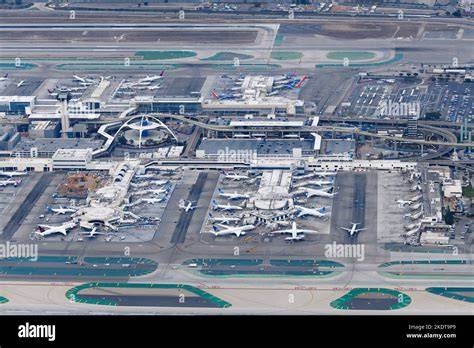
The exit did not sever Los Angeles entirely. Some of those 40 destinations are now served by Allegiant from Burbank or Orange County, or both, and analysis of the first ten months following the pullout shows 23 of the 40 will still have nonstop flights on at least one carrier. The lesson is consistent with the broader record: Allegiant rarely abandons a market outright. It abandons a specific airport when a cheaper, less congested alternative nearby does the same job for lower cost.