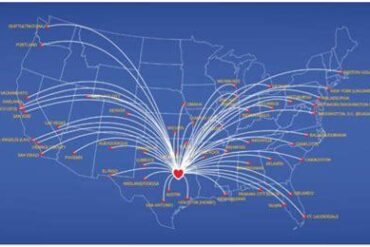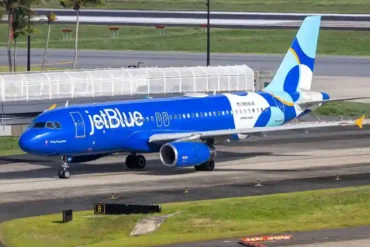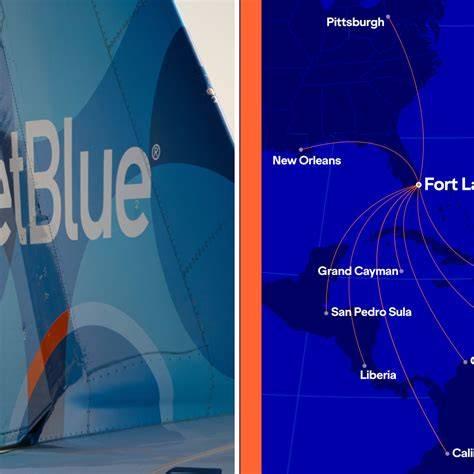
JetBlue has quietly dismantled a significant slice of its route map. Across the first ten months of 2026, the carrier permanently closed 35 routes — 22 domestic and 13 international — every one of which carried passengers at some point this year but now sits in the schedule with zero future flights attached. The removals tell a story about a network in motion: a carrier shedding thin, seasonal, and underperforming markets while pouring enormous capacity into a handful of strongholds. In winter 2026/2027, JetBlue’s submission to Cirium Diio data shows an average of 919 daily departures, a 7% increase over the prior winter. Fort Lauderdale stands out as the headline winner, with departures surging 58%, a spike driven largely by the collapse of Spirit Airlines and the vacuum it left across South Florida.
The 22 Domestic Routes JetBlue Has Abandoned
The domestic picture is more complicated than a simple retreat. Fort Lauderdale actually lost the greatest number of domestic markets, yet it simultaneously posted the network’s largest capacity gain. The explanation lies in timing: most of those Fort Lauderdale cuts were short-lived spring break experiments that operated for only a matter of weeks. Routes such as Bozeman, Denver, Reno, and Salt Lake City to Fort Lauderdale all ended in March 2026, and Portland’s link to Fort Lauderdale closed in April. Reno deserves particular scrutiny, since JetBlue had never before connected it to Fort Lauderdale or anywhere else in Florida. Department of Transportation figures put the route’s load factor at just 60.1%, a number that makes the decision to walk away look less like caution and more like arithmetic.
The January through October timeline reveals how scattered the retreat was. New York JFK to Ponce, in Puerto Rico, ended in January. March brought a cluster of cuts including Boston to Dallas/Fort Worth, New York JFK to Tampa, and the four spring break Florida routes. April removed Providence to Fort Myers; May removed Manchester to Fort Lauderdale and Manchester to Fort Myers; June took Newark to Fort Myers and Newark to Las Vegas; July erased Hartford to Tampa, Manchester to Orlando, and Newark to Tampa. September delivered Boston to Daytona Beach, New York JFK to Daytona Beach, and New York JFK to Vero Beach. October closed with Newark to Los Angeles, New York JFK to Chicago O’Hare, and New York JFK to Nashville. The pattern confirms what the data implies: seasonal demand and weak point-to-point economics, not random pruning.
Airport Exits Behind the Domestic Cuts
Several eliminated markets were byproducts of JetBlue abandoning entire cities rather than individual city pairs. Manchester, New Hampshire lost its last JetBlue flights in July 2026, and Daytona Beach followed two months later. The Daytona Beach story is especially telling: JetBlue only returned to the Florida city in December 2025 after a previous run ended in January 2019, giving the relaunch barely nine months before the plug was pulled again. Hartford and Providence also lost links, though those specific routes — JFK to Hartford and JFK to Providence — persist elsewhere in the network and remain among the carrier’s weakest performers.
Newark’s contraction reinforces the theme. Departures from Newark are down 32%, and the airport accounts for a disproportionate share of the removed domestic and international city pairs. Cancun, Punta Cana, Santo Domingo, and Antigua all lost Newark service in July, while Fort Myers, Las Vegas, Tampa, and Los Angeles disappeared from Newark’s board across June, July, and October respectively.
The 13 International Routes That Have Disappeared
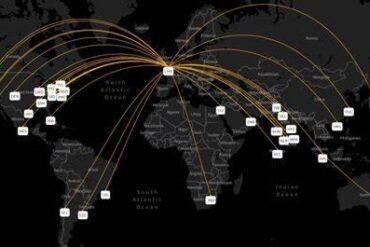
International capacity fell 2% this winter while domestic rose 11%, and the international cuts explain the gap. JetBlue has now exited Antigua, Belize City, Bonaire, and Tulum entirely. New York JFK to Bonaire ended in January and JFK to Tulum in March. May brought the loss of JFK to Belize City, JFK to Guatemala City, and JFK to San Pedro Sula. June removed Fort Lauderdale to Grand Cayman and Tampa to Punta Cana, a market Breeze entered in March. July was the heaviest month, with Newark losing Antigua, Cancun, Punta Cana, and Santo Domingo, plus Orlando to San Jose. JFK to Antigua closed in September.
Tulum stands as the cautionary tale. JetBlue launched JFK to Tulum in June 2024 and ended it in March 2026 — under two years of service. DOT data shows 91,226 round-trip passengers carried but only 70.4% of seats filled, far below the threshold needed to justify scarce aircraft and crews. Redeploying those jets to stronger markets is the rational response, even if the experiment itself was costly.
Which Remaining Routes Are at Risk?
DOT data for the twelve months to July 2026 identifies six surviving routes that carried at least 5,000 round-trip passengers while filling no more than half their seats. Boston to Presque Isle moved 42,119 passengers at a 43.5% load factor; New York JFK to Hartford carried 53,383 at 46.5%; New York JFK to Providence carried 47,073 at 41.1%; Fort Lauderdale to Orlando carried 26,664 at 48.3%; Boston to Martha’s Vineyard carried 9,333 at 45.8%; and Boston to Steamboat Springs carried 6,529 at 49.8%.
The short JFK hops are almost certainly slot-sitting exercises, preserving valuable airport access while feeding connectivity through the hub, and the Boston markets serve community and seasonal roles that extend beyond raw profitability. Still, with planes this empty, every one of these routes sits on borrowed time. JetBlue’s 35 cuts show a carrier willing to move fast when a market fails to deliver, and the winter schedule’s overall growth signals that the airline has a clear plan for where its aircraft belong — just not on the routes above.