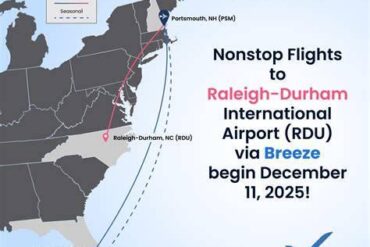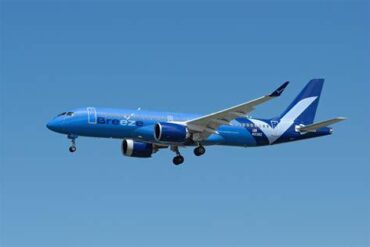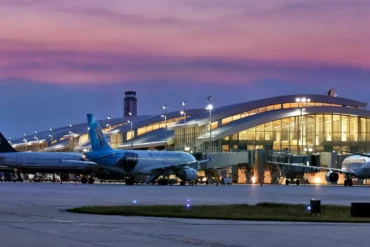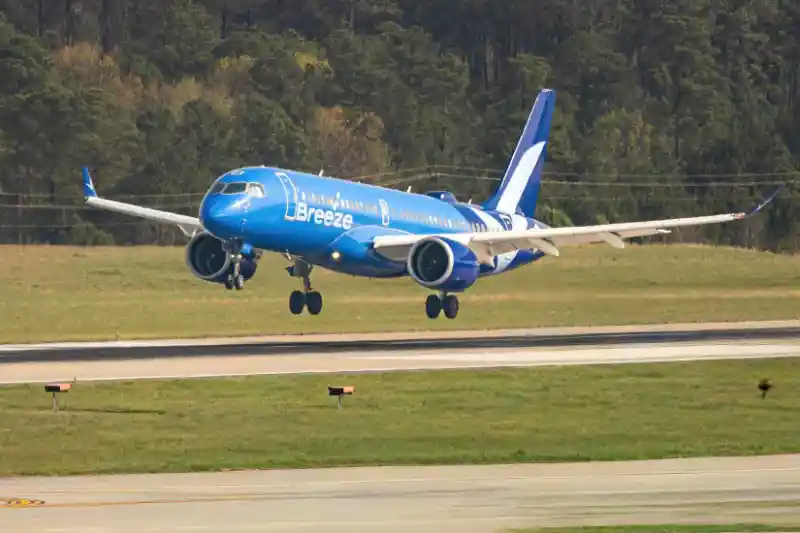
Raleigh-Durham International Airport has quietly become one of the most consequential pieces of Breeze Airways’ growth strategy. The carrier first touched down at the North Carolina airport in February 2023, and in barely four years the Research Triangle has shifted from a promising experiment into a genuine hub of first flights. The region’s position among the fastest-growing metros of the United States gave the airline a dependable pool of business travellers, university traffic and leisure flyers that few young carriers can ignore. Cirium Diio schedule data shows Raleigh-Durham as Breeze’s most-served airport for all of 2026, but the plan does not stop there. Between the twelve routes already launched across 2026 and the three arriving in June 2027, the airline is effectively publishing fifteen new nonstop options from one airport, a statement of intent from a carrier that has made a business of going where nobody else dares.
The Twelve Routes Breeze Launched from Raleigh-Durham in 2026
The 2026 expansion was rolled out as a steady drumbeat rather than a single announcement. On March 4, Breeze began two weekly flights to Punta Cana, the carrier’s lone international addition from Raleigh-Durham this year and a route with a turbulent recent history: no nonstop service existed before 2018, Frontier operated in 2018 and 2019, American and Avelo both jumped in during 2025, and when Avelo withdrew in January 2026, Breeze stepped forward two months later. May 6 brought a triple launch to Bangor, Stewart and Vero Beach, with the Maine and New York markets running twice weekly and Vero Beach fluctuating between two and four frequencies to match seasonal demand. San Antonio followed on May 7 with two to three weekly flights, then Madison on May 8 and Orange County on May 19, both at two weekly. Atlantic City arrived on June 11, Tallahassee on July 2 with three weekly flights, and Birmingham on July 3. The final two entries, Provo on October 2 and Dayton on November 6, rounded out a year in which Breeze filled gaps other airlines left behind.
Seven Destinations That Had Never Had Nonstop Raleigh-Durham Flights
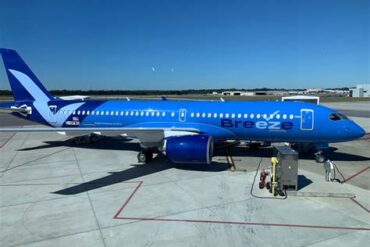
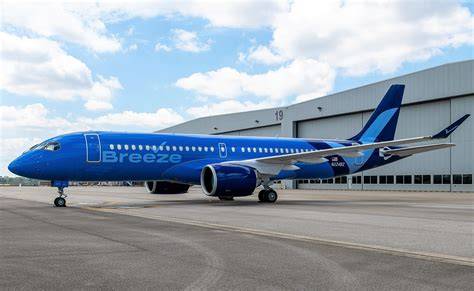
What separates this rollout from routine network growth is how much of it is genuinely new to the airport’s map. Atlantic City, Bangor, Madison, Orange County, Provo, Tallahassee and Vero Beach had never before enjoyed nonstop flights from Raleigh-Durham, and Breeze is the carrier that made each of them possible. This is the strategic signature of the airline’s 137-seat Airbus A220-300, an aircraft small enough to fill profitably on thinner routes yet comfortable enough to defend a premium reputation. Several of the remaining markets are revivals of service lost decades ago: Stewart was part of American Airlines’ network while the carrier still operated a hub at Raleigh-Durham and later flew with Midway Airlines until 1995; San Antonio last saw Frontier in 2018; Dayton was served by Midway until 2001; and Birmingham carried ExpressJet flights until 2008. Breeze is effectively resurrecting abandoned city pairs with modern economics and lower aircraft costs.
Three More Routes Landing at Raleigh-Durham in 2027
The 2027 schedule, known as of November 11, adds another trio and only one of them is familiar. Buffalo begins on June 29 with four weekly flights, Las Vegas returns on June 30 as a daily service, and Nassau launches the same day twice weekly, giving the North Carolina airport a second international leisure market alongside Punta Cana. Las Vegas is the intriguing case. Breeze flew the 3,261-kilometre, 1,761-nautical-mile transcontinental route only between September 2023 and January 2024, carrying 10,284 passengers at a 78.2% load factor that matched the airline’s network average at that time. US Department of Transportation figures show the problem was never demand but money: distance-adjusted total revenue per available seat mile on the Las Vegas route was Breeze’s lowest across its entire Raleigh-Durham network, sitting 31% below the Los Angeles route, which was itself withdrawn in January 2026. Frontier’s exit last August improves the competitive picture, though Delta and Southwest remain in the market.
Forty-Four Routes, Fourth Place in Capacity: Breeze’s Raleigh-Durham Footprint
Between January and June 2027, Breeze has scheduled 44 routes from Raleigh-Durham, well over double the count of any other carrier serving the airport. Those numbers flatter its scale in departures and seats, however. Because most links operate only two or three times weekly on 137-seat aircraft, Breeze will rank just fourth among the airport’s operators for both departures and capacity. Its discipline has been remarkable: since February 2023, the airline has ended exactly one route, Las Vegas aside, namely the Los Angeles service flown between May 2023 and January 2026, and even that market is still served indirectly through Orange County, which covers the vast LA Basin. Looking further ahead, Tampa is due to overtake Raleigh-Durham for Breeze’s top spot from January 2027, though the North Carolina airport reclaims first place in the schedules for next July and August.
What Fifteen New Routes Mean for Travellers in the Research Triangle
The practical effect for passengers is a dramatically wider set of nonstop choices from one of the Southeast’s most congested markets. Travellers can now fly direct to the Dominican Republic, California, Texas, Maine, Ohio, Wisconsin, Alabama, Florida, New York, New Jersey, Utah and the Bahamas, often on routes that no other airline touches. For a region defined by universities, research campuses and a steady inflow of relocating families, those point-to-point connections save hours of connecting through Charlotte, Atlanta or Washington. The bet is straightforward: proven load factors, minimal competition and a fleet sized to the route. If the 2027 Las Vegas relaunch performs better on revenue than its short-lived first attempt, the case for still more Raleigh-Durham flying will be difficult to argue against.