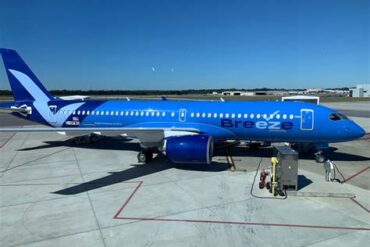
Breeze Airways has revealed eight new international routes that will enter service between December and next summer, a build-out that lifts its international network to 15 routes across six destinations outside the United States. The headline addition is Santo Domingo, the capital of the Dominican Republic and far and away its most populous city. This is the first time Breeze has flown to that market. The airline has also added Raleigh/Durham to Nassau, a city pair that Avelo Airlines had already announced before withdrawing it. Santo Domingo joins San José, Costa Rica, and Montego Bay, Jamaica, as the newest markets on the carrier’s international map, which gives Breeze a compelling match of point-to-point pricing and a cabin product that has drawn remarkably kind reviews for an ultra-low-cost operation. Taken together, the schedule marks the airline’s most aggressive push beyond the US border in its short history as a mainline carrier.
Breeze Airways From Tampa To Santo Domingo: The Route That Flips the Script
Until now, Breeze’s international destinations — Cancun, Montego Bay, Nassau, Punta Cana and San José — have primarily, if not entirely, revolved around outbound tourism from the United States. Flights to Santo Domingo will be very different, because the demand they are built to capture revolves around Dominican Americans and the family travel they make between their adopted country and their country of origin. On June 18, 2027, Breeze will lift off from Tampa International Airport (TPA), which is by far the airline’s leading international gateway, and touch down at Santo Domingo’s Las Américas International Airport (SDQ). Covering 911 nautical miles (1,687 km) on a great circle basis, the route becomes the airline’s ninth-longest international city pair.
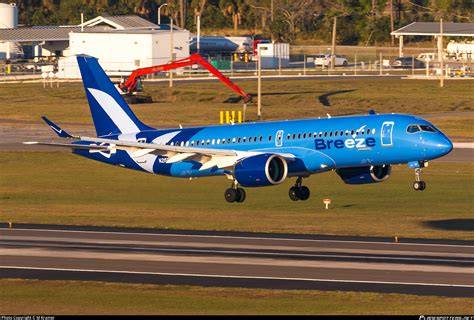
Frequency will follow Breeze’s usual rhythm: two weekly flights aboard the 137-seat Airbus A220-300, which is now the airline’s sole equipment. MX182 departs Tampa at 10:30 AM and lands at 1:25 PM after 2h 55m, while MX183 returns at 2:25 PM and touches down at 5:30 PM after 3h 5m. Mondays and Fridays make up the pairing, an arrangement that suits weekend-leaning VFR traffic and avoids the cost of daily staffing at both ends. Data from Cirium Diio shows that the first nonstop flight in this market appeared only in 2023, when Frontier Airlines introduced it. According to the US Department of Transportation, Frontier’s average load factor between May 2023 and June 2026 was just 65.8%, and some months ran with fewer than half the seats filled. Frontier is exiting TPA–SDQ, with the last departure set for January 2027, which leaves Breeze alone on the airport pair.
Six Florida Routes From Tampa and the Caribbean Traffic Behind Breeze’s Growth
Six of Breeze’s 15 international routes now depart from TPA: Cancun, Montego Bay, Nassau, Punta Cana, San José and Santo Domingo. Tampa is currently the only airport in Florida from which the fast-growing carrier operates beyond the US border, and it anchors a Caribbean and Latin footprint of six routes and seven airports spanning 5,046 network miles. In the 12 months to July 2026, booking data shows that approximately 1.1 million round-trip passengers flew between TPA and the Caribbean, Central America and Mexico — roughly 3,000-plus people every day once seasonality is set aside. Around two-thirds of that traffic flew nonstop, with most of the balance connecting through Miami, Fort Lauderdale, Tampa, Dallas/Fort Worth and Houston George Bush Intercontinental Airport. That leakage to connecting hubs is precisely the demand that nonstop service of Breeze’s kind is built to capture.
Before Breeze launched TPA–Nassau, that short market carried roughly 15,000 round-trip passengers. Used as a guide, it suggests most remaining unserved markets are smaller still. The largest unserved destination across the Caribbean, Central America and Mexico is now Los Cabos at 19,000 passengers, followed by Liberia at 14,000, Aruba at 11,000 and Guatemala City at 10,000. Apart from Los Cabos, the existing traffic is minuscule, which is not surprising for routes with no nonstop option. Still, Breeze’s nonstop flights, relatively low fares, a reasonably well-regarded product and hopefully strong promotions would grow those numbers nicely: the airline launched TPA–Nassau in June 2026 and grew traffic by 68% year-over-year.
All 15 Breeze Airways International Routes and the December 2026 to Summer 2027 Launch Schedule
As of late October and subject to change, the international network runs as follows:
- Charleston to Cancun: weekly to two weekly
- Columbus to Punta Cana: starts January 8, two weekly
- New Orleans to Cancun: two weekly
- Norfolk to Cancun: weekly to two weekly
- Pittsburgh to Cancun: begins January 7, three weekly
- Pittsburgh to Punta Cana: starts January 7, three weekly
- Raleigh/Durham to Nassau: starts June 30, two weekly
- Raleigh/Durham to Punta Cana: weekly to two weekly
- Richmond to Cancun: begins January 8, two weekly
- TPA to Cancun: starts December 18, two weekly
- TPA to Montego Bay: begins December 19, two weekly
- TPA to Nassau: up to six weekly
- TPA to Punta Cana: two weekly
- TPA to San José: two weekly
- TPA to Santo Domingo: starts June 18, two weekly
The eight new routes in that list are the additions that carry the airline’s international network from a thin set of leisure markets to a genuine multi-origin network, with Cancun standing out as the franchise destination that appears from six separate airports. The Santo Domingo service will be watched most closely, because it is the first route on the map that is calibrated for Dominican American travelers rather than US beachgoers, and because Breeze will inherit a market Frontier could not make work with larger airplanes and a higher frequency. A lower-capacity aircraft flying twice weekly changes the economics of a thin route materially, and that is the point.
What the New International Routes Mean for Travelers and Tampa’s Next Destinations
For Tampa Bay travelers, the practical effect is straightforward: Santo Domingo joins a menu that now reaches six international destinations nonstop, and a city pair that has been flown by only one carrier since its birth in 2023 will shortly be served by one again. For passengers on the receiving end in the Dominican Republic, the appeal runs the other way — two well-timed Monday and Friday departures make hometown visits and short business trips far easier than a connection through a hub. Every one of these routes is flown with the A220-300, an airplane with a wider cabin than the narrowbodies typically deployed on thin Caribbean sectors, which is precisely the advantage Breeze is selling.
Whether other cities on the shortlist materialize on Breeze’s map is a question of timing and tolerance for risk. Los Cabos carries the most existing traffic, Aruba and Liberia sit just beneath it, and Guatemala City rounds out the list, but the carrier’s record of traffic stimulation, demonstrated by the 68% rise on Nassau, is the argument in favor of adding them. The route-first, demand-second strategy has already reshaped Florida’s international connectivity, and the schedule running from December 2026 into next summer puts that strategy on its most ambitious footing yet.