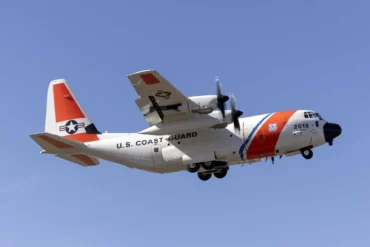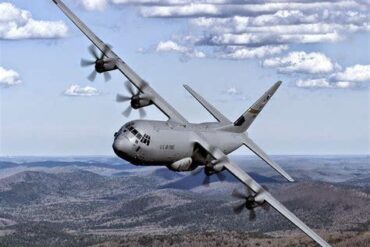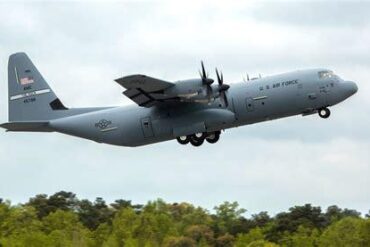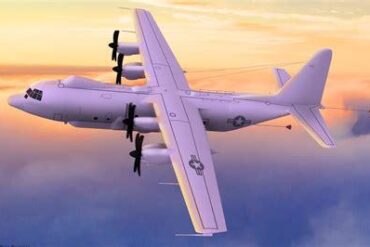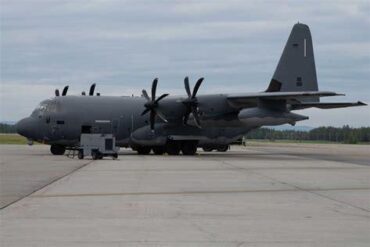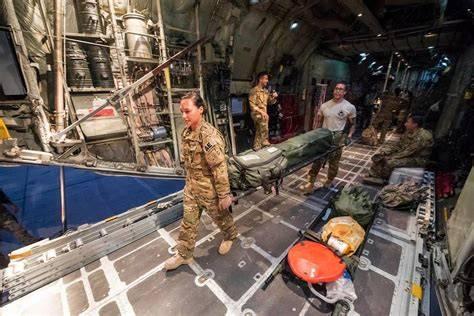
The C-130J Super Hercules flies on a lean three-person operating crew — two pilots and a loadmaster — yet the same airframe transforms into an airborne emergency room the moment an aeromedical evacuation mission is tasked, adding two flight nurses and three medical technicians to the manifest. That five-member medical team turns a rugged tactical transport into a mobile intensive care unit, shifting the crew count from three to eight and changing the aircraft’s entire purpose mid-mission. The contrast is the story: an aircraft designed for efficiency in logistics becomes a lifeline for the wounded, and the people who make that transition possible are the flight nurses and technicians who keep patients alive at altitude.
What makes the C-130J so adaptable is decades of incremental evolution. The Lockheed Martin C-130 Hercules has served as the backbone of tactical airlift since the C-130A entered service in December 1956, and the USAF ordered 219 of that first variant. The C-130J that entered service in 1999 is the most advanced Hercules yet, and Lockheed Martin has delivered more than 570 J-family aircraft to 27 countries, which together have logged more than 3 million flight hours. That fleet-wide experience matters in aeromedical work, where every mission involves unpredictable patient loads, austere airfields, and time-critical decisions made in a vibrating cabin at 365 knots true airspeed.
Why the C-130J’s Three-Person Crew Is a Medical Evacuation Advantage
The reduction from five or six crew members to three was never a cost-cutting stunt; it was an engineering dividend of automation, and aeromedical evacuation is one of the clearest beneficiaries. The previous C-130H typically required two pilots, a loadmaster, a flight engineer, and a navigator. The navigator handled route planning, position tracking, and navigation calculations, while the flight engineer spoke “for the aircraft” and communicated its abilities and limits to the pilots under stress and in different environments. The C-130J moved those functions into integrated avionics, so the two pilots and loadmaster now cover the same ground with more margin for mission-specific work.
The loadmaster’s role becomes especially valuable on medical missions. That crew member owns the cargo compartment, the pallet positions, and the loading calculus — exactly the skills needed to receive roll-on/roll-off medical pallets and modular compartments. With the flight engineer and navigator positions removed, the flight deck is quieter and the cabin is free of crew stations that once competed for space with litters. Charles Moore, a Conversion Officer for the 133rd Airlift Wing, described the shift plainly: the new aircraft carries an extra pallet position, modern glass cockpit avionics with a much higher level of automation, and a newer and stronger propulsion system that lets it fly higher and slightly faster. That extra pallet position is not a minor detail for medevac planners; it is another module of medical capability.
Inside the C-130J-30: Extra Fuselage Length Built for Patients and Medical Crew
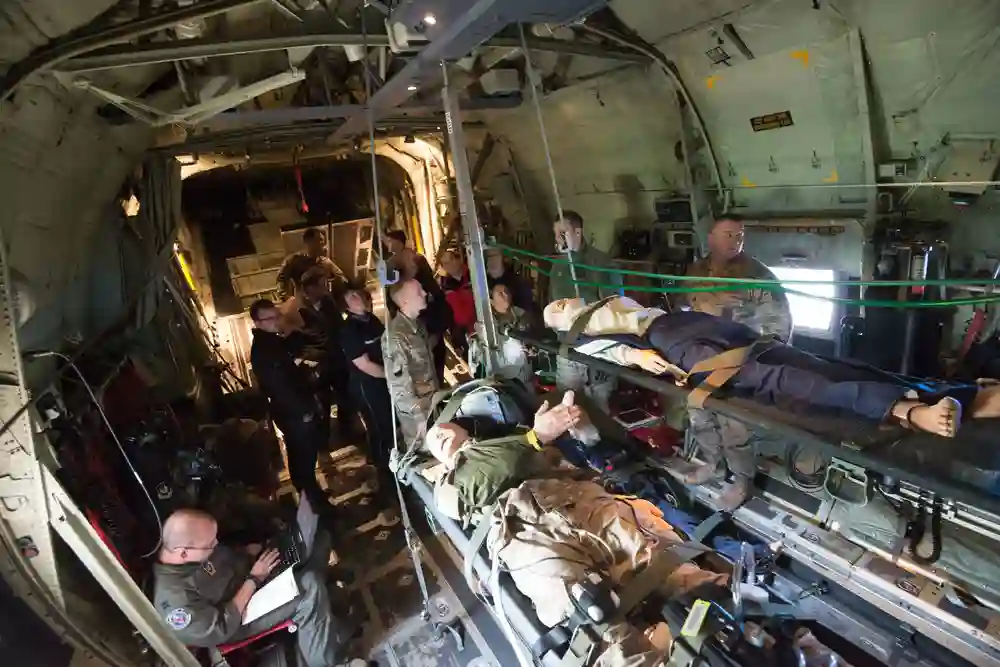
The stretched C-130J-30 adds 15 feet (4.57 meters) of fuselage length over the standard J, and Lockheed states that this variant “has space for up to 97 litters with medical attendants” and can become an airborne emergency room using roll-on/roll-off pallets and modular compartments. That figure is the headline capability of the type, and it sits alongside a five-member medical crew plus all of their equipment. In practical terms, the extra length is what separates a standard tactical airlifter from a hospital ward that happens to have four turboprops.
The airframe itself is a study in useful volume. The C-130J-30 measures 112 feet, 9 inches (34.37 meters) in length, 38 feet, 10 inches (11.84 meters) tall, with a 132-foot, 7-inch (40.41-meter) wingspan. Four Rolls-Royce AE 2100D3 turboprops turn GE-Dowty Aerospace R391 six-blade all-composite propellers. Maximum takeoff weight is 164,000 lb (74,389 kg), maximum payload is 46,700 lb (21,183 kg), operating empty weight is 88,252 lb (40,030 kg), and zero fuel weight is 129,000 lb (58,513 kg). Range with a 40,000 lb payload reaches 2,160 nmi (4,000 km), and landing distance at 135,000 lb is 3,000 feet (914 meters) — short enough for the austere fields where casualties often begin their journey.
The Glass Cockpit and Automation That Freed the Cabin for Lifesaving Equipment
The C-130J’s cockpit is the reason the crew shrank, and its technology deserves close attention because it directly shapes what the cabin can carry. The aircraft features an advanced glass cockpit with four L-3 multifunctional liquid-crystal displays for flight control and navigation, plus a Northrop Grumman color radar display that presents digitally stored map imagery. Each pilot also has a head-up display (HUD), while BAE Systems mission computers monitor aircraft systems and feed status updates to the crew — the automated substitute for the flight engineer’s dash-side vigilance.
Additional avionics round out the suite: a dual-embedded Honeywell GPS/INS, an enhanced traffic alert and collision avoidance system (E-TCAS), a ground collision avoidance system, Station Keeping Equipment (SKE 2000), and an instrument landing system (ILS). In July 2008, Lockheed Martin announced further additions to the baseline configuration, including an Elbit Systems digital mapping unit, a TacView portable mission display, and a commercial GPS landing system from CMC Electronics. The USAF states that the navigator and flight engineer positions are gradually being phased out, with their tasks absorbed by the pilots and loadmaster. Some argue this removes human experience and flexibility from the crew, but the trade-off is undeniable for medevac: less crew station hardware and fewer bodies on the flight deck mean more room for litters, medical pallets, and the technicians who work them.
Two Flight Nurses and Three Medical Technicians: Anatomy of an Aeromedical Evacuation Team
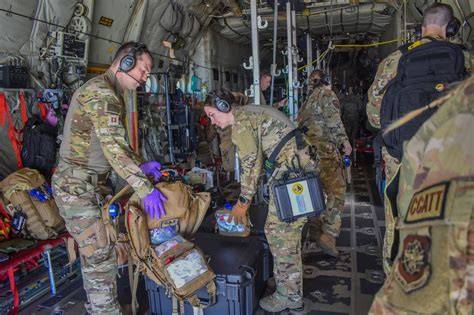
The aeromedical evacuation team (AET) is part of the flight crew, not a passenger detachment, and its standard composition is two flight nurses and three medical technicians. These personnel must know their aircraft intimately — not only the C-130J but also the KC-135R Stratotanker, the C-17A Globemaster III, the C-5M Super Galaxy, and the Learjet C-21A — because AETs rotate across airframes as missions demand. The nurses oversee mission details and clinical direction, while the medical technicians pack and load the medical cargo, which exceeds 1,000 lb (454 kg) of equipment including bandages, intravenous fluids, regulators, defibrillators, suction units, and other vital supplies.
Given the C-130J-30’s capacity for up to 97 patients and the sheer variety of injuries a team may face, the AET packs as many equipment types as possible rather than optimizing for one scenario. That equipment burden explains why the five-member team is inseparable from the aircraft’s space margin: the stretched fuselage accommodates the team and all of its gear without trading away patient capacity. Major Christine Cardoza, a USAF flight nurse with the 379th Expeditionary Aeromedical Evacuation Squadron, captured the responsiveness of the system: “It’s amazing how quickly a non-scheduled mission can spin up and we are sent out the door ready to take on however many patients, any type of health issue from medical health and non-battle injuries to battle injuries.” She added that once patients enter the AE system, “the patient’s survival rate, I believe, is more than 98%. Being a part of that is an honor in itself.”
From Battlefield to Hospital: How the Five-Member Team Saves Lives in the Air
Medical care in a theater of operations is layered, and the C-130J sits at the transition point between the layers. The first care a wounded service member receives comes from medics or corpsmen, who stabilize the patient and prepare them for movement to a rear-area aid station, where they are readied for emergency transport to a hospital that may lie in another country. The Hercules is uniquely suited to that leg because its rugged design lets it combine tactical combat logistics with casualty evacuation, reaching short and unimproved strips that larger jets cannot use. Humanitarian operations follow the same logic, with injured or ill civilians taking the place of combat casualties.
The payoff of that layered system is measurable. Air Mobility Command states that its rapid-response capabilities deliver “an incredible 98 percent survival rate” when wounded personnel reach a hospital quickly and are returned to the US within three days or less — a dramatic improvement over Vietnam, “when the survivability rate was 75 percent, taking an average of 45 days.” The five-member AET is the human mechanism behind that statistic, providing continuous treatment in flight so that the golden hours are not lost to transit time.
One mission from March 2013 in Afghanistan illustrates the point. After picking up an Air Force combat controller with a severe gunshot wound to his thigh, the crew watched the airman’s condition deteriorate during the flight. The aircraft diverted directly to Bagram Airfield, completing a journey that normally took more than an hour in just 42 minutes, while the five-member medical team continued intensive treatment en route. The airman reached advanced care in time to save not only his life but also his severely wounded leg.
C-130J Aeromedical Evacuation Capability: Space, Speed, and a Proven Survival Record
The C-130J has improved on the Hercules in nearly every dimension that matters for patient movement: modern avionics, greater automation, a reduced flight crew, and the tactical agility that made the type a military aviation mainstay. The stretched C-130J-30 variant adds the cabin volume to carry patients, medical personnel, and the equipment required to deliver lifesaving care. Lockheed’s description of the aircraft as a potential airborne emergency room is not marketing shorthand; it reflects roll-on/roll-off pallets and modular compartments that let planners reconfigure a single airframe for anything from a handful of litter patients to a mass casualty lift, all while a five-member medical team manages care in the air.
The value of the aircraft ultimately rests on that team and on the system around it. A three-person operating crew keeps the flight deck efficient, but the mission’s purpose is carried out in the cabin by two flight nurses and three medical technicians who monitor, treat, and comfort patients at altitude. Whether the tasking is a battlefield casualty evacuation or a humanitarian response to injured civilians, the Super Hercules and its five-member AET remain a crucial link between frontline treatment and advanced hospital care — and a proven reason why more than 98 percent of patients who enter the aeromedical evacuation system survive to receive the care they need.