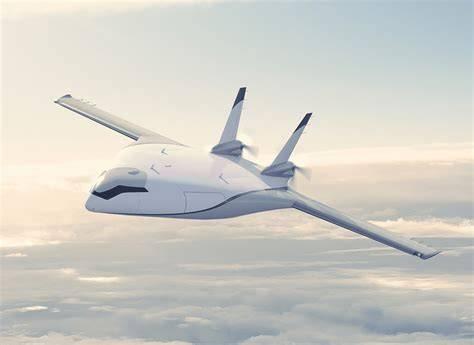
The Boeing Company has spent more than a century teaching the world that flight is a solved problem, and over the last two decades it has quietly been solving a harder one: how to make a flying machine decide for itself. Across a sprawling portfolio that includes purpose-built military drones, converted helicopters, electric air taxis, and even a reusable orbital spaceplane, Boeing and its subsidiaries have produced experimental and operational aircraft that no longer need anyone at the controls. Some of these craft are already patroling oceans and refueling fighters; others never left the prototype stage. Together they map the company’s evolving theory of autonomy, where machines handle the dangerous, the tedious, and the human-impossible work while people handle judgment. What follows is a close look at ten of the most technically ambitious autonomous aircraft Boeing has built, what each one was engineered to do, and how far each made it before contracts, crashes, or shifting military priorities rewrote its story.
MQ-25 Stingray: The Unmanned Aerial Refueling Tanker
Midair refueling is one of the most demanding maneuvers in aviation. Two aircraft must fly within meters of each other at hundreds of miles per hour while a boom or hose connects them, and a tanker crewed by human specialists must burn fuel, crew rest cycles, and flight hours just to orbit a carrier and hand out gas. The MQ-25A Stingray was engineered to eliminate that entire burden. In 2021, Boeing’s T1 demonstrator became the first unmanned aircraft in history to complete a midair refueling procedure, proving that the delicate rendezvous and fuel transfer could be handled by onboard autonomy rather than a human boom operator watching through a window. That single flight greenlit the operational program, and the Stingray flew in operational form in April 2026. By September 2026 the U.S. Navy had committed $562 million for an initial production run, with deliveries expected in 2029.
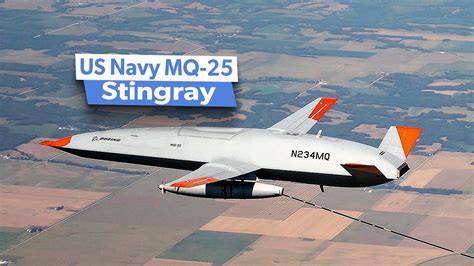
The design logic behind the Stingray is lean and telling. Because there is no cockpit, no life-support hardware, and no crew cabin, engineers stripped away the weight and complexity that define crewed tankers. A single Rolls-Royce AE 3007N powerplant propels a machine light enough to be fully integrated with carrier operations, catapult launches and arrested recoveries included. Once deployed, the Stingray is expected to free up scarce, highly trained aviators for missions that genuinely cannot be delegated to software, and to extend the reach of U.S. air assets without expanding the fleet of crewed tankers. The strategic payoff is larger than the aircraft itself: an autonomous tanker quietly turns every carrier strike group into a longer-ranged force.
MQ-28A Ghost Bat: Boeing Australia’s Loyal Wingman
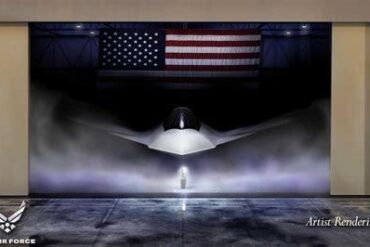
Of all the names attached to Boeing’s autonomous aircraft, none is more evocative than the MQ-28A Ghost Bat, an Unmanned Combat Air Vehicle built around the “loyal wingman” concept. The premise is simple and radical at once: pair low-cost, stealthy, attritable drones with crewed fighters such as the F-35A or the F/A-18F Super Hornet, and let the drones extend the human pilot’s eyes, reach, and survivability. A pilot in a cockpit can order a Ghost Bat to scout ahead, carry out a strike, or jam and spoof enemy electronics, all while the crewed aircraft stays outside the most dangerous airspace. In an era of beyond-visual-range combat, where pilots rely on sensor fusion more than eyesight, a handful of stealthy wingmen dramatically expands what a single human can control.
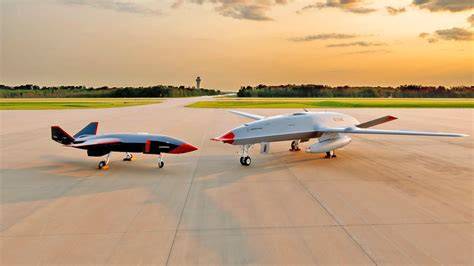
The Ghost Bat was designed in Australia by Boeing Defense Australia in cooperation with the Royal Australian Air Force, and it first flew in 2021. It became combat-relevant in a 2025 test in which it fired an AIM-120 air-to-air missile and destroyed an aerial practice target, coordinating with an E-7A Wedgetail and an F/A-18F Super Hornet. That milestone demonstrated the core promise of the loyalty concept: a drone that can be trusted with weapons employment while remaining under the tactical direction of a human crew. The Ghost Bat is the clearest expression of Boeing’s vision for air superiority, blending human judgment with machine persistence and stealth.
ScanEagle: Insitu’s Long-Endurance Maritime Watcher
Not every Boeing autonomous aircraft is a large defense program. The ScanEagle, built by Boeing subsidiary Insitu, is a compact, catapult-launched drone recovered by a SkyHook Recovery System that snags it out of the air with a vertical cable. Its size is deceptive. The ScanEagle carries up to 17 pounds of payload and stays aloft for more than 18 hours, offering a persistent bird’s-eye view that consumer drones can only dream of. Payloads range from electro-optical cameras and infrared sensors to radar, which makes the platform adaptable to maritime patrol, wilderness surveillance, and intelligence collection. Insitu officially reports 1.6 million combat flight hours, a figure that speaks to how deeply embedded the airframe has become in real-world operations.
That endurance and maturity have produced concrete results. In February 2025, a ScanEagle operated by the U.S. Coast Guard helped stop four smuggling vessels carrying thousands of pounds of narcotics, a textbook demonstration of a drone that costs a fraction of a manned patrol aircraft yet can cover vast stretches of ocean without tiring. The ScanEagle remains one of Boeing’s quiet commercial successes in autonomy: unglamorous, inexpensive, and deployed everywhere.
A160T Hummingbird: The Autonomous Cargo Helicopter That Almost Was
Helicopters are famously difficult to fly, so difficult that pilots joke they do not fly at all but simply beat the air into submission. In 2010, Boeing’s A160T Hummingbird proved that the pilot could be removed entirely and that the aircraft could still complete complex missions, including underslung cargo delivery. The Hummingbird was designed for forward-position resupply, the dangerous work of moving supplies to troops in remote locations, and it promised a 2,500-pound payload capacity and a maximum endurance of 18.7 hours. In 2009, more than twenty test flights carried the FORESTER foliage-penetrating radar system, showing that the drone could see through dense canopy and perform reconnaissance missions that would otherwise expose crewed helicopters to risk.
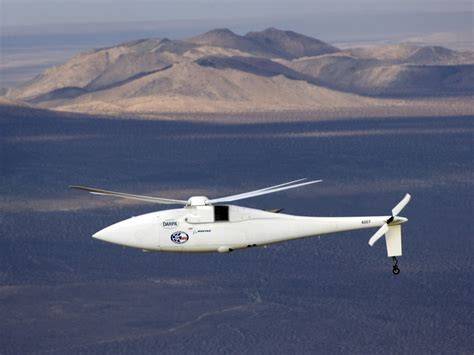
The Hummingbird was powered by a unique rigid-rotor design that allowed it to fly more efficiently than conventional helicopters, and expectations were high. Ultimately, the aircraft failed to win contracts with the U.S. Navy or the U.S. Army, and development ceased. Boeing moved on, but the Hummingbird’s demonstrations of autonomous cargo and radar work laid groundwork that later autonomous logistics programs would build upon. It remains a compelling case study in how technically successful prototypes can still fall victim to budget math and procurement politics.
Phantom Eye: Hydrogen-Powered High-Altitude Persistence
High-altitude surveillance has a storied history, from the legendary SR-71 Blackbird to today’s satellite networks, but militaries still need slow, loitering aircraft that can stare at a patch of ground for days and feed data into an increasingly unified digital battlefield. Boeing’s Phantom Eye was built for exactly that mission. Its first autonomous flight in 2012 lasted only 28 minutes, but the program’s ambition was far greater: the mission specification called for four days of unrefueled autonomous flight, powered by hydrogen engines designed to achieve extreme endurance. The Phantom Eye was an early, deliberate experiment in persistent ISR, the idea that a single aircraft could remain on station for days rather than hours.
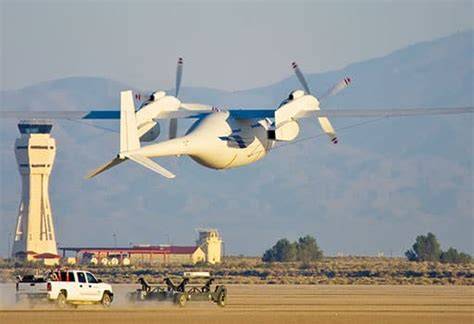
The program did not reach its target. Phantom Eye completed only nine flights before ending in 2014, and in 2016 the prototype was sent to a test flight museum, where it now serves as a monument to what might have been. The craft’s twin-boom layout and bulbous liquid-hydrogen tanks made it unmistakable on the flight line, and its failure to achieve multi-day endurance highlighted the practical difficulties of hydrogen storage and propulsion. Yet the persistence mission it pursued remains central to modern ISR doctrine.
H-6U Unmanned Little Bird: The Optionally Crewed Helicopter
The MH-6M Little Bird, affectionately known as the Killer Egg, is one of the most recognizable helicopters in special operations, famous for dropping operatives on rooftops and darting away to provide close air support. Boeing’s H-6U Unmanned Little Bird took that proven airframe and made it optionally crewed, meaning a human could still fly it while software handled the flying when needed. The craft’s standout feature is its flexibility: it can operate as a fully autonomous aircraft or act as the ultimate autopilot for a human passenger who stays in the loop. Introduced in 2004, the H-6U was not built for combat roles but to demonstrate that a UAV of this size and performance could perform resupply, communications relay, and surveillance missions.
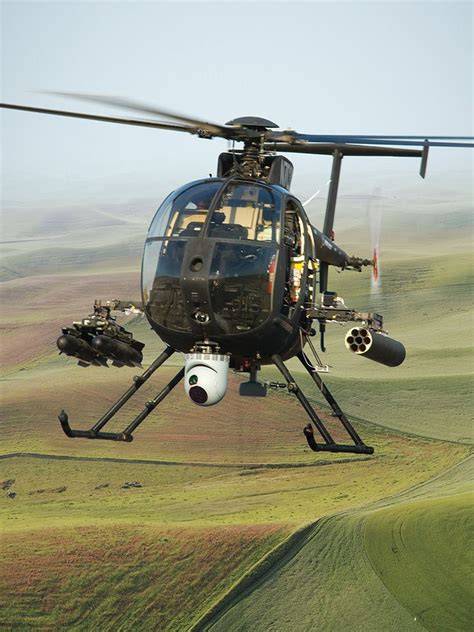
The Unmanned Little Bird conducted flight demonstrations for shipboard operations as late as 2012, proving that a rotary-wing drone could safely launch, land, and operate from naval decks. Despite its maturity, the platform never entered actual service. It nonetheless matters as a bridge between crewed and uncrewed aviation, showing a path where the same helicopter can carry people when judgment is needed and fly itself when it is not.
RQ-21A Blackjack: Insitu’s Battlefield Reconnaissance Specialist
The RQ-21A Blackjack was developed by Insitu for the U.S. Marine Corps as a tactical ISR drone that could provide intelligence day or night and serve as a communications relay connecting ground forces to commanders. To do that job, the Blackjack offers up to 16 hours of endurance, a maximum takeoff weight of 135 pounds, and an operating altitude of up to 20,000 feet. Its sensor suite includes an electro-optical imager with 4x digital zoom, an infrared imager, a laser rangefinder, and an infrared marker, all of which allow operators to identify and track targets in conditions that hide them from unaided eyes.
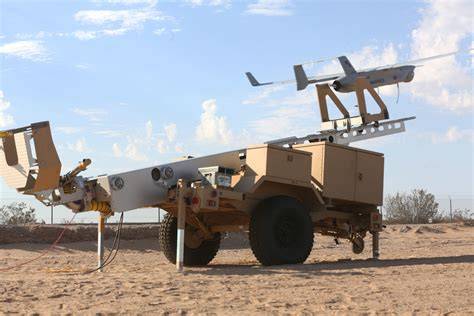
The Blackjack’s operational record is short but intense. It accumulated more than 17,000 flight hours across 14 deployments with the Marines, leaving little doubt about the art of tactical reconnaissance. As of recent reporting, the Marine Corps has been divesting from the RQ-21A in favor of the MQ-9A Reaper, a shift toward more capable platforms. Even so, Insitu continues to support the Blackjack for other customers, and its demonstrated reliability gives it life beyond the Marine Corps community.
SKIRON-X: Aurora’s Portable Hybrid ISR Solution
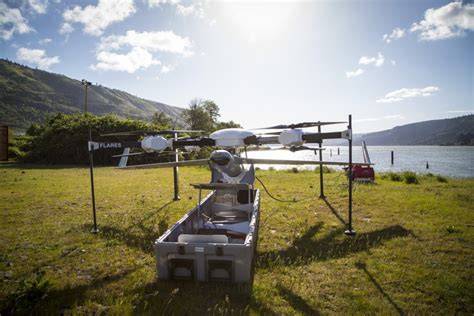
Boeing’s subsidiary Aurora Flight Sciences calls the SKIRON-X a “small UAS,” which is a flexible term, but the aircraft’s versatility backs up the label. In its boxed form it fits on the back of a standard pickup truck, and its defining trick is combining vertical multirotor takeoff and landing with the endurance, efficiency, and range of a fixed-wing drone. Where similar ISR drones such as the Blackjack and ScanEagle must be launched from a catapult and caught with a net or hook, the SKIRON-X sidesteps all that logistical drama. Its modular payload system can be swapped out quickly, and it is fully electric, using fuel-cell technology to achieve up to 3.5 hours of flight time and a range of up to 47 miles with the optional extended radio.
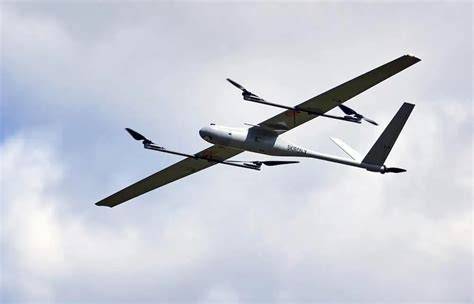
The SKIRON-X can be deployed and operated by just two people, and it flies autonomously without constant direct control, making it well suited to forward positions where a small team has no room for heavy equipment. It is a neat counterpoint to Boeing’s massive drone programs, demonstrating that autonomy does not require scale. A small unit can now field persistent, eyes-in-the-sky intelligence without a runway, a catapult, or a support crew.
Passenger Air Vehicle: Boeing’s Autonomous Air Taxi
The idea of the flying car has tantalized engineers for decades, and while true car-like vehicles remain elusive, autonomous air taxis may be the closest achievable version. Boeing’s Passenger Air Vehicle prototype flew in 2019, using an all-electric propulsion system with an estimated range of up to 50 miles and the ability to lift approximately 500 pounds, about two people plus luggage. The design was built around a modern, streamlined fuselage with a wing and a tail, and its autonomy removed the biggest obstacle to a flying car: expecting ordinary people to pilot complex aircraft through crowded airspace. If the vehicle flies itself, the passenger only needs to be a passenger.
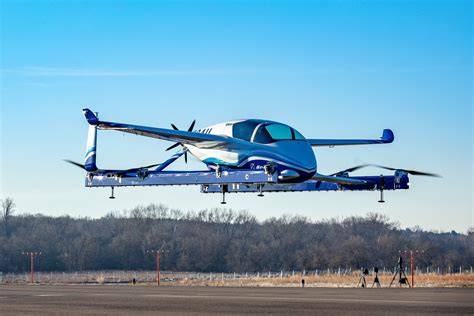
The PAV completed its first successful flight and crashed later in the same year. The program was paused, and no official cancellation was confirmed. Boeing has since invested heavily in Wisk Aero, committing $450 million to advance passenger electric unmanned flight, and although Wisk’s aircraft are less visually dramatic than the PAV, they pursue the same objective. The PAV illustrates both the promise and the friction of urban air mobility: engineering a self-flying air taxi is solvable, but certifying and regulating one in dense city airspace is a slower battle.
X-37B Orbital Test Vehicle: Boeing’s Reusable Spaceplane
Boeing’s most mysterious autonomous vehicle does not stay within the atmosphere. The X-37B Orbital Test Vehicle, operated by the U.S. Space Force, is a reusable autonomous spaceplane that has flown at least eight missions to date, launched on a SpaceX Falcon Heavy Rocket. The program is famously classified, and one mission remained in orbit for 900 days while doing work that officials have never publicly described in detail. Across two vehicles, the X-37Bs have accumulated more than 4,000 days in space, suggesting an increasingly routine ability to launch, operate, and recover a reusable orbital platform.
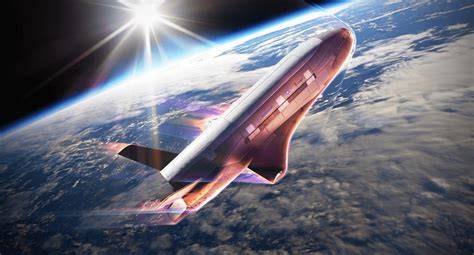
The X-37B matters because space is no longer just a place to pass through; it is increasingly an operational domain where persistence, reconnaissance, and experimentation have military value. Its autonomy allows it to maneuver, survive, and return without a crew, and its reusability makes repeated missions economically viable. How the vehicle gets into orbit still requires a rocket, but what it can do once there is carefully protected information. For anyone tracking Boeing’s autonomous portfolio, the X-37B is the clearest sign that autonomy in flight extends far beyond the atmosphere.
Taken together, these ten aircraft reveal a company exploring autonomy from every angle: small and cheap with ScanEagle, attritable and stealthy with Ghost Bat, persistent and exotic with Phantom Eye, and orbital with the X-37B. Some programs succeeded, others stalled, but each contributed knowledge that shapes how Boeing and its subsidiaries build machines that fly, think, and act on their own.