The United States remains the undisputed epicenter of modern fighter jet manufacturing, combining unmatched industrial depth with decades of combat aviation expertise. Every year, American assembly lines deliver hundreds of high-performance combat aircraft to the U.S. Air Force, Navy, Marine Corps, and a long list of allied nations. These jets are not merely machines; they are expressions of doctrine, technology, and geopolitical influence, produced at a scale no other nation can consistently match.
Understanding how many fighter jets the United States produces annually requires more than a single number. It demands an appreciation of multiple production lines operating simultaneously, the distinction between fourth-, fifth-, and emerging sixth-generation aircraft, and the reality that modern fighters are among the most complex industrial products ever built. In 2025, U.S. fighter production sits at a historic intersection: legacy platforms are winding down, stealth fighters dominate output, and a new generation is beginning to take shape.
The Annual Production Range: A Clear Numerical Answer
At present production rates, the United States manufactures between 318 and 372 fighter jets per year. This range reflects monthly fluctuations across several aircraft programs rather than uncertainty. Production is spread across Lockheed Martin and Boeing facilities, with Lockheed Martin accounting for the overwhelming majority of new airframes.
This output level places the U.S. far ahead of any peer competitor, not only in quantity but in technological sophistication per aircraft. Each jet integrates stealth shaping, advanced radar systems, sensor fusion, encrypted datalinks, and software architectures that rival those of advanced supercomputers. The fact that hundreds of such platforms are delivered annually speaks to the depth of America’s aerospace ecosystem.
America’s Fighter Jet Industrial Backbone
Two companies dominate U.S. fighter jet production: Lockheed Martin and Boeing. While other firms support subsystems, engines, avionics, and software, final assembly and program leadership reside with these aerospace giants.
Lockheed Martin’s facilities in Texas and South Carolina anchor America’s high-volume stealth fighter output, while Boeing’s St. Louis complex remains essential for heavy fighters and naval aviation. Over time, production has consolidated, with fewer aircraft types built in larger numbers, a trend driven by cost, logistics, and operational doctrine.
The closure of the F-22 Raptor line in 2011 and the planned shutdown of the F/A-18 Super Hornet line in 2027 illustrate how fighter production is cyclical, shaped by strategy rather than pure demand.
Monthly Output Breakdown by Aircraft Type
Current production rates translate into a steady monthly rhythm across U.S. assembly lines. On average, American factories deliver 26.5 to 31 fighter jets per month, resulting in the annual total exceeding 300 aircraft.
The distribution is heavily weighted toward one aircraft in particular: the F-35 Lightning II. Other fighters contribute smaller but strategically vital numbers, ensuring force diversity and mission specialization.
This balance allows the U.S. military to recapitalize aging fleets while maintaining readiness across air superiority, strike, electronic warfare, and maritime operations.
The F-35 Lightning II: The Engine of U.S. Fighter Production
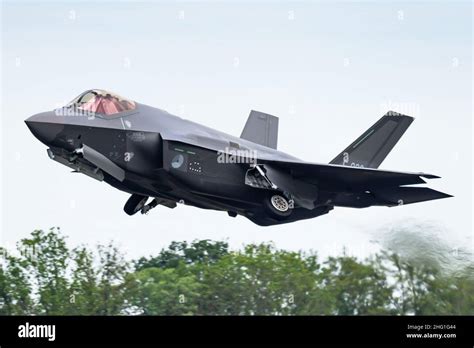
The F-35 Lightning II is the single most important factor behind America’s fighter production volume. Lockheed Martin currently delivers 20 to 23 F-35s per month, making it the highest-output stealth fighter program in history. On an annual basis, that equates to 240 to nearly 280 aircraft, depending on supply chain stability and upgrade cycles.
What makes the F-35 unique is its three-variant architecture. The F-35A serves the U.S. Air Force and most export customers, the F-35B provides short takeoff and vertical landing capability for the Marine Corps and select allies, and the F-35C operates from U.S. Navy aircraft carriers. Despite their differences, all three share a common production ecosystem, allowing economies of scale unmatched by any previous fighter program.
The F-35A alone accounts for roughly 90 percent of all F-35 deliveries, cementing it as the backbone of American tactical airpower. By April 2025, Lockheed Martin achieved a record monthly output of 23 aircraft, signaling a return to full-rate production after delays related to the Technology Refresh 3 upgrade.
Managing Complexity in High-Volume Stealth Production
Producing fifth-generation fighters at scale is not simply a matter of increasing assembly speed. Each F-35 incorporates millions of lines of software code, advanced radar-absorbent materials, and highly sensitive electronic warfare systems. Recent delivery figures include a mix of newly manufactured aircraft and previously completed jets that were updated after resolving TR-3 integration issues.
Approximately 18 percent of current-year deliveries originate from stored airframes, highlighting how modern fighter production is as much about software maturity as physical assembly. Even so, the program remains on track to surpass its previous annual record of 156 aircraft delivered in a single year.
The Enduring Role of the F-16 Fighting Falcon
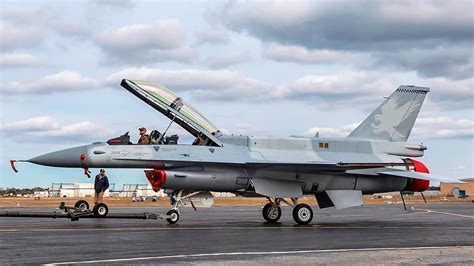
Despite its first flight nearly five decades ago, the F-16 Fighting Falcon continues to play a meaningful role in U.S. fighter production. Lockheed Martin’s Greenville, South Carolina facility now serves as the global hub for new-build F-16 Block 70 and 72 aircraft.
Current output stands at 3.5 to 4 aircraft per month, translating to approximately 23 to 26 fighters annually in 2025. This figure represents a sharp increase from just five aircraft delivered in 2023, underscoring renewed global demand for modernized fourth-generation fighters.
The F-16’s appeal lies in its balance of cost, performance, and interoperability. Nations seeking advanced avionics, AESA radar, and NATO-compatible systems without the financial and political complexity of stealth fighters continue to place orders.
Global Demand Sustaining U.S. Production Lines
Lockheed Martin holds over 140 firm international orders for new F-16s, with an additional backlog exceeding 100 aircraft. Beyond new builds, more than 700 legacy F-16s worldwide are undergoing Block 70/72 upgrades, effectively extending the fighter’s operational relevance well into the 2030s.
This dual track of new production and modernization ensures that even as the U.S. shifts toward a fifth-generation fleet, its industrial base remains diversified and resilient.
The F-15EX Eagle II: Heavy Fighter Revival
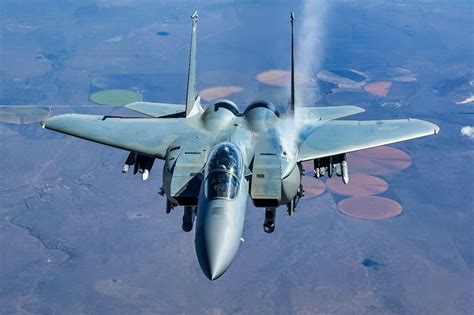
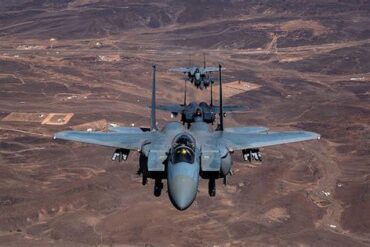
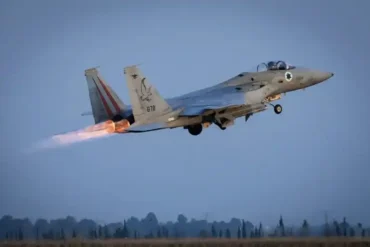
Boeing’s F-15EX Eagle II represents a rare example of a fourth-generation airframe evolving into a highly relevant modern platform. Designed to replace aging F-15C/D aircraft, the Eagle II combines proven aerodynamics with cutting-edge avionics, open mission systems, and unmatched weapons payload capacity.
Production currently runs at 1.5 to 2 aircraft per month, with Boeing targeting a steady rate of two monthly deliveries by the end of 2026. With 90 aircraft already ordered by the U.S. Air Force, annual output is set to stabilize between 18 and 24 fighters.
The F-15EX’s value lies in its ability to carry large numbers of air-to-air missiles, hypersonic weapons, and electronic warfare payloads without sacrificing range or endurance. For Pentagon planners facing near-peer threats, this makes the aircraft a crucial complement to stealth platforms.
Export Potential and Strategic Constraints
International interest in the F-15EX is growing, with Indonesia positioned as the first foreign customer. Additional interest from Middle Eastern and Indo-Pacific allies exists, though the aircraft’s high acquisition cost remains a limiting factor.
Even so, the program reinforces America’s ability to sustain multiple fighter production lines simultaneously, a capability few nations possess.
The Final Years of the F/A-18 Super Hornet
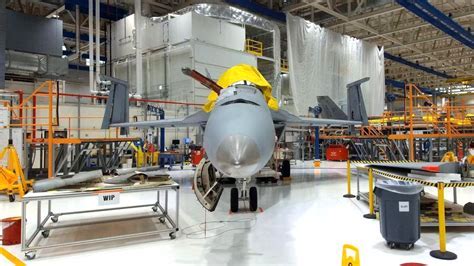
The F/A-18E/F Super Hornet is approaching the end of its production life. Boeing plans to close the line in 2027, despite a recent Navy contract that extended operations by two years. Output has already declined to 1.5 to 2 aircraft per month, with annual production falling below 20 fighters.
As workers transition to programs like the F-15EX, T-7A trainer, and MQ-25 unmanned tanker, the Super Hornet’s role shifts from production to sustainment. Hundreds of existing aircraft are being upgraded to the Block III standard, ensuring their relevance well beyond the line’s closure.
The winding down of the Super Hornet marks the end of an era in U.S. naval aviation manufacturing.
Why U.S. Fighter Production Remains Unmatched
The United States does not simply produce more fighter jets; it produces more advanced fighters at scale. Several factors underpin this dominance, including a mature supply chain, sustained defense budgets, and deep integration with allied procurement programs.
Unlike competitors that must choose between quantity and quality, the U.S. industrial base delivers both. Even as production numbers fluctuate year to year, America maintains the ability to surge output when strategic conditions demand it.
The Shift Toward Fifth-Generation Dominance
By the late 2020s, the majority of U.S. fighter production will consist of fifth-generation aircraft. Fourth-generation fighters will increasingly serve niche roles or export markets, while stealth platforms form the backbone of American airpower.
This transition is not abrupt but deliberate, allowing time for workforce retraining, infrastructure upgrades, and software maturation.
The F-47 and the Sixth-Generation Horizon
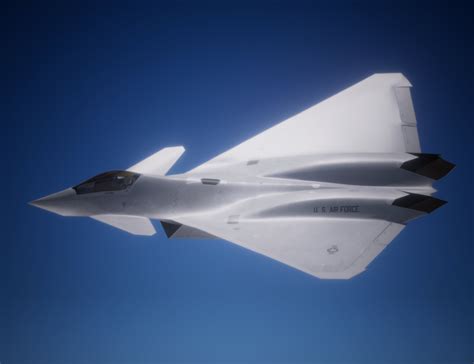
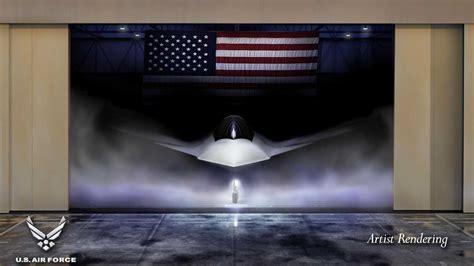
Looking beyond current production figures, the F-47 Next Generation Air Dominance fighter represents the future of U.S. combat aviation manufacturing. Recently backed by the Pentagon’s Fiscal Year 2026 budget, the program signals a strategic choice to prioritize a single sixth-generation platform over competing concepts.
While full-rate production remains years away, early development will begin to reshape the industrial landscape. Lessons learned from F-35 production are expected to influence how the F-47 is built, potentially enabling faster scaling once the aircraft enters service.
For now, the F-47 does not add to annual production totals, but it defines the trajectory beyond the 2030s.
A Production System Built for Longevity
America’s fighter jet output is not the result of short-term surges but of decades-long planning and sustained investment. From workforce development to supplier networks spanning continents, the system is designed to endure.
As geopolitical competition intensifies, this production capacity becomes a strategic asset in its own right. Fighter jets are not only tools of combat but instruments of deterrence, diplomacy, and alliance cohesion.
The Bottom Line on U.S. Fighter Jet Production
In clear terms, the United States currently produces roughly 320 to 370 fighter jets per year, a figure unmatched by any other nation. The majority are F-35 Lightning IIs, supported by ongoing production of F-16s, F-15EXs, and the final runs of the F/A-18 Super Hornet.
This output reflects not only industrial capability but strategic intent. As the U.S. transitions toward sixth-generation air dominance, its fighter production engine remains robust, adaptive, and firmly at the center of global military aviation.